YOUR COMPANY
Your Address
Postcode - CITY
Tel.: 000 000 0000
www.your-website.co.uk
Company No. 12345678


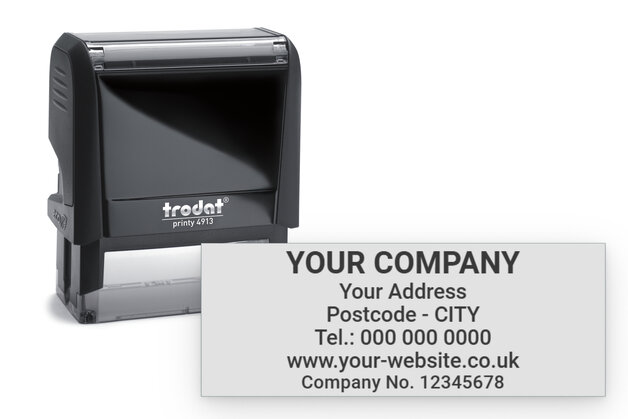
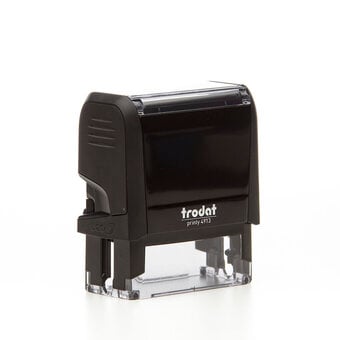
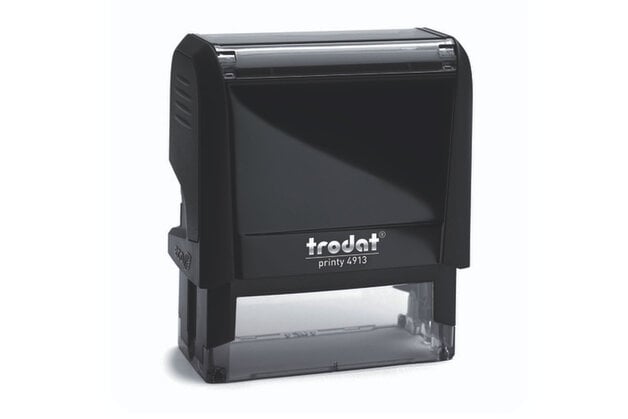
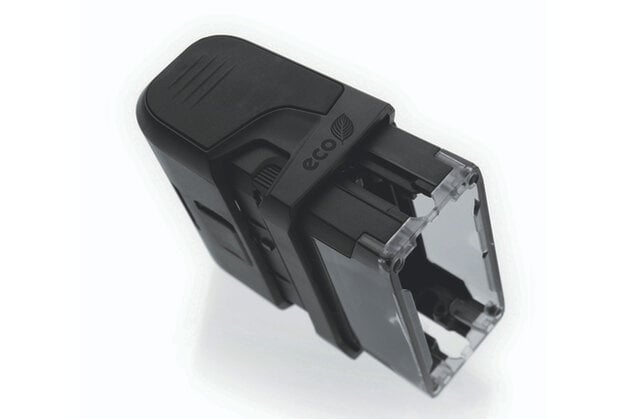
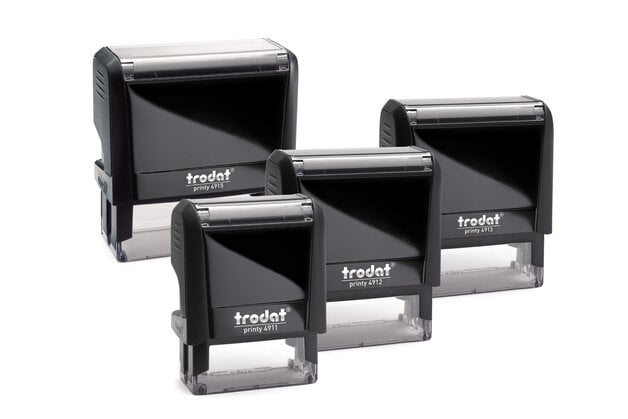
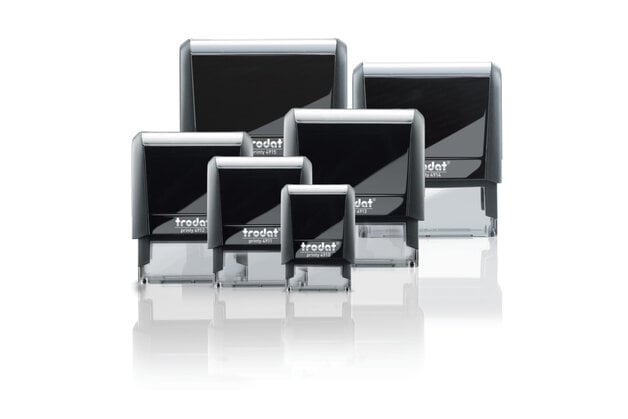
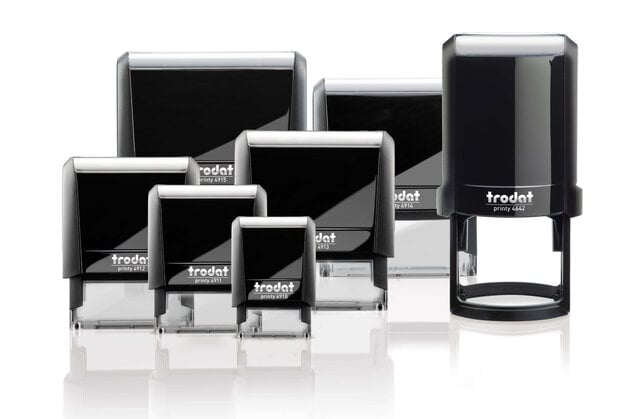
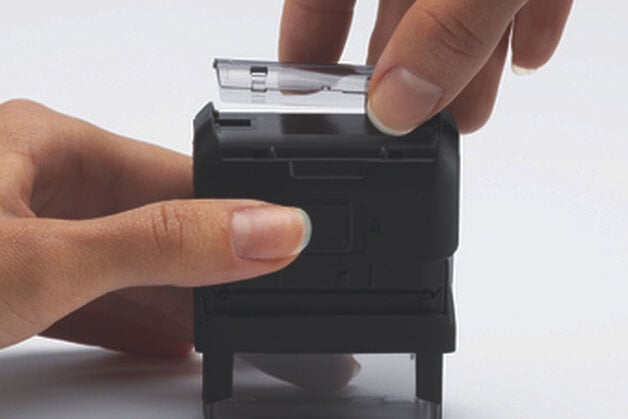




 Ink pad included
 Volume discounts
'%3e%3cpath%20d='M20.5563%202.67834H1.42533C0.639422%202.67834%200%203.31772%200%204.10363V15.5822C0%2016.3682%200.639422%2017.0076%201.42533%2017.0076H15.3578C15.6167%2017.0076%2015.8265%2016.7977%2015.8265%2016.5388C15.8265%2016.2799%2015.6167%2016.0701%2015.3578%2016.0701H1.42533C1.15636%2016.0701%200.9375%2015.8512%200.9375%2015.5822V8.87691H21.0442V11.2778C21.0442%2011.5367%2021.254%2011.7465%2021.5129%2011.7465C21.7718%2011.7465%2021.9817%2011.5367%2021.9817%2011.2778V4.10363C21.9817%203.31772%2021.3423%202.67834%2020.5563%202.67834ZM1.42533%203.61584H20.5563C20.8253%203.61584%2021.0442%203.83466%2021.0442%204.10363V5.54799H0.9375V4.10363C0.9375%203.83466%201.15631%203.61584%201.42533%203.61584ZM0.9375%207.93941V6.48549H21.0442V7.93941H0.9375Z'%20fill='%230C4D5A'/%3e%3cpath%20d='M20.5563%202.67834H1.42533C0.639422%202.67834%200%203.31772%200%204.10363V15.5822C0%2016.3682%200.639422%2017.0076%201.42533%2017.0076H15.3578C15.6167%2017.0076%2015.8265%2016.7977%2015.8265%2016.5388C15.8265%2016.2799%2015.6167%2016.0701%2015.3578%2016.0701H1.42533C1.15636%2016.0701%200.9375%2015.8512%200.9375%2015.5822V8.87691H21.0442V11.2778C21.0442%2011.5367%2021.254%2011.7465%2021.5129%2011.7465C21.7718%2011.7465%2021.9817%2011.5367%2021.9817%2011.2778V4.10363C21.9817%203.31772%2021.3423%202.67834%2020.5563%202.67834ZM1.42533%203.61584H20.5563C20.8253%203.61584%2021.0442%203.83466%2021.0442%204.10363V5.54799H0.9375V4.10363C0.9375%203.83466%201.15631%203.61584%201.42533%203.61584ZM0.9375%207.93941V6.48549H21.0442V7.93941H0.9375Z'%20fill='black'%20fill-opacity='0.5'/%3e%3cpath%20d='M6.92061%2013.6835H2.61612C1.9962%2013.7059%201.99409%2014.5977%202.61612%2014.621H6.92061C7.54054%2014.5986%207.54265%2013.7067%206.92061%2013.6835Z'%20fill='%230C4D5A'/%3e%3cpath%20d='M6.92061%2013.6835H2.61612C1.9962%2013.7059%201.99409%2014.5977%202.61612%2014.621H6.92061C7.54054%2014.5986%207.54265%2013.7067%206.92061%2013.6835Z'%20fill='black'%20fill-opacity='0.5'/%3e%3cpath%20d='M6.92061%2011.7704H2.61612C1.9962%2011.7928%201.99409%2012.6846%202.61612%2012.7079H6.92061C7.54054%2012.6855%207.54265%2011.7936%206.92061%2011.7704Z'%20fill='%230C4D5A'/%3e%3cpath%20d='M6.92061%2011.7704H2.61612C1.9962%2011.7928%201.99409%2012.6846%202.61612%2012.7079H6.92061C7.54054%2012.6855%207.54265%2011.7936%206.92061%2011.7704Z'%20fill='black'%20fill-opacity='0.5'/%3e%3cpath%20fill-rule='evenodd'%20clip-rule='evenodd'%20d='M16.9424%2010.7995L14.5898%2013.152C14.5898%2016.752%2015.1919%2020.2222%2019.2948%2021.3216C23.3978%2020.2222%2023.9998%2016.752%2023.9998%2013.152L21.6473%2010.7995H16.9424Z'%20fill='%23FDF300'/%3e%3cpath%20d='M19.2949%2019.7875C16.7214%2019.0081%2016.1647%2016.8451%2016.0451%2013.9479C16.0413%2013.8187%2016.0909%2013.6937%2016.1822%2013.6023L17.4034%2012.3812C17.4913%2012.2933%2017.6105%2012.2439%2017.7348%2012.2439H20.8549C20.9792%2012.2439%2021.0985%2012.2933%2021.1864%2012.3812L22.4075%2013.6023C22.4989%2013.6937%2022.5485%2013.8187%2022.5446%2013.9478C22.4255%2016.8443%2021.8681%2019.0084%2019.2949%2019.7875ZM16.9894%2014.121C17.1385%2016.4295%2017.4228%2018.0275%2019.2949%2018.8167C21.1665%2018.0277%2021.4513%2016.4301%2021.6004%2014.121L20.6608%2013.1814H17.929L16.9894%2014.121Z'%20fill='%230C4D5A'/%3e%3cpath%20d='M19.2949%2019.7875C16.7214%2019.0081%2016.1647%2016.8451%2016.0451%2013.9479C16.0413%2013.8187%2016.0909%2013.6937%2016.1822%2013.6023L17.4034%2012.3812C17.4913%2012.2933%2017.6105%2012.2439%2017.7348%2012.2439H20.8549C20.9792%2012.2439%2021.0985%2012.2933%2021.1864%2012.3812L22.4075%2013.6023C22.4989%2013.6937%2022.5485%2013.8187%2022.5446%2013.9478C22.4255%2016.8443%2021.8681%2019.0084%2019.2949%2019.7875ZM16.9894%2014.121C17.1385%2016.4295%2017.4228%2018.0275%2019.2949%2018.8167C21.1665%2018.0277%2021.4513%2016.4301%2021.6004%2014.121L20.6608%2013.1814H17.929L16.9894%2014.121Z'%20fill='black'%20fill-opacity='0.5'/%3e%3c/g%3e%3cdefs%3e%3cclipPath%20id='clip0'%3e%3crect%20width='24'%20height='24'%20fill='white'/%3e%3c/clipPath%3e%3c/defs%3e%3c/svg%3e "paiement") Secure payment
Secure payment Ships Within 24h
 Quote on request


Creating a personalised stamp has never been more accessible for UK businesses and individuals seeking professional, customised solutions. Whether you need a company stamp for official documents, an address stamp for correspondence, or a unique design for creative projects, personalised stamps offer unmatched convenience and professional presentation. These versatile tools transform routine tasks into opportunities for brand expression while ensuring consistent, crisp impressions every time.
Modern personalised stamps combine traditional craftsmanship with cutting-edge customisation technology, allowing you to design exactly what you need through intuitive online tools. From self-inking mechanisms that eliminate mess to traditional rubber stamps offering maximum flexibility, today's options cater to every requirement and budget. The ability to incorporate logos, specific text layouts, and even decorative elements means your stamp becomes a true reflection of your personal or professional identity.
With European quality standards and rapid production capabilities, ordering your custom stamp has become a streamlined process that delivers professional results within days. Whether you're a small business owner seeking to enhance document authenticity, a craft enthusiast exploring creative possibilities, or an office manager streamlining administrative processes, personalised stamps provide practical solutions that save time while maintaining professional standards.
Professional appearance forms the cornerstone of successful business communications, and personalised stamps deliver this instantly across all your documentation. When clients receive invoices, letters, or packages bearing your custom stamp, they immediately recognise the attention to detail and professionalism that defines quality businesses. This consistent branding reinforces your company identity with every interaction, creating lasting impressions that extend far beyond the initial contact.
Time efficiency represents another compelling advantage, particularly for businesses handling substantial correspondence volumes. Rather than handwriting addresses repeatedly or printing individual labels, a quick stamp application completes the task in seconds. This efficiency multiplies significantly across daily operations, freeing valuable time for core business activities while maintaining presentation standards that reflect your commitment to excellence.
Cost-effectiveness becomes apparent when comparing stamp usage to alternative marking methods. Unlike printed materials requiring minimum quantities or expensive label systems, stamps provide unlimited impressions at minimal ongoing cost. The initial investment pays dividends through years of reliable service, making personalised stamps particularly attractive for small businesses managing tight budgets without compromising professional presentation.
Legal and financial sectors rely heavily on document authentication, where personalised stamps serve crucial verification functions. Solicitors use custom stamps to mark documents as received, reviewed, or processed, creating clear audit trails essential for regulatory compliance. Accountants employ date stamps alongside company details to track invoice processing and payment authorisation, ensuring accurate record-keeping that satisfies both internal procedures and external audit requirements.
Healthcare practices benefit enormously from personalised stamps streamlining patient record management. Appointment stamps mark scheduling information clearly, while prescription stamps ensure accurate dispensing instructions reach pharmacies. Veterinary practices use custom stamps for vaccination records, creating permanent documentation that pet owners value for ongoing care coordination.
Creative industries embrace personalised stamps as artistic tools extending beyond administrative functions. Graphic designers use custom stamps for portfolio marking, while photographers employ them for copyright protection on prints. Craft businesses create unique packaging stamps that enhance product presentation, transforming simple wrapping into memorable unboxing experiences that customers associate with quality and creativity.
Understanding stamp mechanisms helps ensure optimal selection for specific applications. Each type offers distinct advantages depending on usage frequency, portability requirements, and impression quality expectations. Modern manufacturing techniques have refined these traditional tools, incorporating contemporary materials and precision engineering that delivers consistent performance across thousands of impressions.
Self-inking stamps represent the most popular choice for high-volume applications, incorporating built-in ink reservoirs that automatically re-ink the stamp surface with each use. This mechanism eliminates separate ink pads while ensuring consistent impression quality throughout the stamp's lifespan. The sealed design prevents ink from drying out during storage, making self-inking stamps ideal for offices where stamps may sit unused for extended periods.
Traditional rubber stamps paired with separate ink pads offer maximum versatility for users requiring multiple ink colours or special formulations. This configuration allows switching between standard black ink for documents, red ink for urgent markings, or specialty inks for fabric applications. The separate components also enable easy maintenance and replacement, extending the stamp's useful life while providing flexibility that integrated systems cannot match.
The internal ink reservoir system distinguishes self-inking stamps from traditional alternatives, housing sufficient ink for thousands of clear impressions without external pad requirements. This self-contained design proves particularly valuable for mobile professionals who need reliable stamping capabilities away from office environments. Estate agents conducting property viewings, delivery drivers confirming receipts, and field service technicians documenting completed work all benefit from this portable convenience.
Impression consistency remains remarkably stable throughout the ink supply's lifespan, thanks to precision-engineered distribution mechanisms that deliver uniform ink coverage across the entire stamp surface. This reliability ensures professional presentation whether you're marking the first document of the day or the hundredth, maintaining the crisp, clear impressions that reflect positively on your business standards.
Refilling procedures have been simplified to accommodate users without technical expertise, typically involving straightforward cartridge replacement or ink reservoir refilling through accessible ports. Most self-inking stamps provide clear indicators when ink levels require attention, preventing unexpected impression failures during critical tasks. Quality models deliver 10,000 or more impressions per ink supply, making them extremely cost-effective for regular users.
Separate ink pad systems enable colour versatility that integrated stamps cannot provide, allowing users to switch between different ink types for specific applications. Document marking might require permanent black ink, while temporary markings benefit from washable formulations. Fabric crafting demands textile-specific inks, while archival applications need acid-free options ensuring long-term document preservation.
Precision benefits become apparent in detailed designs where fine lines and small text require optimal ink transfer control. Traditional stamps allow users to adjust ink application by controlling pressure and pad contact time, achieving perfect impressions even with intricate artwork or complex layouts. This control proves invaluable for artistic applications where impression quality directly impacts the final result.
Durability advantages emerge through the replaceable component design, where worn ink pads can be renewed without replacing the entire stamp assembly. Quality rubber stamps can provide decades of service with proper maintenance, making them excellent investments for applications requiring long-term reliability. The natural rubber construction also provides superior detail reproduction compared to synthetic alternatives, ensuring sharp impressions that maintain clarity over time.
Effective stamp design balances visual impact with practical functionality, ensuring your custom creation serves its intended purpose while reflecting your professional image. The design process begins with identifying essential information that must appear clearly in the final impression, whether that's company details, contact information, or decorative elements that enhance your brand presentation.
Text hierarchy plays a crucial role in stamp readability, with the most important information positioned prominently and sized appropriately for clear reproduction. Company names typically receive primary emphasis through larger fonts or bold formatting, while secondary details like addresses or phone numbers appear in smaller but still legible sizes. This structured approach ensures recipients can quickly identify key information while maintaining overall design harmony.
Logo integration requires careful consideration of size limitations and detail complexity, as intricate designs may not reproduce clearly at stamp scale. Simplified versions of complex logos often work better than attempting to include every design element. Professional design services can adapt existing logos for optimal stamp reproduction, ensuring brand consistency while maximising impression clarity.
Font selection significantly impacts stamp legibility, with sans-serif typefaces generally providing clearer reproduction than ornate or script fonts. Bold or medium weight fonts ensure adequate ink coverage while maintaining character definition, particularly important for smaller text elements. Avoid extremely thin fonts that may break up during stamping or overly decorative styles that compromise readability in practical applications.
Spacing considerations prevent text crowding that can result in unclear impressions or ink bleeding between elements. Adequate white space around text and graphics ensures each component reproduces distinctly while contributing to overall design balance. This spacing becomes particularly critical for stamps containing multiple information lines or combining text with graphic elements.
Border treatments can enhance stamp appearance while providing clear impression boundaries, but should complement rather than overwhelm the main content. Simple line borders work effectively for professional applications, while decorative borders suit creative or artistic uses. Consider how border elements will appear when stamped repeatedly, ensuring they enhance rather than distract from the primary message.
Resolution requirements ensure your uploaded graphics reproduce clearly at stamp scale, with vector formats preferred for text and simple graphics due to their scalability without quality loss. Raster images should exceed 300 DPI at the intended stamp size to prevent pixelation or blurriness in the final product. This attention to technical specifications separates professional-quality stamps from amateur attempts that may disappoint in practical use.
Colour considerations focus on how multi-colour designs translate to single-colour stamp impressions, as most stamps use monochromatic ink regardless of original design colours. High contrast between design elements and background ensures clear reproduction, while subtle colour variations in the original may disappear entirely in the stamped impression. Design with the final ink colour in mind rather than relying on original colour schemes.
Size limitations vary by stamp type and manufacturer, but generally favour designs that remain legible when reduced to practical stamping dimensions. Text smaller than 6-point typically becomes difficult to read in stamped impressions, while fine details may fill in with ink during repeated use. Consider the viewing distance for stamped impressions when determining appropriate text sizes and detail levels.
Modern online ordering systems have revolutionised custom stamp acquisition, transforming what once required in-person consultations into streamlined digital experiences accessible 24/7. These platforms guide users through design creation with intuitive tools that preview exactly how the final stamp will appear, eliminating guesswork and ensuring satisfaction before production begins.
Customisation parameters extend far beyond simple text entry, encompassing layout options, font selections, graphic integration, and size specifications that accommodate diverse requirements. Professional platforms like those offered by Otypo provide comprehensive design flexibility while maintaining user-friendly interfaces that don't require technical expertise. This balance ensures both novice users and design professionals can achieve their vision efficiently.
The proof approval process represents a critical quality checkpoint where customers review digital mockups showing exact stamp appearance before production commences. This stage allows refinements to text positioning, size adjustments, or design modifications ensuring complete satisfaction with the final product. Quality providers encourage customer feedback during this phase, recognising that minor adjustments at the proof stage prevent disappointment upon delivery.
Business stamps typically incorporate company names, addresses, and contact information arranged in logical hierarchy that facilitates quick information retrieval. Phone numbers and email addresses enhance communication accessibility, while website URLs direct recipients to additional company information. Consider including professional designations or certifications that reinforce credibility, particularly relevant for service-based businesses where qualifications influence customer confidence.
Regulatory requirements may mandate specific information inclusion for certain business types, such as VAT registration numbers for qualifying companies or professional registration details for regulated industries. Research applicable requirements before finalising stamp design to ensure compliance while maintaining attractive presentation. This proactive approach prevents costly redesigns when regulatory obligations become apparent after initial production.
Personal stamps offer greater creative freedom while serving practical functions like return address marking or craft project identification. Include sufficient contact information for intended purposes while maintaining privacy appropriate to usage contexts. Decorative elements can enhance personal stamps without compromising functionality, creating unique tools that reflect individual personality while serving practical needs.
Stamp construction materials directly influence longevity, impression quality, and user satisfaction throughout the product's operational life. Premium materials resist wear from repeated use while maintaining precise detail reproduction that reflects positively on your professional image. Understanding material characteristics helps inform purchasing decisions that balance initial investment with long-term value.
European manufacturing standards ensure consistent quality control throughout production processes, from initial design transfer through final assembly and testing. These standards encompass material selection, precision tolerances, and performance verification that guarantee reliable operation across thousands of impressions. Quality manufacturers maintain detailed specifications ensuring every stamp meets exacting standards regardless of order size or complexity.
Durability testing simulates extended use conditions to verify performance longevity before products reach customers. This testing includes impression consistency evaluation, material wear assessment, and ink compatibility verification ensuring stamps perform reliably throughout their intended lifespan. Such comprehensive testing distinguishes quality products from cheaper alternatives that may fail prematurely or deliver inconsistent results.
Sustainable manufacturing practices increasingly influence purchasing decisions as businesses seek environmentally responsible suppliers. Modern stamp production incorporates recycled materials where possible while maintaining performance standards, and packaging utilises minimal materials with recyclable components. These practices align with corporate sustainability goals while delivering products that meet operational requirements.
Ink formulations have evolved to reduce environmental impact while maintaining performance characteristics essential for professional applications. Water-based inks provide excellent impression quality while minimising volatile organic compound emissions, creating healthier workplace environments. Biodegradable options suit applications where environmental impact represents a primary concern, though performance characteristics may differ from traditional formulations.
Product longevity represents perhaps the most significant environmental benefit, as quality stamps provide years of reliable service, reducing replacement frequency and associated waste generation. This durability, combined with refillable ink systems, creates sustainable solutions that minimise ongoing environmental impact while delivering superior economic value compared to disposable alternatives.
Proper maintenance extends stamp life significantly while ensuring consistent impression quality throughout the product's operational period. Simple care procedures prevent common problems that can compromise performance or necessitate premature replacement. Understanding these procedures helps maximise your investment while maintaining professional presentation standards.
Cleaning procedures vary by stamp type but generally involve gentle removal of accumulated ink and debris that can affect impression clarity. Self-inking stamps benefit from periodic cleaning of the impression surface using appropriate solvents that don't damage internal mechanisms. Traditional rubber stamps require more frequent cleaning but offer easier access to all surfaces requiring attention.
Storage conditions significantly impact stamp longevity, with proper positioning preventing warping or damage to delicate components. Self-inking stamps should be stored impression-side down to maintain ink contact with the stamping surface, while traditional stamps benefit from protective covers preventing dust accumulation. Temperature extremes can affect both rubber components and ink consistency, making climate-controlled storage preferable for valuable or frequently-used stamps.
Impression quality problems often stem from correctable causes rather than fundamental stamp defects, making troubleshooting knowledge valuable for maintaining optimal performance. Faint impressions may indicate low ink levels in self-inking stamps or insufficient ink pad saturation in traditional systems. Uneven impressions often result from improper stamping technique or surface irregularities rather than stamp defects.
Ink flow issues in self-inking stamps sometimes respond to gentle agitation that redistributes settled ink within the reservoir. Persistent problems may require professional servicing or component replacement, but many issues resolve through simple maintenance procedures. Understanding these solutions prevents unnecessary stamp replacement while maintaining reliable operation.
Replacement indicators help identify when maintenance transitions from routine care to component renewal. Worn impression surfaces show reduced detail reproduction, while damaged mechanisms may affect ink distribution or impression consistency. Recognising these indicators enables proactive replacement before performance deteriorates to unacceptable levels, maintaining professional standards throughout the stamp's service life.
Size selection balances information inclusion with practical usability, ensuring your personalised stamp accommodates necessary content while remaining manageable for regular use. Larger stamps accommodate more information and complex designs but require more storage space and may prove cumbersome for frequent use. Smaller formats offer portability and convenience but limit content inclusion and may compromise readability for detailed information.
Standard size options typically range from compact 20mm formats suitable for simple text or small logos up to 70mm sizes accommodating comprehensive business information with decorative elements. Medium sizes around 40-50mm represent popular choices balancing content capacity with practical usability for most business applications. Consider actual usage scenarios when selecting sizes, ensuring the chosen format suits intended applications without creating operational difficulties.
Multi-line text considerations become critical as content complexity increases, with line spacing and text size requiring careful balance to maintain readability. Too many lines in small formats can create cramped appearances that compromise professional presentation, while excessive spacing in larger formats may appear sparse or unbalanced. Professional design services can optimise layouts for specific size constraints, ensuring attractive results regardless of content complexity.
Custom sizing capabilities extend beyond standard offerings for applications requiring specific dimensions or unusual formats. Specialty applications like fabric marking, large document stamping, or integration with existing systems may benefit from non-standard sizes tailored to particular requirements. Quality manufacturers can accommodate these needs while maintaining the precision and reliability expected from standard products.
The evolution of personalised stamps reflects broader trends toward customisation and professional presentation in business communications. As digital communication dominates many interactions, physical stamps provide tangible authenticity that reinforces professional credibility and attention to detail. Whether marking documents, enhancing correspondence, or streamlining administrative processes, quality personalised stamps deliver practical benefits that justify their continued relevance in modern business operations.
Investing in a well-designed personalised stamp represents a commitment to professional excellence that pays dividends through improved efficiency, enhanced brand presentation, and streamlined operations. The combination of European quality standards, advanced customisation options, and reliable performance ensures your stamp will serve faithfully for years while maintaining the crisp, professional impressions that reflect positively on your business or personal brand.
Custom quotes available for bulk or special requestsSecure payment via card or PayPalFree delivery from £60Up to 20% off with volume discounts! Create your own product easily with our online editorCustom quotes available for bulk or special requestsSecure payment via card or PayPalFree delivery from £60Up to 20% off with volume discounts!Create your own product easily with our online editor