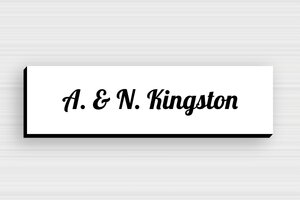
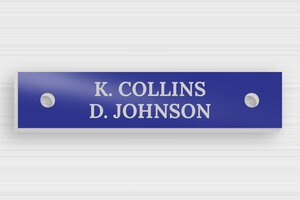
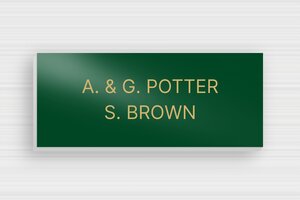
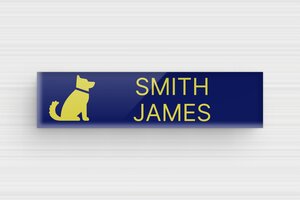
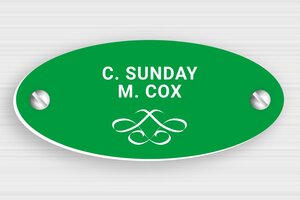
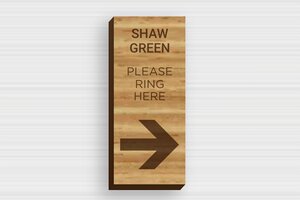
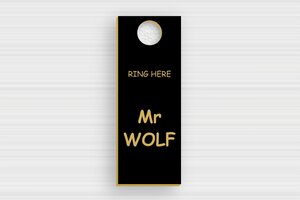
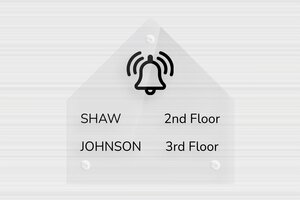
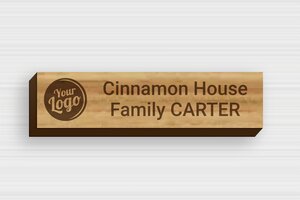
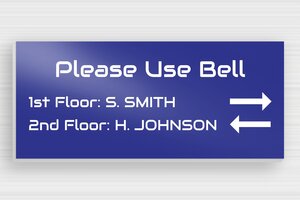
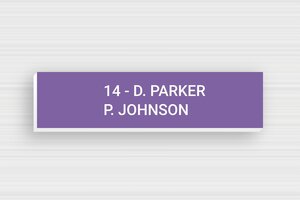
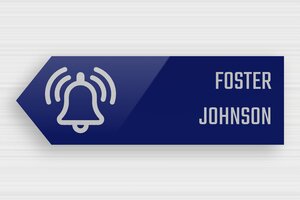
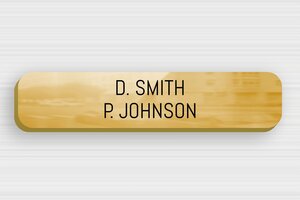
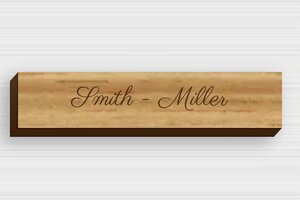
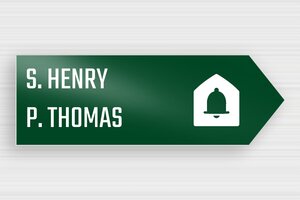
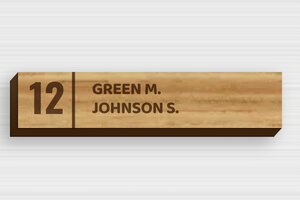
Doorbell Signs for Two Names
Your sign in just 2 minutes.
Full editor: 27 materials, 219 colors, 12 mounting options
Marking: laser engraving, mechanical or printed
starting at £2.50

Your sign in just 2 minutes.
Full editor: 27 materials, 219 colors, 12 mounting options
Marking: laser engraving, mechanical or printed
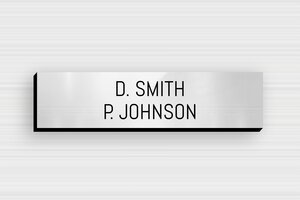
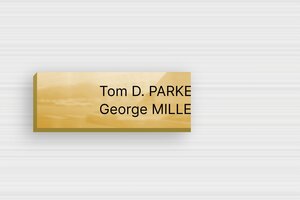
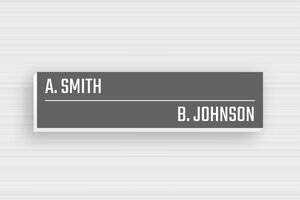
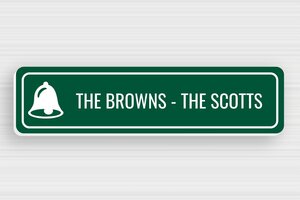

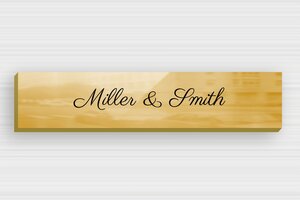
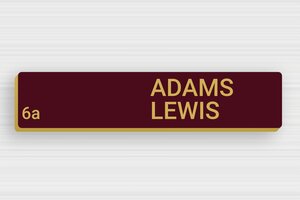
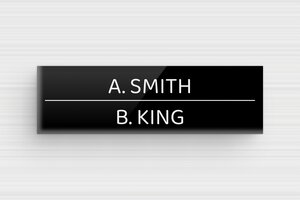
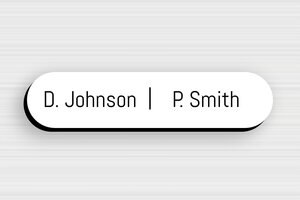
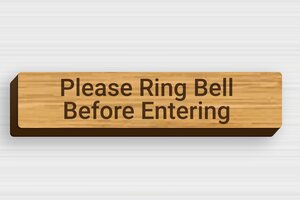
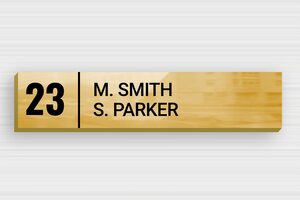

For UK weather conditions, several materials offer excellent durability and weather resistance for doorbell signs with two names:
All these materials are specifically chosen to withstand British weather challenges, from driving rain and temperature fluctuations to coastal conditions.
Choosing the right size for your two-name doorbell sign depends on several key factors:
Viewing Distance: Street-facing properties require larger signage for visibility from passing vehicles and pedestrian approaches. A sign readable from 10-15 metres typically needs minimum letter heights of 25-30mm.
Available Space: Consider the wall space beside your door or bell push. Horizontal layouts work well for properties with adequate width, while vertical stacking suits narrower spaces or when one name is significantly longer than the other.
Architectural Scale: Your sign should complement rather than overwhelm your property's entrance. Consider the proportional relationship with doors, windows, and other architectural features.
Font Choice: Sans-serif typefaces generally offer superior readability at distance, while serif fonts require larger sizing to maintain clarity.
Properties set back from the road can use more modest sizing whilst maintaining adequate visibility for visitors and delivery services.
Yes, Otypo's intuitive online customisation tools allow extensive personalisation for doorbell signs with two names, regardless of different name lengths:
Layout Options:
Typography Features:
Our design tools automatically adjust proportions and spacing to ensure both names appear balanced and clearly readable, regardless of their individual character counts.
Different UK property types require specific installation approaches for optimal results:
Masonry Walls (Brick, Stone, Concrete):
Smooth Surfaces (Painted Metal, Sealed Timber, Glazed Tiles):
Professional Installation Considerations:
Most doorbell signs can be successfully installed by competent DIY enthusiasts using basic tools and our comprehensive fitting guides.
Yes, doorbell signs with two names fully comply with UK address display requirements and often exceed standard expectations:
Postal Service Benefits:
Emergency Services: Clear signage helps emergency responders locate properties quickly and accurately, which is especially important for shared accommodations or multi-generational households.
Security Advantages: Well-designed signs signal that your home is actively maintained and monitored, contributing to both personal safety and neighbourhood watch effectiveness.
Modern Household Recognition: UK regulations accommodate contemporary living arrangements including couples maintaining separate surnames, professional partnerships, flatmates, and multi-generational families with different surnames through marriage, adoption, or cultural naming traditions.
A comprehensive doorbell sign actually enhances compliance by providing clearer identification than single-name alternatives.
When two names need to grace your front door, finding the perfect doorbell sign becomes both a practical necessity and a design opportunity. Whether you're newlyweds combining surnames, flatmates sharing a home, or a multi-generational family, a doorbell sign with two names ensures visitors know exactly where to ring whilst adding a personalised touch to your property's entrance.
Modern households increasingly require signage that reflects their unique composition. Gone are the days when a single family name sufficed for every home. Today's diverse living arrangements call for flexible, attractive solutions that accommodate different surnames, business partnerships operating from residential addresses, or simply couples who prefer to display both their identities prominently.
At Otypo, we understand that your doorbell sign serves as more than mere identification – it's your home's first impression. Our European-quality materials and intuitive online customisation tools make creating the perfect two-name doorbell sign straightforward, whether you prefer the rustic charm of slate, the contemporary appeal of acrylic, or the timeless elegance of engraved metal.
The practical benefits of displaying two names extend far beyond simple identification. Postal services, delivery drivers, and emergency responders rely on clear signage to locate properties quickly and accurately. When your household includes different surnames, a comprehensive doorbell sign eliminates confusion and ensures important correspondence reaches the correct recipients.
From a security perspective, clear identification helps legitimate visitors whilst potentially deterring unwanted callers who might target properties that appear unoccupied or unclear about residents. A well-designed sign signals that your home is actively maintained and monitored, contributing to both personal safety and neighbourhood watch effectiveness.
Contemporary living arrangements have evolved beyond traditional nuclear families, creating demand for signage that reflects this diversity. Couples maintaining separate surnames after marriage often struggle with generic "The Smiths" options that don't represent their individual identities. Professional partnerships operating consultancies or small businesses from home addresses require clear identification for both personal and commercial visitors.
Flatmates and house-sharers benefit enormously from comprehensive signage, particularly in urban areas where multiple occupancy is common. University towns, city centres, and professional districts see frequent turnover in shared accommodation, making clear identification essential for maintaining postal delivery accuracy and visitor convenience.
Multi-generational households, increasingly common as housing costs rise, often include family members with different surnames through marriage, adoption, or cultural naming traditions. A thoughtfully designed doorbell sign acknowledges these family structures whilst maintaining the welcoming appearance that makes a house feel like home.
Selecting the right material for your two-name doorbell sign depends on your property's architectural style, local climate conditions, and personal aesthetic preferences. Each material offers distinct advantages in terms of durability, appearance, and maintenance requirements.
Slate remains the most popular choice for traditional and period properties throughout the UK. Its natural texture and weather-resistant properties make it ideal for coastal locations where salt air might corrode metal alternatives. Welsh slate, in particular, offers exceptional longevity and develops an attractive patina over time. The deep engraving possible with slate ensures text remains clearly visible even after decades of exposure to British weather.
Acrylic signs provide contemporary appeal with remarkable versatility in colour and finish options. Modern manufacturing techniques allow for precise laser cutting and engraving, creating crisp, professional results that suit urban properties and new builds. UV-resistant formulations prevent fading and yellowing, maintaining their appearance far longer than traditional plastic alternatives.
British weather presents unique challenges for outdoor signage, from driving rain and coastal salt spray to temperature fluctuations and occasional extreme weather events. Materials must withstand not just moisture but the freeze-thaw cycles that can crack inferior products over winter months.
Aluminium and brass offer excellent corrosion resistance whilst maintaining professional appearance. Marine-grade aluminium, commonly used in coastal applications, provides exceptional longevity even in harsh seaside environments. Brass develops an attractive verdigris patina over time, adding character whilst protecting the underlying metal from further corrosion.
Wood requires careful selection and treatment for outdoor use, but properly prepared timber can last decades with minimal maintenance. Oak, cedar, and other hardwoods naturally resist moisture when correctly sealed, whilst offering warmth and character that complements rural and traditional properties perfectly.
Creating an effective two-name doorbell sign requires careful consideration of layout, typography, and visual hierarchy. The challenge lies in presenting both names clearly whilst maintaining aesthetic balance and ensuring readability from typical viewing distances.
Horizontal layouts work well for properties with adequate wall space beside the door or bell push. Names can be arranged side by side with appropriate spacing, or separated by decorative elements like ampersands, bullets, or custom graphics. This approach suits contemporary properties where clean lines and symmetry are priorities.
Vertical stacking offers advantages for narrower spaces or when one name is significantly longer than the other. Careful font sizing ensures both names receive equal visual weight whilst maintaining overall proportion. This layout particularly suits tall, narrow spaces common in Victorian terraces and modern townhouses.
Font selection significantly impacts both aesthetic appeal and practical functionality. Sans-serif typefaces generally offer superior readability at distance, making them ideal for properties set back from the street or where the sign must be visible from car windows. Serif fonts provide traditional elegance but require larger sizing to maintain clarity.
Contrast between text and background becomes crucial when displaying multiple elements. Dark engraving on light materials typically provides optimal visibility, though reverse combinations can create striking effects when properly executed. Consider viewing angles and typical lighting conditions when finalising design choices.
Letter spacing and overall proportions require adjustment when accommodating two names of different lengths. Professional design software allows for precise kerning and tracking adjustments, ensuring both names appear balanced regardless of their individual character counts.
Proper installation ensures your doorbell sign remains securely positioned whilst maintaining its appearance over time. Different mounting methods suit various wall types and architectural features common in UK properties.
Masonry fixings work well for solid brick, stone, or concrete walls typical of older properties. Stainless steel screws and wall plugs provide secure attachment whilst resisting corrosion. Pre-drilling prevents cracking in harder materials, whilst appropriate plug selection ensures firm grip in softer substrates like aerated concrete blocks.
Adhesive mounting offers advantages for delicate surfaces or rental properties where drilling might be restricted. Modern structural adhesives provide remarkable strength when properly applied, though surface preparation becomes critical for long-term success. This method suits smooth surfaces like painted metal doors, sealed timber, or glazed tiles.
Most doorbell signs can be successfully installed by competent DIY enthusiasts using basic tools and following supplied instructions. Pre-drilled mounting holes and comprehensive fitting guides simplify the process considerably. However, certain situations may warrant professional installation.
Listed buildings, conservation areas, or properties with unusual architectural features might require specialist knowledge to avoid damage or planning complications. Professional installers understand local regulations and possess appropriate tools for challenging installations.
Height restrictions, awkward access, or integration with existing electrical systems might also justify professional involvement. The modest cost of expert installation often proves worthwhile when weighed against potential damage from incorrect DIY attempts.
Proportional sizing ensures your doorbell sign complements rather than overwhelms your property's entrance. Factors including viewing distance, architectural scale, and surrounding features all influence optimal dimensions.
Street-facing properties require larger signage for visibility from passing vehicles and pedestrian approaches. A sign readable from 10-15 metres typically needs minimum letter heights of 25-30mm, though this varies with font choice and contrast levels. Properties set back from the road can use more modest sizing whilst maintaining adequate visibility.
Architectural context plays a crucial role in style selection. Georgian and Victorian properties often benefit from traditional materials and classic typography that complement their period features. Contemporary homes might suit bold, minimalist designs that echo their clean architectural lines.
Successful doorbell sign design considers existing architectural elements, colour schemes, and decorative features. Matching or complementing door furniture, window frames, or other metalwork creates visual cohesion that enhances overall kerb appeal.
Colour coordination need not mean exact matching – complementary tones often create more sophisticated results than identical colours. Consider seasonal changes in natural lighting and surrounding vegetation when finalising colour choices, as these factors affect how your sign appears throughout the year.
Scale relationships with doors, windows, and other architectural features prevent your sign from appearing either lost or overpowering. Professional designers often use mathematical proportions based on golden ratio principles, though visual assessment usually suffices for residential applications.
Creating the perfect doorbell sign with two names combines practical functionality with personal expression, ensuring your home welcomes visitors whilst reflecting your household's unique character. Quality materials, thoughtful design, and proper installation create signage that serves reliably for decades whilst enhancing your property's street appeal. Whether you prefer traditional slate elegance or contemporary acrylic sophistication, the right doorbell sign transforms a simple necessity into an attractive feature that makes your house unmistakably yours.
 Custom quotes available for bulk or special requests
'%3e%3cpath%20d='M20.5563%202.67834H1.42533C0.639422%202.67834%200%203.31772%200%204.10363V15.5822C0%2016.3682%200.639422%2017.0076%201.42533%2017.0076H15.3578C15.6167%2017.0076%2015.8265%2016.7977%2015.8265%2016.5388C15.8265%2016.2799%2015.6167%2016.0701%2015.3578%2016.0701H1.42533C1.15636%2016.0701%200.9375%2015.8512%200.9375%2015.5822V8.87691H21.0442V11.2778C21.0442%2011.5367%2021.254%2011.7465%2021.5129%2011.7465C21.7718%2011.7465%2021.9817%2011.5367%2021.9817%2011.2778V4.10363C21.9817%203.31772%2021.3423%202.67834%2020.5563%202.67834ZM1.42533%203.61584H20.5563C20.8253%203.61584%2021.0442%203.83466%2021.0442%204.10363V5.54799H0.9375V4.10363C0.9375%203.83466%201.15631%203.61584%201.42533%203.61584ZM0.9375%207.93941V6.48549H21.0442V7.93941H0.9375Z'%20fill='%230C4D5A'/%3e%3cpath%20d='M20.5563%202.67834H1.42533C0.639422%202.67834%200%203.31772%200%204.10363V15.5822C0%2016.3682%200.639422%2017.0076%201.42533%2017.0076H15.3578C15.6167%2017.0076%2015.8265%2016.7977%2015.8265%2016.5388C15.8265%2016.2799%2015.6167%2016.0701%2015.3578%2016.0701H1.42533C1.15636%2016.0701%200.9375%2015.8512%200.9375%2015.5822V8.87691H21.0442V11.2778C21.0442%2011.5367%2021.254%2011.7465%2021.5129%2011.7465C21.7718%2011.7465%2021.9817%2011.5367%2021.9817%2011.2778V4.10363C21.9817%203.31772%2021.3423%202.67834%2020.5563%202.67834ZM1.42533%203.61584H20.5563C20.8253%203.61584%2021.0442%203.83466%2021.0442%204.10363V5.54799H0.9375V4.10363C0.9375%203.83466%201.15631%203.61584%201.42533%203.61584ZM0.9375%207.93941V6.48549H21.0442V7.93941H0.9375Z'%20fill='black'%20fill-opacity='0.5'/%3e%3cpath%20d='M6.92061%2013.6835H2.61612C1.9962%2013.7059%201.99409%2014.5977%202.61612%2014.621H6.92061C7.54054%2014.5986%207.54265%2013.7067%206.92061%2013.6835Z'%20fill='%230C4D5A'/%3e%3cpath%20d='M6.92061%2013.6835H2.61612C1.9962%2013.7059%201.99409%2014.5977%202.61612%2014.621H6.92061C7.54054%2014.5986%207.54265%2013.7067%206.92061%2013.6835Z'%20fill='black'%20fill-opacity='0.5'/%3e%3cpath%20d='M6.92061%2011.7704H2.61612C1.9962%2011.7928%201.99409%2012.6846%202.61612%2012.7079H6.92061C7.54054%2012.6855%207.54265%2011.7936%206.92061%2011.7704Z'%20fill='%230C4D5A'/%3e%3cpath%20d='M6.92061%2011.7704H2.61612C1.9962%2011.7928%201.99409%2012.6846%202.61612%2012.7079H6.92061C7.54054%2012.6855%207.54265%2011.7936%206.92061%2011.7704Z'%20fill='black'%20fill-opacity='0.5'/%3e%3cpath%20fill-rule='evenodd'%20clip-rule='evenodd'%20d='M16.9424%2010.7995L14.5898%2013.152C14.5898%2016.752%2015.1919%2020.2222%2019.2948%2021.3216C23.3978%2020.2222%2023.9998%2016.752%2023.9998%2013.152L21.6473%2010.7995H16.9424Z'%20fill='%23FDF300'/%3e%3cpath%20d='M19.2949%2019.7875C16.7214%2019.0081%2016.1647%2016.8451%2016.0451%2013.9479C16.0413%2013.8187%2016.0909%2013.6937%2016.1822%2013.6023L17.4034%2012.3812C17.4913%2012.2933%2017.6105%2012.2439%2017.7348%2012.2439H20.8549C20.9792%2012.2439%2021.0985%2012.2933%2021.1864%2012.3812L22.4075%2013.6023C22.4989%2013.6937%2022.5485%2013.8187%2022.5446%2013.9478C22.4255%2016.8443%2021.8681%2019.0084%2019.2949%2019.7875ZM16.9894%2014.121C17.1385%2016.4295%2017.4228%2018.0275%2019.2949%2018.8167C21.1665%2018.0277%2021.4513%2016.4301%2021.6004%2014.121L20.6608%2013.1814H17.929L16.9894%2014.121Z'%20fill='%230C4D5A'/%3e%3cpath%20d='M19.2949%2019.7875C16.7214%2019.0081%2016.1647%2016.8451%2016.0451%2013.9479C16.0413%2013.8187%2016.0909%2013.6937%2016.1822%2013.6023L17.4034%2012.3812C17.4913%2012.2933%2017.6105%2012.2439%2017.7348%2012.2439H20.8549C20.9792%2012.2439%2021.0985%2012.2933%2021.1864%2012.3812L22.4075%2013.6023C22.4989%2013.6937%2022.5485%2013.8187%2022.5446%2013.9478C22.4255%2016.8443%2021.8681%2019.0084%2019.2949%2019.7875ZM16.9894%2014.121C17.1385%2016.4295%2017.4228%2018.0275%2019.2949%2018.8167C21.1665%2018.0277%2021.4513%2016.4301%2021.6004%2014.121L20.6608%2013.1814H17.929L16.9894%2014.121Z'%20fill='black'%20fill-opacity='0.5'/%3e%3c/g%3e%3cdefs%3e%3cclipPath%20id='clip0'%3e%3crect%20width='24'%20height='24'%20fill='white'/%3e%3c/clipPath%3e%3c/defs%3e%3c/svg%3e) Secure payment via card or PayPal
Secure payment via card or PayPal Free delivery from £60
 Up to 20% off with volume discounts!
 Create your own product easily with our online editorCustom quotes available for bulk or special requestsSecure payment via card or PayPalFree delivery from £60Up to 20% off with volume discounts!Create your own product easily with our online editor