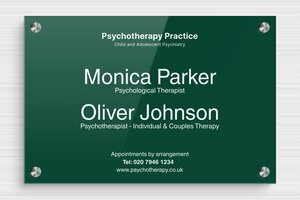
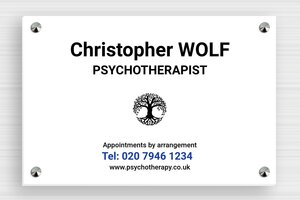
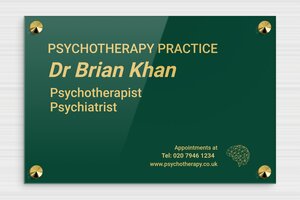
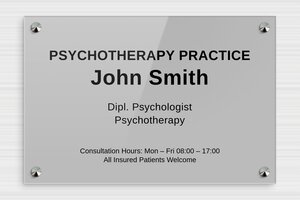
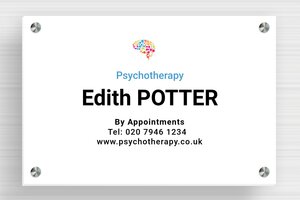
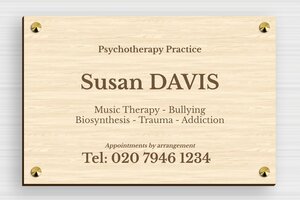
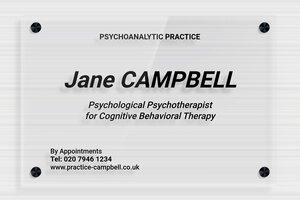
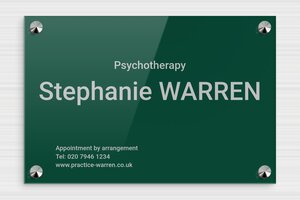
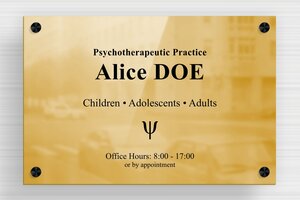
Psychotherapy Business Signs
Your sign in just 2 minutes.
Full editor: 27 materials, 219 colors, 12 mounting options
Marking: laser engraving, mechanical or printed
starting at £48.50

Your sign in just 2 minutes.
Full editor: 27 materials, 219 colors, 12 mounting options
Marking: laser engraving, mechanical or printed

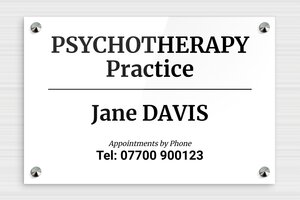
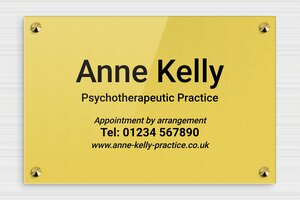
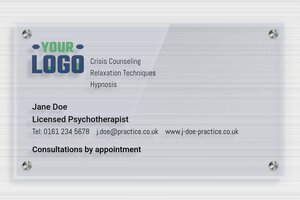


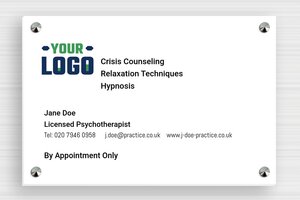
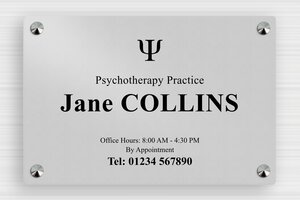
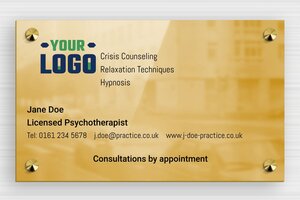

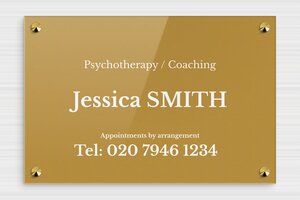

The best materials for psychotherapy practice signs depend on your specific needs and environment. Acrylic signs are increasingly popular for modern practices due to their versatility and contemporary appearance. They offer excellent durability, UV resistance to prevent fading, and easy cleaning - crucial for healthcare settings where hygiene is paramount.
Brass signs convey prestige and established professional credibility, making them ideal for senior practitioners. They develop a natural patina over time and have inherent antimicrobial properties beneficial in healthcare environments.
Aluminium signs provide the durability of metal with modern manufacturing flexibility. Anodised aluminium finishes offer excellent corrosion resistance while accepting detailed engraving that remains crisp for years.
Consider these factors when choosing:
Yes, you can and should include relevant professional qualifications and registration details on your psychotherapy sign. This information helps establish credibility and allows clients to understand your expertise and professional standing.
Consider including:
However, balance comprehensive information with readability. Ensure essential details remain clear and accessible from typical viewing distances. Avoid overcrowding your sign with too much information, which can make it difficult to read and appear unprofessional.
The key is to provide enough information to establish trust and credibility while maintaining a clean, professional appearance that complements the therapeutic environment.
Choosing the right size and placement for your psychotherapy sign requires balancing visibility with client privacy and discretion. Mental health practices face unique challenges in this regard.
Size considerations:
Placement guidelines:
The goal is creating clear identification for clients while maintaining the privacy and discretion essential to therapeutic environments.
While there are no specific UK-wide regulations exclusively governing psychotherapy signage, several guidelines and considerations apply to mental health practice signage.
Professional body requirements:
Building and facility requirements:
General considerations:
It's advisable to check with your professional body, building management, and local authorities to ensure full compliance with any applicable requirements.
Proper maintenance of your psychotherapy sign is essential for maintaining a professional appearance and ensuring longevity. Different materials require specific care approaches.
Acrylic signs:
Brass signs:
Aluminium signs:
General maintenance tips:
Professional psychotherapy signs serve as the cornerstone of any mental health practice's visual identity, creating the first impression for clients seeking therapeutic support. These carefully crafted psychotherapy signs communicate professionalism, discretion, and accessibility whilst helping patients navigate to their appointments with confidence. Whether you're establishing a private practice, upgrading your clinic's signage, or moving to new premises, selecting the right therapy practice signage requires careful consideration of materials, design, and placement to reflect the welcoming yet professional atmosphere essential to therapeutic environments.
The significance of quality signage extends beyond mere identification. In the mental health sector, where trust and professionalism are paramount, your office signage becomes an integral part of the therapeutic environment. Clients often arrive feeling vulnerable or anxious, making clear, reassuring signage crucial for reducing stress and creating a sense of security. Modern psychotherapy practices increasingly recognise that thoughtful signage design contributes to the overall therapeutic experience, supporting both wayfinding and emotional comfort.
Otypo's expertise in creating bespoke professional signage ensures that your practice receives European-quality products tailored specifically to the unique requirements of mental health environments. With decades of experience in crafting personalised signage solutions, our online customisation tools make it simple to design signs that perfectly reflect your practice's ethos whilst maintaining the discretion and professionalism that therapy work demands.
Understanding the various types of signage available for mental health practices helps you make informed decisions that align with your specific requirements and aesthetic preferences. Door signs represent the most common choice, typically mounted directly onto consultation room doors or adjacent walls. These signs clearly identify the practitioner and room function whilst maintaining appropriate discretion for client privacy.
Wall-mounted plaques offer a more substantial presence, particularly suitable for reception areas or main entrance displays. These larger format signs can accommodate additional information such as qualifications, practice hours, or contact details whilst creating a strong professional impression. Desk signs provide flexibility for shared spaces or temporary arrangements, allowing practitioners to establish their professional presence in various settings.
Acrylic materials have become increasingly popular for therapy practice signage due to their versatility and contemporary appearance. These signs offer excellent durability whilst maintaining a clean, professional aesthetic that complements modern healthcare environments. The material's inherent UV resistance ensures that colours remain vibrant even in bright reception areas or rooms with significant natural light exposure.
The smooth surface of acrylic signs facilitates easy cleaning and maintenance, an important consideration in healthcare settings where hygiene standards are paramount. Available in a wide range of colours and finishes, acrylic signs can be customised to match existing décor or create subtle brand consistency across multiple practice locations. The material also accepts various printing and engraving techniques, allowing for precise reproduction of logos, qualifications, and contact information.
Traditional materials like brass continue to convey prestige and established professional credibility, making them particularly suitable for senior practitioners or practices emphasising their heritage and experience. Brass signs develop a natural patina over time, creating an distinguished appearance that many clients associate with expertise and reliability. The material's inherent antimicrobial properties also provide practical benefits in healthcare environments.
Aluminium offers the durability of metal signage with modern manufacturing flexibility. Anodised aluminium finishes provide excellent corrosion resistance whilst accepting detailed engraving that remains crisp and legible for many years. The material's lightweight nature simplifies installation whilst maintaining the substantial feel that clients expect from professional healthcare signage.
Personalisation represents one of the most crucial aspects of selecting appropriate psychotherapy signage, as each practice has unique requirements based on specialisation, clientele, and physical environment. The ability to customise every aspect of your signage ensures that the final product accurately reflects your professional identity whilst meeting practical needs for visibility and durability.
Text customisation extends beyond simply adding your name and title. Consider including relevant qualifications, professional body memberships, or specialisation areas that help clients understand your expertise. However, balance comprehensive information with readability, ensuring that essential details remain clear and accessible from typical viewing distances.
Mental health practices face unique challenges in balancing professional identification with client privacy and discretion. Your signage should clearly identify your services whilst avoiding overly clinical or intimidating language that might deter potential clients. Consider how your sign's wording might be perceived by someone experiencing anxiety or depression, opting for welcoming, accessible language that encourages rather than intimidates.
Size considerations play a crucial role in achieving this balance. Signs should be large enough to be easily readable by clients with varying visual abilities, yet not so prominent as to draw unwanted attention to individuals entering or leaving your practice. Standard door sign dimensions typically range from 150mm x 50mm for basic name plates to 300mm x 100mm for more comprehensive information displays.
Colour selection impacts both visibility and psychological comfort. Neutral tones like deep blues, forest greens, or warm greys often work well in therapeutic environments, providing professional appearance whilst creating calming associations. Avoid overly bright or aggressive colours that might increase anxiety levels or appear unprofessional in healthcare contexts.
Strategic placement of your psychotherapy signage significantly impacts its effectiveness in guiding clients and creating appropriate professional impressions. Door-mounted signs should be positioned at eye level, typically between 1400mm and 1600mm from floor level, ensuring accessibility for clients of varying heights whilst maintaining clear visibility from corridor approaches.
Consider the viewing angles from which clients will approach your practice. Signs should remain legible from multiple directions, particularly in busy shared buildings where clients might approach from various corridor directions. Wall-mounted options often provide superior visibility compared to door-mounted alternatives, especially in narrow corridors or areas with frequent door movement.
Professional mounting systems ensure that your signage remains securely positioned whilst maintaining its aesthetic appeal over time. Screw fixings with decorative caps provide the most secure mounting option, particularly suitable for permanent installations in owned premises. These systems distribute weight evenly whilst concealing fixing points for a clean, professional appearance.
Self-adhesive mounting offers flexibility for rental premises or temporary installations where drilling might not be permitted. Modern adhesive systems provide excellent holding power whilst allowing removal without surface damage when circumstances change. However, consider the surface material and environmental conditions, as some adhesives perform better on certain materials or in specific temperature and humidity ranges.
Standoff fixings create a contemporary floating appearance that works particularly well with acrylic or metal signs. These systems position the sign slightly away from the mounting surface, creating subtle shadow effects that enhance visual impact whilst allowing air circulation that can prevent moisture buildup behind the sign.
Investment in quality psychotherapy signs delivers multiple benefits that extend far beyond simple identification. Professional signage enhances credibility and trust, crucial factors in therapeutic relationships where clients must feel confident in their practitioner's competence and professionalism. First impressions significantly influence client comfort levels, and quality signage contributes to the overall perception of practice standards and attention to detail.
Improved wayfinding reduces client stress and anxiety, particularly important for individuals who may already feel apprehensive about seeking therapeutic support. Clear, well-positioned signage helps clients locate your practice confidently, reducing the additional stress that can result from confusion or uncertainty about finding the correct room or entrance.
Brand consistency across multiple locations or shared premises helps establish professional identity and recognition. Consistent signage design creates familiarity and trust, particularly valuable for practices operating in multiple locations or therapists working within larger healthcare facilities where professional distinction becomes important for client recognition and referral purposes.
Quality signage represents a long-term investment that continues delivering value throughout its operational life. Professional-grade materials and manufacturing ensure that your signs maintain their appearance and legibility for many years, avoiding the costs and professional embarrassment associated with faded, damaged, or poorly maintained signage.
Many professional bodies and healthcare facilities have guidelines regarding signage standards, particularly in shared buildings or clinical environments. Quality signage helps ensure compliance with these requirements whilst demonstrating your commitment to professional standards and attention to detail that clients and colleagues notice and appreciate.
Selecting appropriate signage requires careful consideration of your practice type, client demographics, and physical environment. Private practices often have more flexibility in design choices compared to practitioners working within NHS facilities or shared healthcare buildings, where consistency with existing signage schemes might be required or preferred.
Budget considerations should balance initial investment with long-term value and professional impact. While premium materials like brass or high-grade acrylics require higher initial investment, their durability and professional appearance often provide better value over time compared to budget alternatives that may require frequent replacement or maintenance.
Standard dimensions for therapy practice signage typically follow established conventions that balance visibility with discretion. Door signs commonly measure between 200mm x 75mm and 300mm x 100mm, providing adequate space for essential information whilst maintaining proportional appearance on standard door sizes.
Font selection impacts both legibility and professional impression. Sans-serif fonts like Arial or Helvetica provide excellent readability whilst maintaining contemporary appearance. Avoid decorative or script fonts that might appear unprofessional or prove difficult to read for clients with visual impairments or reading difficulties.
Contrast between text and background colours ensures maximum legibility across various lighting conditions. Dark text on light backgrounds generally provides optimal readability, though reversed combinations can work effectively when contrast ratios remain sufficient for clear visibility.
Modern online customisation tools have revolutionised the process of ordering professional signage, making it possible to design, preview, and order custom psychotherapy signs from the comfort of your practice or home. Otypo's intuitive design interface allows you to experiment with different materials, colours, and layouts whilst seeing real-time previews of your finished signage.
The design process typically begins with selecting your preferred material and size, followed by text customisation and layout refinement. Advanced preview tools show exactly how your finished sign will appear, including font rendering, colour accuracy, and proportional relationships between different text elements. This preview capability eliminates guesswork and ensures satisfaction with the final product.
Quality assurance processes ensure that every sign meets professional standards before dispatch. European manufacturing standards guarantee consistent quality and attention to detail that reflects positively on your practice's professional image. Production typically completes within one working day of order confirmation, with various delivery options available to meet your scheduling requirements.
Professional psychotherapy signs represent more than simple identification tools; they serve as integral components of the therapeutic environment that influence client comfort, professional credibility, and practice success. By choosing quality materials, thoughtful design, and professional manufacturing, you invest in signage that supports your practice's growth whilst demonstrating the attention to detail and commitment to excellence that characterises successful therapeutic work. Whether you're establishing a new practice or upgrading existing signage, the right professional signs help create the welcoming, trustworthy environment that effective therapy requires.
 Custom quotes available for bulk or special requests
'%3e%3cpath%20d='M20.5563%202.67834H1.42533C0.639422%202.67834%200%203.31772%200%204.10363V15.5822C0%2016.3682%200.639422%2017.0076%201.42533%2017.0076H15.3578C15.6167%2017.0076%2015.8265%2016.7977%2015.8265%2016.5388C15.8265%2016.2799%2015.6167%2016.0701%2015.3578%2016.0701H1.42533C1.15636%2016.0701%200.9375%2015.8512%200.9375%2015.5822V8.87691H21.0442V11.2778C21.0442%2011.5367%2021.254%2011.7465%2021.5129%2011.7465C21.7718%2011.7465%2021.9817%2011.5367%2021.9817%2011.2778V4.10363C21.9817%203.31772%2021.3423%202.67834%2020.5563%202.67834ZM1.42533%203.61584H20.5563C20.8253%203.61584%2021.0442%203.83466%2021.0442%204.10363V5.54799H0.9375V4.10363C0.9375%203.83466%201.15631%203.61584%201.42533%203.61584ZM0.9375%207.93941V6.48549H21.0442V7.93941H0.9375Z'%20fill='%230C4D5A'/%3e%3cpath%20d='M20.5563%202.67834H1.42533C0.639422%202.67834%200%203.31772%200%204.10363V15.5822C0%2016.3682%200.639422%2017.0076%201.42533%2017.0076H15.3578C15.6167%2017.0076%2015.8265%2016.7977%2015.8265%2016.5388C15.8265%2016.2799%2015.6167%2016.0701%2015.3578%2016.0701H1.42533C1.15636%2016.0701%200.9375%2015.8512%200.9375%2015.5822V8.87691H21.0442V11.2778C21.0442%2011.5367%2021.254%2011.7465%2021.5129%2011.7465C21.7718%2011.7465%2021.9817%2011.5367%2021.9817%2011.2778V4.10363C21.9817%203.31772%2021.3423%202.67834%2020.5563%202.67834ZM1.42533%203.61584H20.5563C20.8253%203.61584%2021.0442%203.83466%2021.0442%204.10363V5.54799H0.9375V4.10363C0.9375%203.83466%201.15631%203.61584%201.42533%203.61584ZM0.9375%207.93941V6.48549H21.0442V7.93941H0.9375Z'%20fill='black'%20fill-opacity='0.5'/%3e%3cpath%20d='M6.92061%2013.6835H2.61612C1.9962%2013.7059%201.99409%2014.5977%202.61612%2014.621H6.92061C7.54054%2014.5986%207.54265%2013.7067%206.92061%2013.6835Z'%20fill='%230C4D5A'/%3e%3cpath%20d='M6.92061%2013.6835H2.61612C1.9962%2013.7059%201.99409%2014.5977%202.61612%2014.621H6.92061C7.54054%2014.5986%207.54265%2013.7067%206.92061%2013.6835Z'%20fill='black'%20fill-opacity='0.5'/%3e%3cpath%20d='M6.92061%2011.7704H2.61612C1.9962%2011.7928%201.99409%2012.6846%202.61612%2012.7079H6.92061C7.54054%2012.6855%207.54265%2011.7936%206.92061%2011.7704Z'%20fill='%230C4D5A'/%3e%3cpath%20d='M6.92061%2011.7704H2.61612C1.9962%2011.7928%201.99409%2012.6846%202.61612%2012.7079H6.92061C7.54054%2012.6855%207.54265%2011.7936%206.92061%2011.7704Z'%20fill='black'%20fill-opacity='0.5'/%3e%3cpath%20fill-rule='evenodd'%20clip-rule='evenodd'%20d='M16.9424%2010.7995L14.5898%2013.152C14.5898%2016.752%2015.1919%2020.2222%2019.2948%2021.3216C23.3978%2020.2222%2023.9998%2016.752%2023.9998%2013.152L21.6473%2010.7995H16.9424Z'%20fill='%23FDF300'/%3e%3cpath%20d='M19.2949%2019.7875C16.7214%2019.0081%2016.1647%2016.8451%2016.0451%2013.9479C16.0413%2013.8187%2016.0909%2013.6937%2016.1822%2013.6023L17.4034%2012.3812C17.4913%2012.2933%2017.6105%2012.2439%2017.7348%2012.2439H20.8549C20.9792%2012.2439%2021.0985%2012.2933%2021.1864%2012.3812L22.4075%2013.6023C22.4989%2013.6937%2022.5485%2013.8187%2022.5446%2013.9478C22.4255%2016.8443%2021.8681%2019.0084%2019.2949%2019.7875ZM16.9894%2014.121C17.1385%2016.4295%2017.4228%2018.0275%2019.2949%2018.8167C21.1665%2018.0277%2021.4513%2016.4301%2021.6004%2014.121L20.6608%2013.1814H17.929L16.9894%2014.121Z'%20fill='%230C4D5A'/%3e%3cpath%20d='M19.2949%2019.7875C16.7214%2019.0081%2016.1647%2016.8451%2016.0451%2013.9479C16.0413%2013.8187%2016.0909%2013.6937%2016.1822%2013.6023L17.4034%2012.3812C17.4913%2012.2933%2017.6105%2012.2439%2017.7348%2012.2439H20.8549C20.9792%2012.2439%2021.0985%2012.2933%2021.1864%2012.3812L22.4075%2013.6023C22.4989%2013.6937%2022.5485%2013.8187%2022.5446%2013.9478C22.4255%2016.8443%2021.8681%2019.0084%2019.2949%2019.7875ZM16.9894%2014.121C17.1385%2016.4295%2017.4228%2018.0275%2019.2949%2018.8167C21.1665%2018.0277%2021.4513%2016.4301%2021.6004%2014.121L20.6608%2013.1814H17.929L16.9894%2014.121Z'%20fill='black'%20fill-opacity='0.5'/%3e%3c/g%3e%3cdefs%3e%3cclipPath%20id='clip0'%3e%3crect%20width='24'%20height='24'%20fill='white'/%3e%3c/clipPath%3e%3c/defs%3e%3c/svg%3e) Secure payment via card or PayPal
Secure payment via card or PayPal Free delivery from £60
 Up to 20% off with volume discounts!
 Create your own product easily with our online editorCustom quotes available for bulk or special requestsSecure payment via card or PayPalFree delivery from £60Up to 20% off with volume discounts!Create your own product easily with our online editor