Get a quote
express 4h


Suitable for prolonged outdoor exposure. Material and colours resist fading and degradation under direct sunlight.
Surface withstands harsh industrial contact including solvents, mild acids, oils, greases, and heavy-duty cleaning agents.
Matt or textured finish providing robust protection against impact, abrasion, and everyday wear in industrial settings.
Full-colour CMYK printing with UV-cured inks, delivering photographic-quality output and vibrant, long-lasting colours.
Designed for demanding environments. Thermal integrity guaranteed from -40°C to +80°C with no warping or distortion.
All-purpose material equally suited to smart interior signage and durable long-term outdoor display.
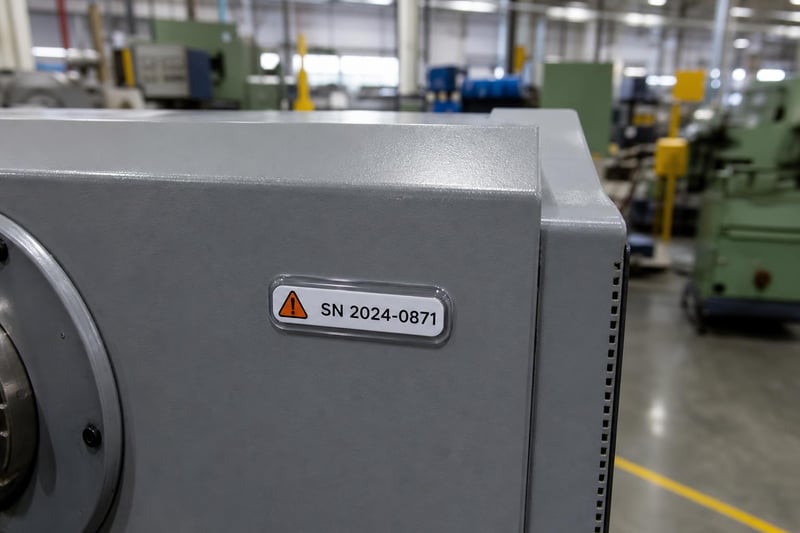
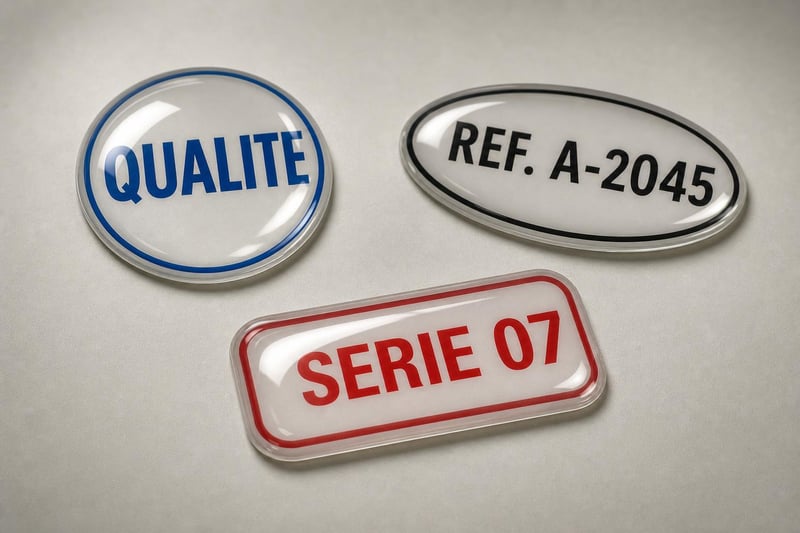
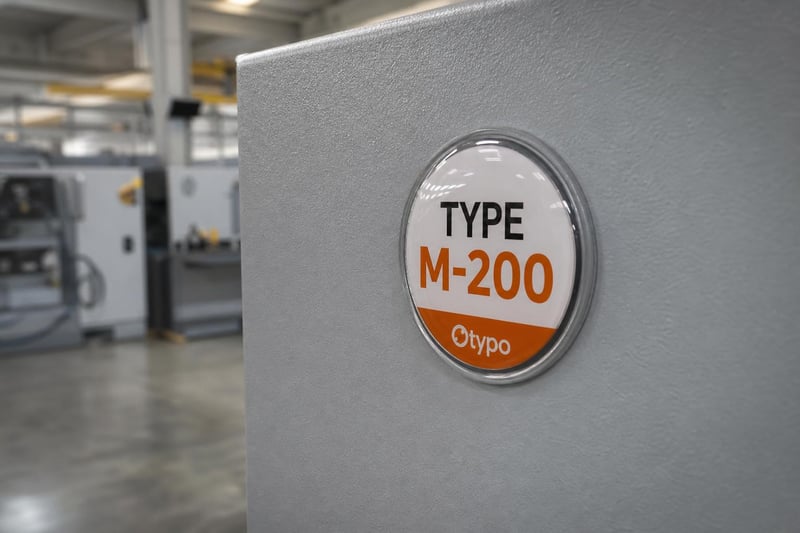
The industrial domed label covers the identification of machinery, electrical enclosures, construction plant, fleet vehicles and workstations. It meets the needs of manufacturing, construction, transport, food processing and public sector organisations — wherever durable marking must remain legible without routine maintenance.
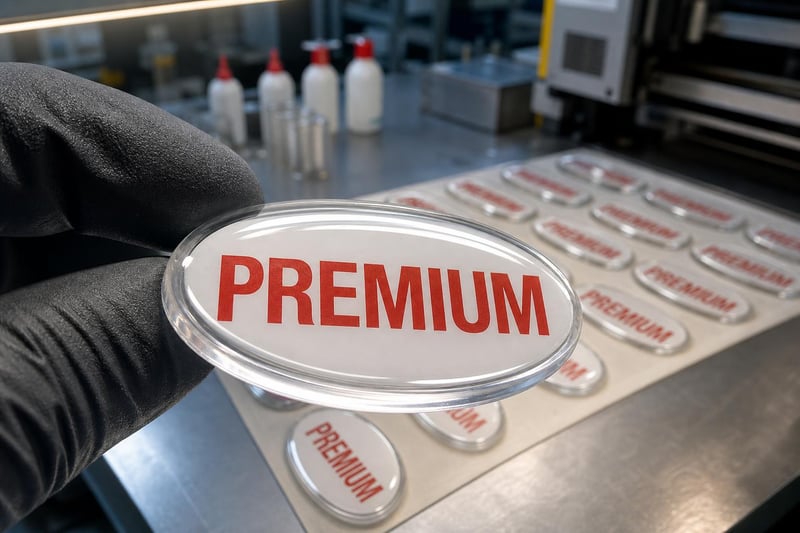
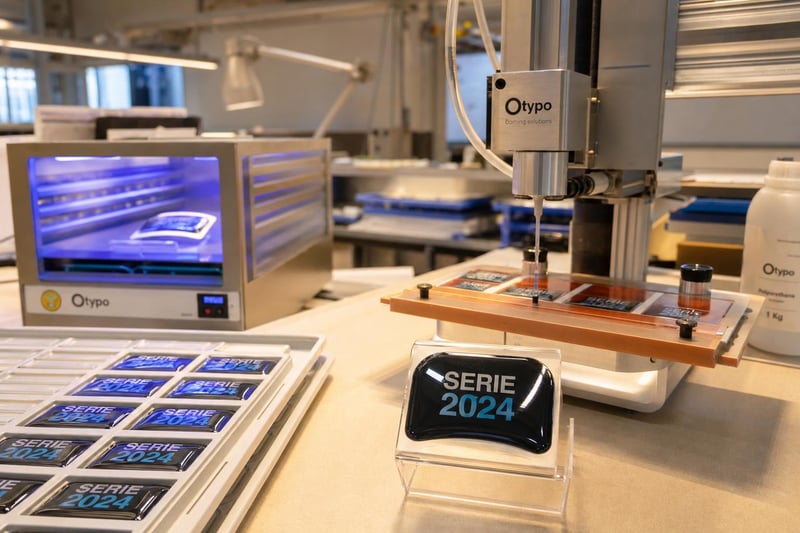
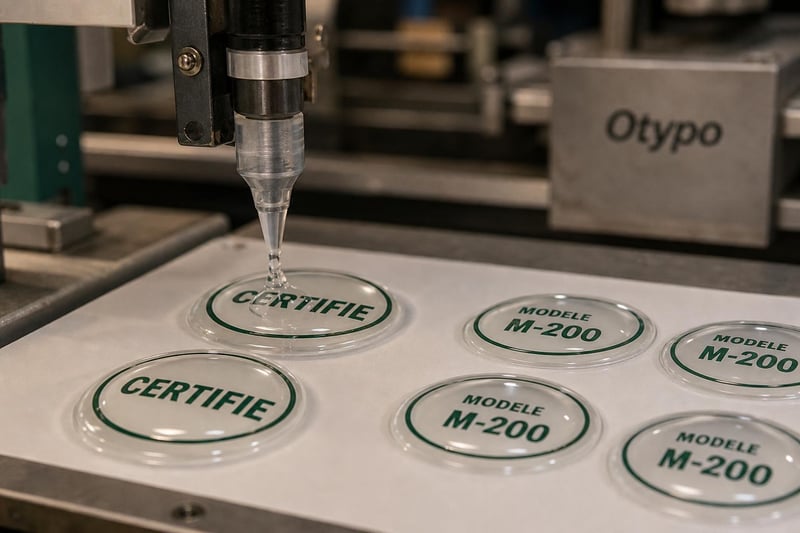
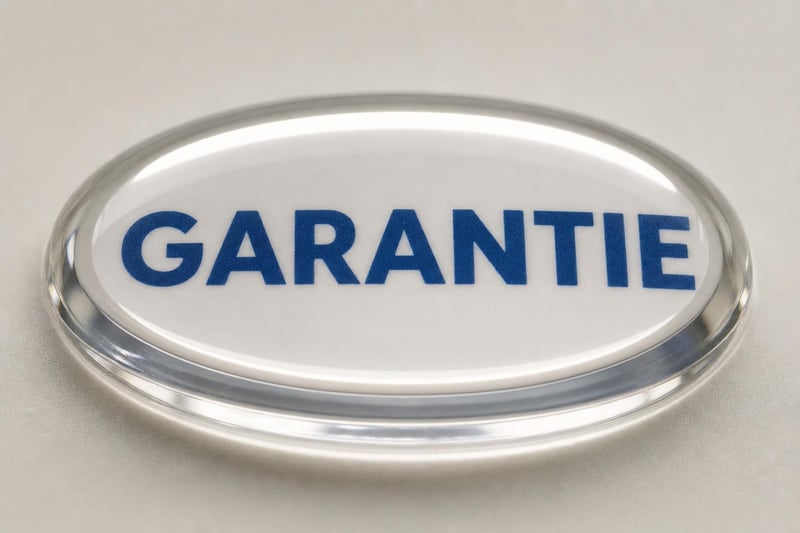
The polyurethane resin spreads by capillary action to the edges and cures as a continuous dome: no visible seam, no entry point for moisture ingress or progressive delamination. It absorbs abrasion without transmitting wear to the underlying print.
Send us your plans or your specifications. Our design office analyses your requirements and sends you a bespoke commercial proposal within 4 to 8 working hours.
The choice between a domed label, a standard vinyl label and an engraved plate rests on four concrete criteria: the level of exposure to abrasion, the expected service life, chemical constraints and the importance of visual quality. Vinyl labels are suitable for low-stress indoor applications. Engraved aluminium or brass plates are the reference in highly abrasive or high-temperature environments. Doming occupies the widest intermediate zone: it delivers the durability of permanent marking combined with the visual richness of full-colour printing, on virtually all flat substrates encountered in professional settings.
On scratch and abrasion resistance, polyurethane resin doming outperforms standard vinyl labels and approaches the performance of engraved plates. On colour reproduction and logo fidelity, it clearly surpasses both alternatives. For chemically aggressive environments involving strong solvents or acid baths, engraved plates remain the benchmark. In all other common industrial situations, doming represents the most balanced solution in terms of durability, legibility and ease of application.
The resin amplifies a good design — it does not correct a poor one. The quality of the underlying high-definition digital print directly determines the final result: sufficient resolution, strong contrasts and calibrated CMYK files. Rounded corners on the substrate promote resin adhesion to the edges without risk of early delamination. For labels incorporating QR codes, DataMatrix or barcodes, module dimensions and contrasts must be validated at the design stage to ensure reliable optical readability once the resin has cured.
Applying a self-adhesive domed label requires no specialist tooling. The receiving surface must be degreased and dry before application. After fitting, a curing period is required before intensive handling, depending on the resin formulation and ambient conditions. In the event of impact or partial detachment, replacement is on a unit basis: each label is independent, simplifying maintenance across machine fleets or vehicle fleets without having to replace the entire marking scheme.
Custom B2B doming adapts to all ordering requirements: short runs to test a new marking scheme or equip specific machinery, medium runs for machine fleets or vehicle fleets, and repeat orders for periodic renewals. Each label is produced to the format and artwork specified by the customer, with no constraint on standard sizes. Production repeatability ensures visual and technical consistency across successive runs, including over multiple years.
The primary trigger for switching to domed labels is typically the premature degradation of vinyl labels on handling equipment or process machinery: corner peeling, print erased by repeated cleaning, unreadable references within less than a year. In food processing, resistance to high-frequency cleaning with hot water and alkaline detergents led several maintenance managers to replace their bolted metal plates with repositionable domed labels on production line equipment. In the instrumentation sector, doming replaced metal plates on equipment where visual appearance and faithful logo reproduction were as important as durability.
In sectors subject to obligations for permanent equipment marking — manufacturing, energy, medical devices, food processing — the identification medium must remain legible over time without corrective intervention. The resin protects critical information: manufacturer references, safety pictograms, traceability codes and conformity marks. The transparency and gloss of the dome do not impair optical code reading provided the printed artwork follows sound design practice. For equipment subject to specific sector identification requirements, doming offers the permanence required on a flexible self-adhesive substrate, with the ability to adapt the resin formulation to the most demanding specifications.