Get a quote
express 4h


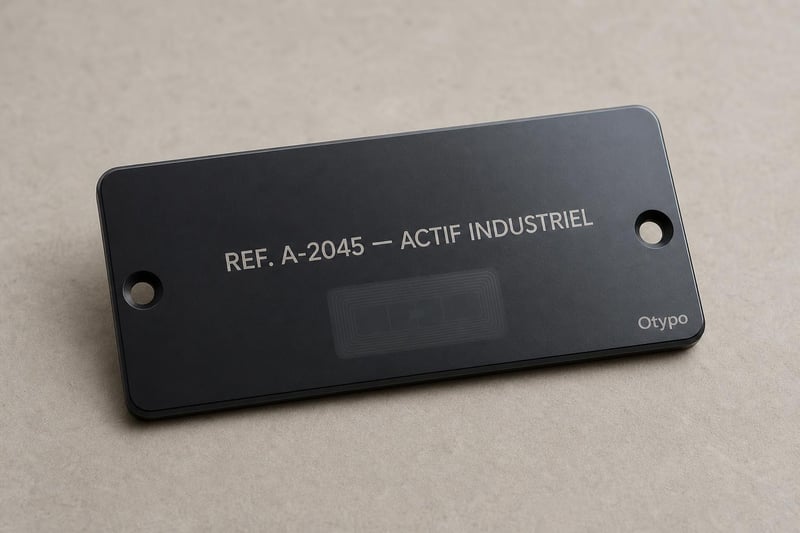
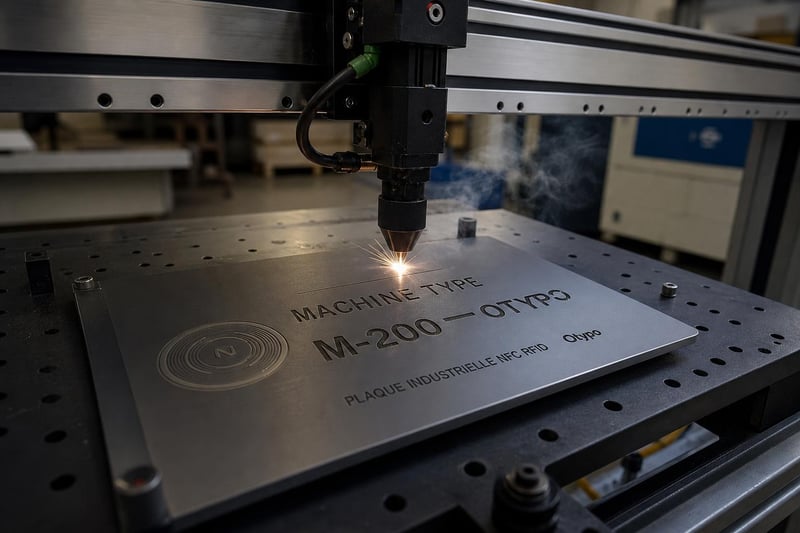
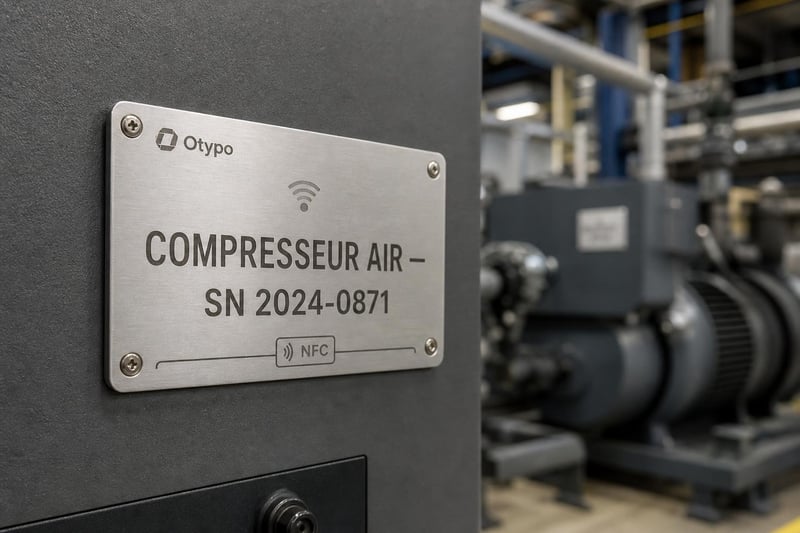
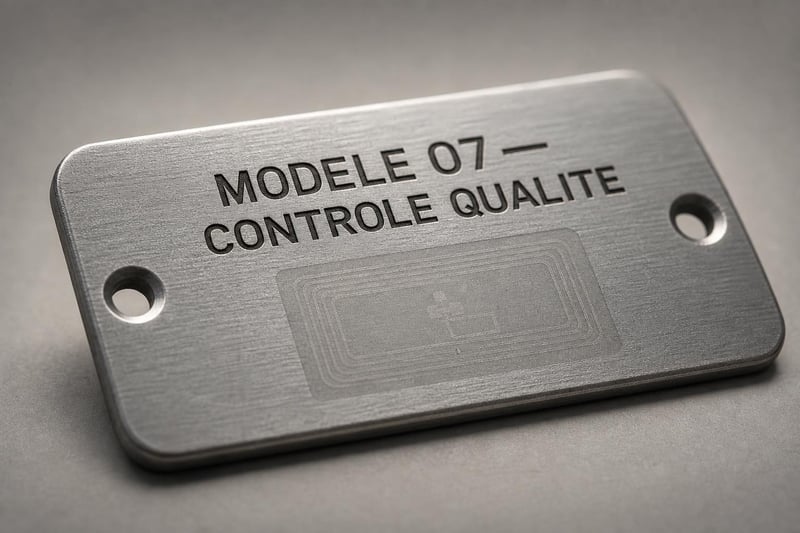
Premium industrial aesthetic. Anodised surface treatment ensures lasting corrosion resistance in demanding conditions.
Surface withstands harsh industrial contact including solvents, mild acids, oils, greases, and heavy-duty cleaning agents.
Designed for demanding environments. Thermal integrity guaranteed from -40°C to +80°C with no warping or distortion.
Text and graphics cut directly into the substrate (precision to 0.08 mm), producing a permanent, tamper-proof mark.
Suitable for prolonged outdoor exposure. Material and colours resist fading and degradation under direct sunlight.
Full-colour CMYK printing with UV-cured inks, delivering photographic-quality output and vibrant, long-lasting colours.
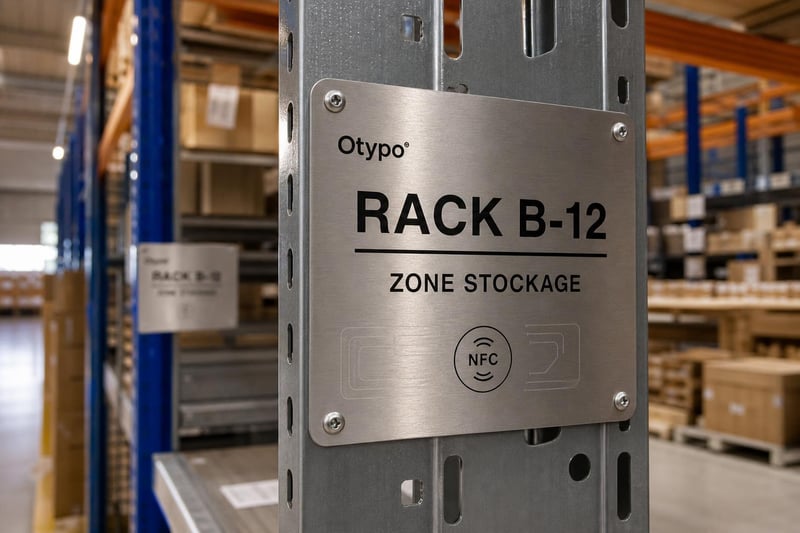
From manufacturing to construction, the industrial RFID NFC plate is fitted to machine tools, electrical cabinets, plant and inspection points exposed to impacts and chemicals.
It accelerates maintenance and inventory operations by eliminating manual data entry, in environments where flexible labels cannot withstand field conditions.
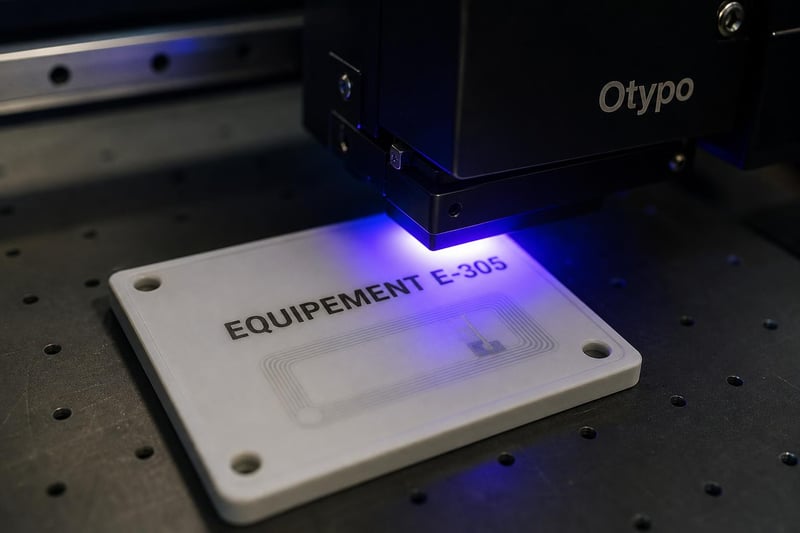
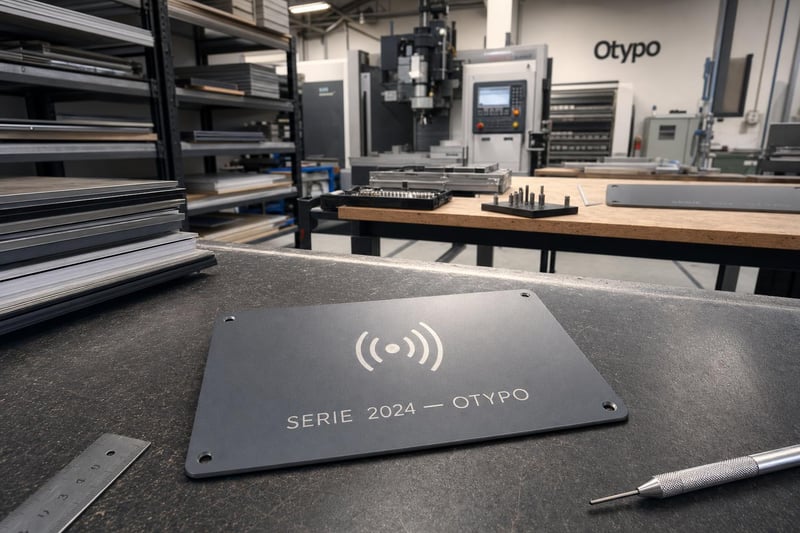
Laser engraving on anodised aluminium or stainless steel provides an indelible marking that is independent of the inlay's condition. Encapsulation of the antenna protects the contactless function against moisture, vibrations and thermal cycling.
Send us your plans or your specifications. Our design office analyses your requirements and sends you a bespoke commercial proposal within 4 to 8 working hours.
Flexible RFID labels are suited to clean, protected environments. As soon as equipment is exposed to oils, vibrations, high-pressure washdowns or significant thermal cycling, the flexible substrate degrades rapidly and compromises both marking legibility and the reliability of contactless reading. An RFID NFC plate on a metal substrate — anodised aluminium or stainless steel — maintains its mechanical and electronic performance throughout the service life of the equipment, meeting the permanent marking obligations imposed across many industrial sectors in the UK.
Laser engraving cuts text, pictograms and numbers directly into the material, making the marking independent of any surface coating. Direct UV printing allows QR codes, data matrix symbols and logos in full colour to be integrated on the same substrate as the inlay. These two processes are complementary: engraving ensures the longevity of visual identification, while digital printing enriches the graphic content without affecting the electronic function.
Anodised aluminium offers low weight, corrosion resistance and excellent resistance to common industrial cleaning agents. It is suitable for the majority of manufacturing environments. Stainless steel is the preferred choice in food processing, chemical or medical sectors where chemical aggression is more severe and cleaning cycles more frequent. Engineering plastics — PETG, polycarbonate, polyamide — provide low weight and forming flexibility for applications where mass or the risk of scratching a metal substrate are constraints.
Standard RFID NFC inlays suffer degraded performance when in contact with a metal surface. On-metal inlays incorporate a spacer or an antenna specifically designed to operate on conductive substrates. The selection of the appropriate inlay is determined during the specification phase, taking into account the material of the mounting surface, the required read range and the operating frequency.
Each plate can carry a unique identifier encoded in the inlay and visible graphically as a serial number, QR code or data matrix. This consistency between the physically engraved information and the electronically encoded data simplifies integration with CMMS systems and asset management tools. A technician can access the maintenance record of a piece of equipment simply by holding a smartphone or handheld reader close to the plate, with no manual data entry or paper register lookup required.
Equipment subject to permanent marking obligations — industrial machinery, pressure equipment, electrical installations — requires a plate whose legibility is guaranteed throughout the service life of the equipment. A laser-engraved metal substrate meets this requirement where flexible labels fail in the medium term. In specific risk zones — explosive atmospheres, cleanrooms, food-grade environments — the material and fixing method must be validated against the relevant sector best practice and applicable BS and EN standards before ordering.
Plates incorporating a passive electronic inlay are subject to specific requirements relating to radio equipment. Working with a manufacturer who is familiar with these obligations helps avoid non-conformities upon delivery and ensures that the deployed solution is consistent with the technical file of the equipment. The combination of laser engraving and RFID NFC inlay provides dual readability — visual and digital — meeting both documentary traceability requirements and operational needs on the shop floor.
The first signs of wear on an industrial RFID NFC plate are a reduction in read distance — indicating degradation of the antenna or chip — and deterioration of the graphic marking in abrasive environments. Conditions that accelerate ageing include prolonged UV exposure without adequate protection, repeated thermal cycling beyond the inlay's operating range, and direct mechanical impacts to the antenna area. The replacement logic depends on the criticality of the equipment: batch replacement for homogeneous fleets, individual replacement for critical assets where unplanned downtime is costly. Anticipating replacement before failure prevents gaps in traceability tracking histories.