Get a quote
express 4h


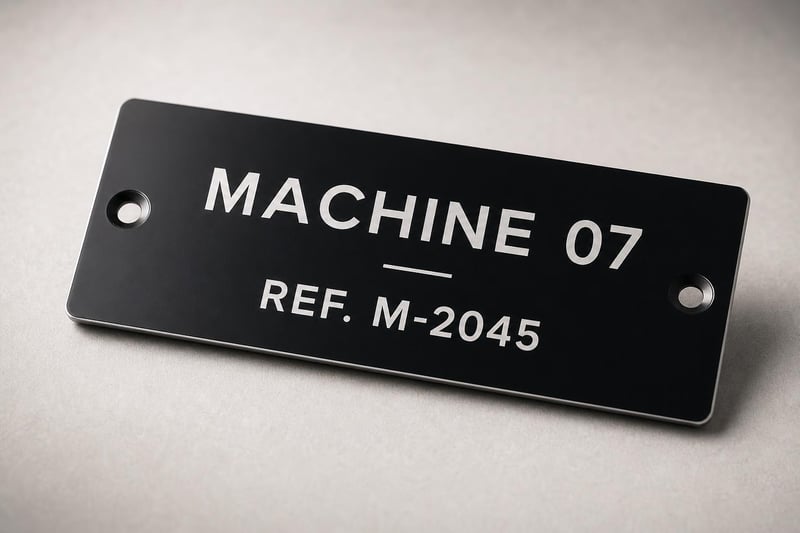
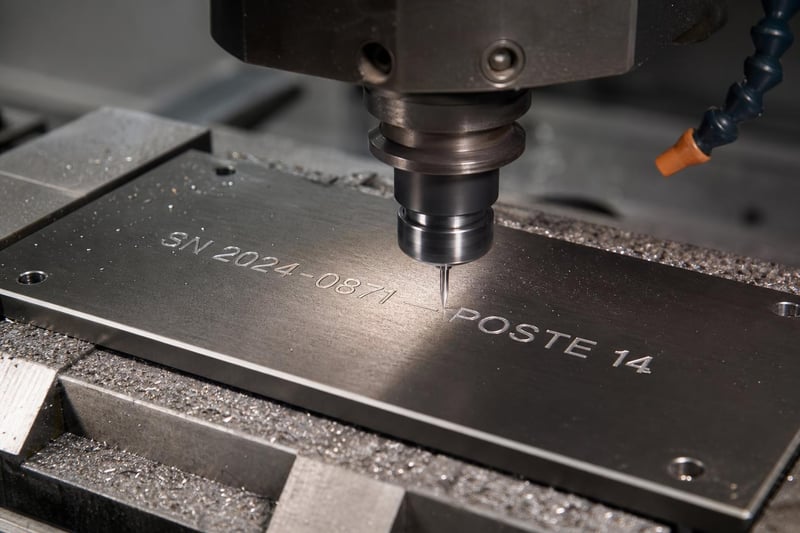
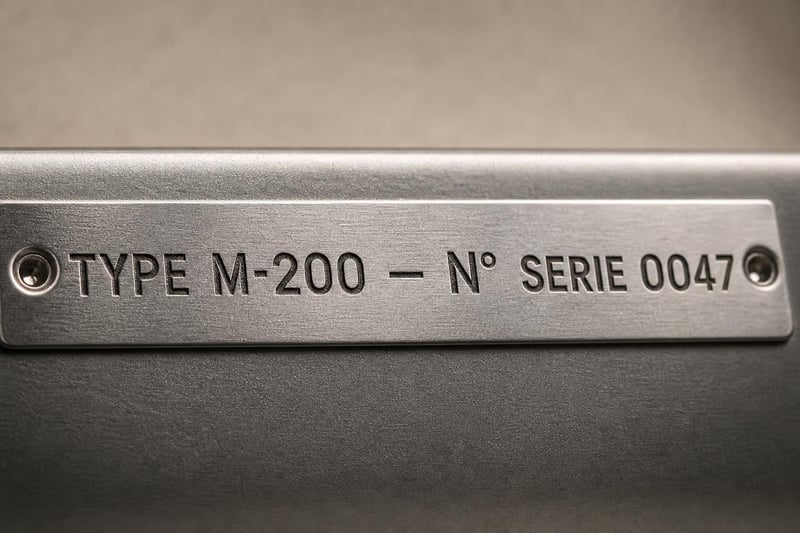
Text and graphics cut directly into the substrate (precision to 0.08 mm), producing a permanent, tamper-proof mark.
Premium industrial aesthetic. Anodised surface treatment ensures lasting corrosion resistance in demanding conditions.
Surface withstands harsh industrial contact including solvents, mild acids, oils, greases, and heavy-duty cleaning agents.
Matt or textured finish providing robust protection against impact, abrasion, and everyday wear in industrial settings.
Deep mechanical engraving by rotary cutting. Ideal for solid brass and aluminium where infilled painted lettering is required.
Premium acrylic engineered with a thin cap layer (0.05 mm) over a contrasting core, delivering sharp legibility and crisp engraved detail.
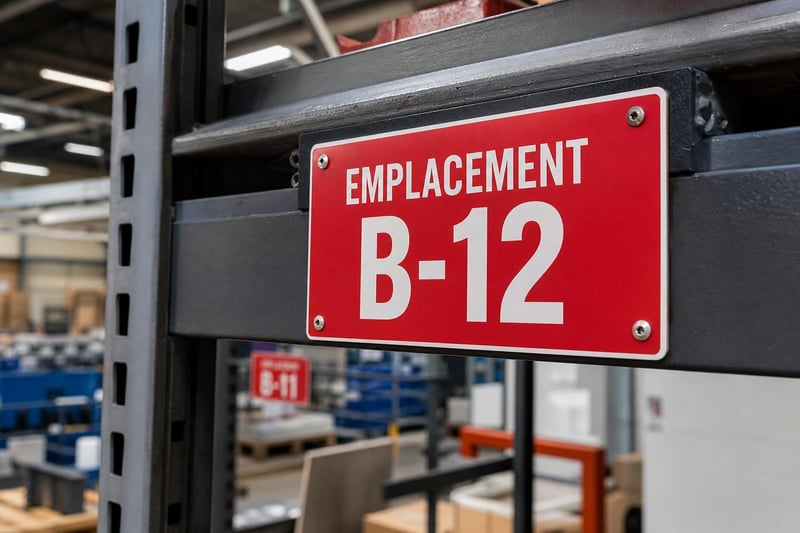
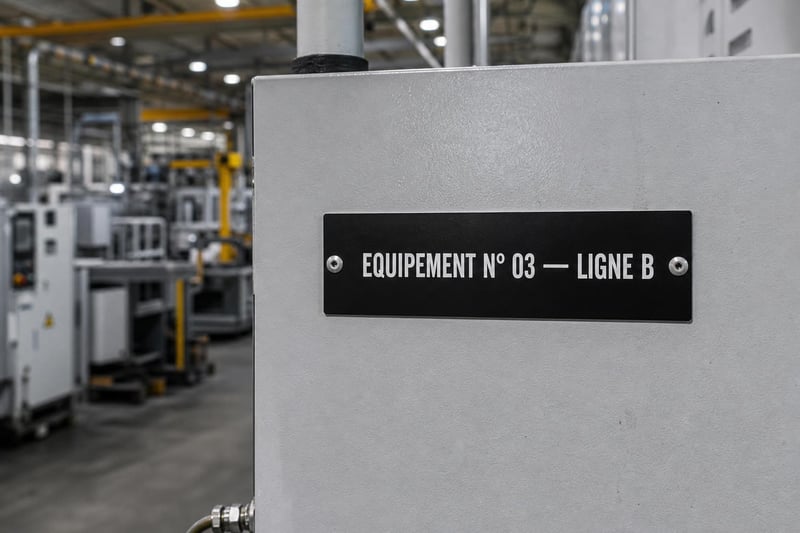
From machine numbering on production floors to valve and panel identification on large sites, numbered plates structure operational traceability across manufacturing, construction, food and beverage, and logistics.
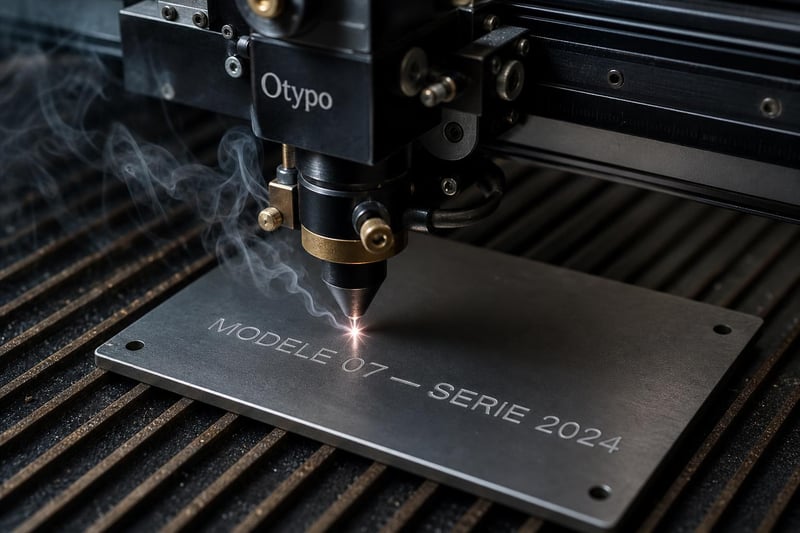
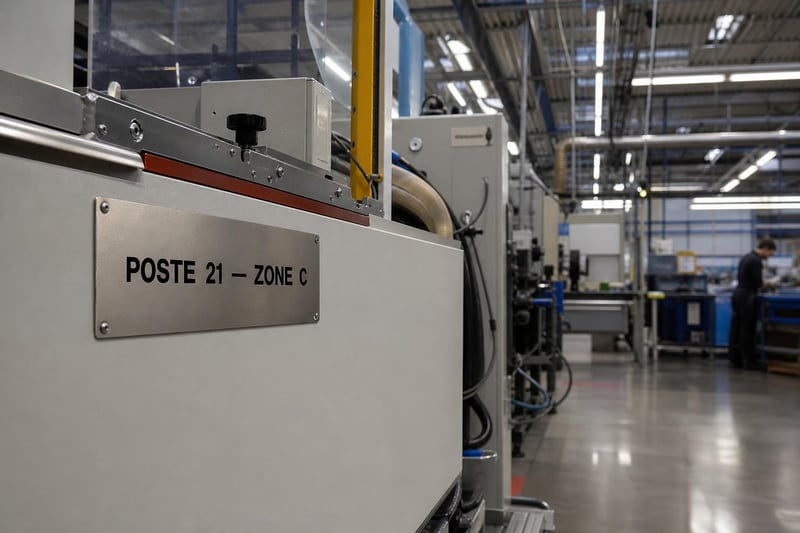
The marking process determines the useful lifespan of the plate just as much as the material does. A number engraved into the substrate holds where a surface print fades. Process and material must be selected together based on the real operating environment.
Send us your plans or your specifications. Our design office analyses your requirements and sends you a bespoke commercial proposal within 4 to 8 working hours.
The material of an industrial numbered plate determines its real service life, not just its appearance. Anodised aluminium provides effective corrosion protection for standard outdoor use and moderately humid environments. Stainless steel is the benchmark for aggressive conditions: chemical processing, food and beverage, marine or any site subject to frequent cleaning with active products. Bi-layer plastic suits indoor series requiring high visual contrast — the coloured core revealed by engraving ensures immediate legibility. Brass is the choice where a premium finish and long-term mechanical durability are the priority.
An under-specified material relative to the environment leads to premature marking degradation and unplanned replacements. Material selection errors occur regularly when the actual operating conditions — temperature, humidity, chemical agents present — have not been factored in at the design stage of the series. This point is addressed systematically during the requirements qualification phase.
Laser engraving cuts into the material with precision to a tenth of a millimetre: the marking is indelible, unaffected by abrasion, solvents and high-pressure cleaning. It is the reference process for mechanically or chemically demanding environments. CNC milling allows deep machining on solid aluminium or brass — ideal for nameplate applications, high mechanical stress environments and parts intended to be painted in the recesses. UV printing delivers high-definition output for series incorporating barcodes, DataMatrix codes, pictograms or complex multi-colour numbering.
A laser-engraved bi-layer plastic plate does not perform the same as a CNC-milled stainless steel plate in a petrochemical environment. Process and material must be selected together, based on the actual exposure of the plate in the field. This combined approach is the only one that guarantees the durability of machine traceability marking throughout the equipment's service life.
A well-designed equipment identification plate integrates directly into a computerised maintenance management system (CMMS) or asset management platform. Sequential numbering, custom prefixes, alphanumeric codes and the integration of barcodes or DataMatrix codes allow each physical plate to be linked to an equipment record in the database. Visual and dimensional consistency across an entire series — from replacing a damaged plate to fully standardising a fleet of several hundred machines — is an operational requirement that batch production handles natively.
Traceability of the marking itself — retaining the material, process and numbering reference to enable consistent reordering — is as important as the quality of the original plate. A series produced two years later in a different material creates visual inconsistency that complicates stock-takes and audits.
In regulated industrial sectors, machine traceability marking must meet permanent marking requirements. Industrial equipment placed on the market must carry legible identification throughout its useful service life. A plate whose marking fades creates an immediate documentary risk: loss of traceability during a quality audit, inability to associate a piece of equipment with its maintenance record, and a break in the preventive maintenance tracking chain. Environments with potentially explosive atmospheres, sites under strict quality control and critical equipment all demand a level of legibility and durability over time that only in-material marking can guarantee.
Industry best practice recommends selecting a material and process suited to the real operating environment at the design stage of the identification system, rather than correcting degraded plates after the fact. This forward-thinking approach avoids unplanned replacements, maintains fleet consistency and meets the documented tracking requirements that quality audits and preventive maintenance programmes increasingly impose.
The fixing method for a custom numbered plate depends on the substrate, the ambient temperature and whether the plate may need to be removed at a later stage. Stainless steel screws are the most durable solution on metal or concrete. High-bond double-sided industrial adhesive suits painted surfaces or substrates where drilling is not possible. Eyelets and holes integrated into the cut allow quick installation and easy replacement. On surfaces exposed to significant thermal variation, adhesive alone may have limitations — screwing remains preferable in such cases to ensure long-term hold.
Replacing a damaged plate must reproduce the material, process and typeface of the original series exactly. Archiving the complete reference for each series — material, process, font, numbering — is a best practice that simplifies reorders and guarantees the visual uniformity of the fleet. This consistency is particularly important in environments where the immediate legibility of numbers directly affects the speed of response from maintenance teams.