Get a quote
express 4h


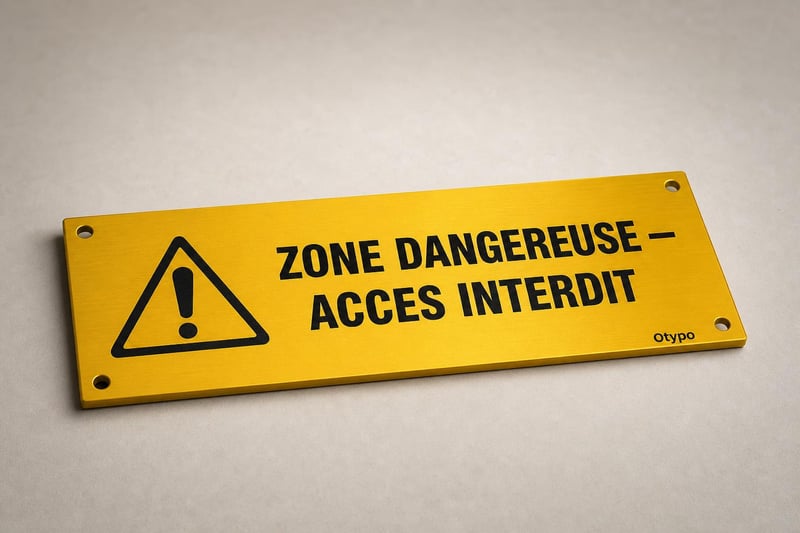
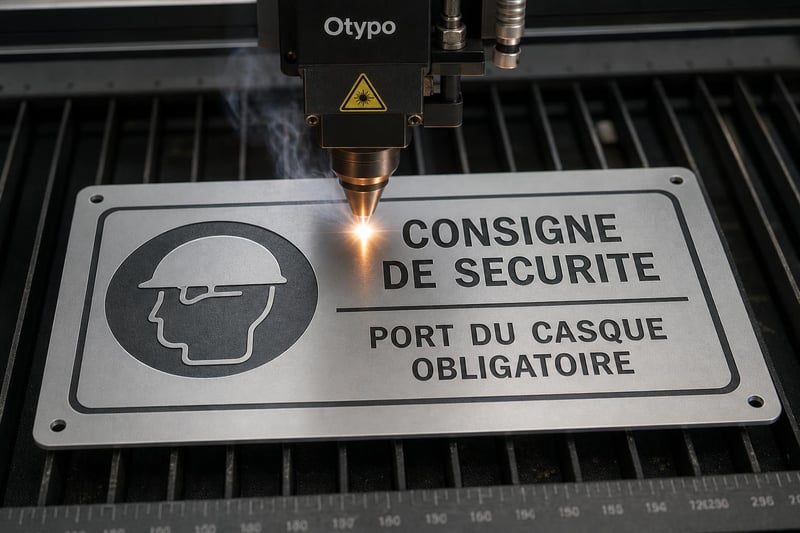
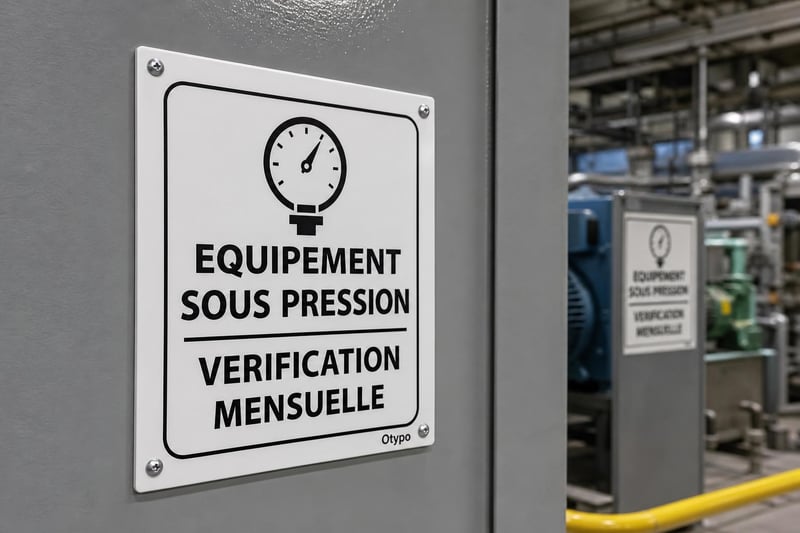
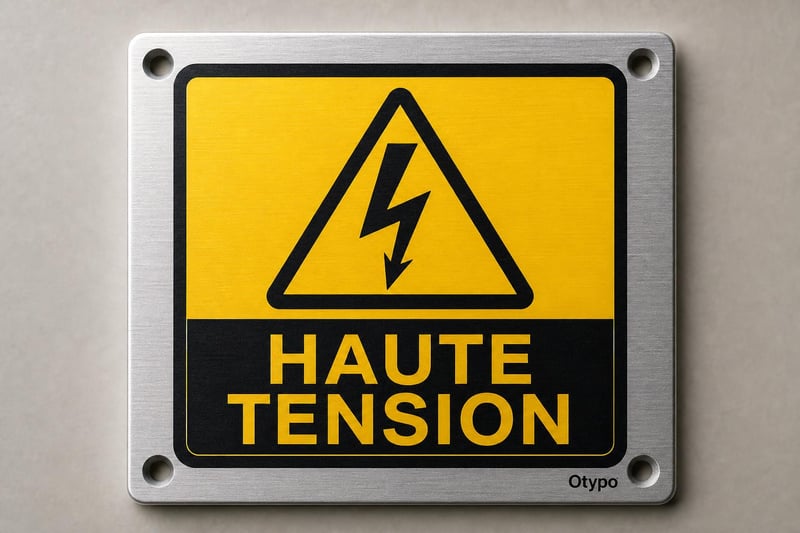
Suitable for prolonged outdoor exposure. Material and colours resist fading and degradation under direct sunlight.
Designed for demanding environments. Thermal integrity guaranteed from -40°C to +80°C with no warping or distortion.
Surface withstands harsh industrial contact including solvents, mild acids, oils, greases, and heavy-duty cleaning agents.
Text and graphics cut directly into the substrate (precision to 0.08 mm), producing a permanent, tamper-proof mark.
Premium industrial aesthetic. Anodised surface treatment ensures lasting corrosion resistance in demanding conditions.
Full-colour CMYK printing with UV-cured inks, delivering photographic-quality output and vibrant, long-lasting colours.
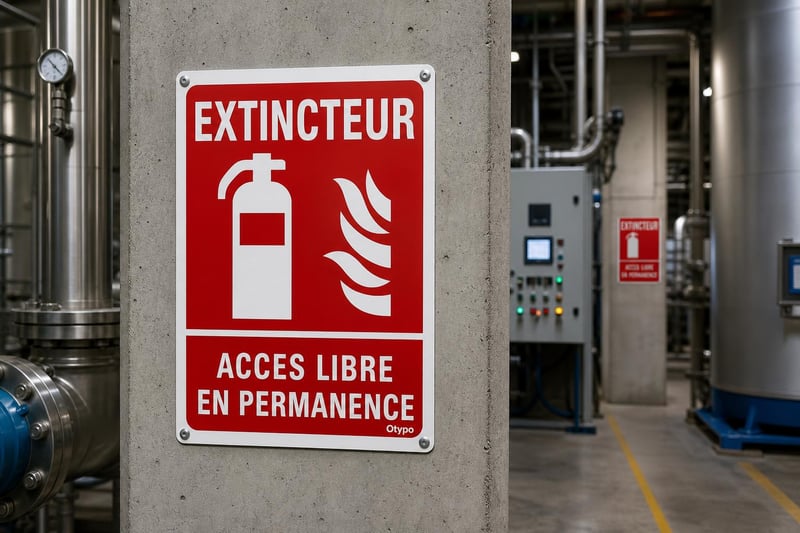
From production workshops to ATEX zones and logistics loading bays, safety nameplates identify equipment, define hazardous areas and mark evacuation routes. Each context imposes its own requirements for legibility, resistance and visual compliance.
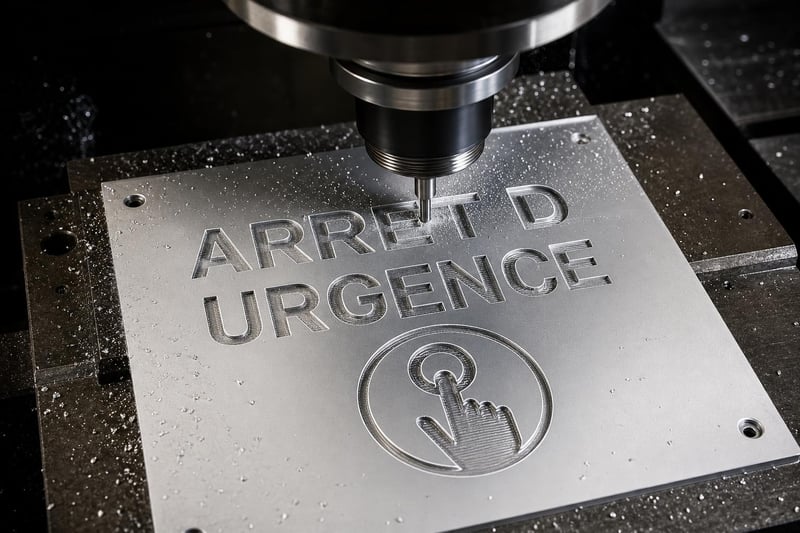
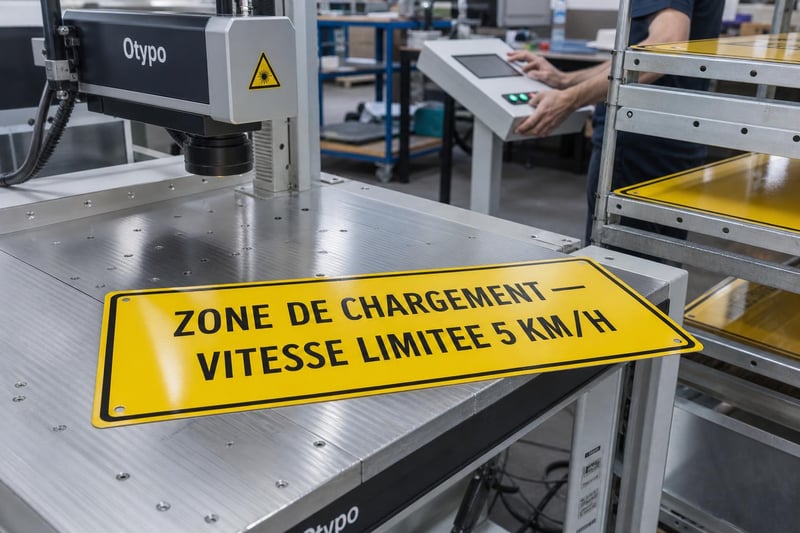
The marking process determines the longevity of the safety message as much as the substrate material. Each technique addresses specific exposure constraints and can be combined to meet several requirements simultaneously.
Send us your plans or your specifications. Our design office analyses your requirements and sends you a bespoke commercial proposal within 4 to 8 working hours.
Expanded PVC is suitable for dry indoor environments, away from UV radiation and chemical agents. Lightweight and easy to cut, it meets everyday signage needs in workshops or warehouses. As soon as outdoor exposure or the presence of solvents is a factor, it reaches its limits.
Anodised aluminium is the go-to choice for permanent outdoor nameplates or aggressive industrial environments: unaffected by atmospheric corrosion, stable under UV exposure and resistant to significant thermal variation, it maintains marking legibility throughout the entire service life of the installation. Aluminium composite offers the same properties at a reduced weight, suited to large surfaces or substrates that are difficult to reinforce. In food processing or pharmaceutical environments, where cleaning with solvents, mild acids or powerful disinfectants is routine, surface chemical resistance becomes the determining criterion — lacquered aluminium or treated composite meets this requirement where standard PVC degrades.
Laser engraving cuts the marking into the material to a precision of around one tenth of a millimetre. The text or pictogram remains intact even after repeated abrasion, chemical splashes or high-pressure cleaning. It is the reference process for manufacturer's data plates, lockout/tagout plates and any marking that must withstand regular physical contact. Its limitation: the absence of inherent colour, which makes it less suited to standardised pictograms requiring a precise colour code.
Direct UV printing cures inks onto the substrate surface in a fraction of a second, producing a marking resistant to UV, common solvents and light abrasion. It allows faithful reproduction of standardised pictograms in full colour — red for danger, green for safe condition, blue for mandatory action, yellow for warning — with colours that remain stable over time. Screen printing delivers comparable results for larger runs, with a thick ink deposit that is particularly resistant to surface wear. CNC milling on aluminium or brass produces a raised or recessed marking suited to environments where contact-based erasure is a real risk, particularly on machinery with high operator traffic.
Safety pictograms — prohibition, mandatory action, warning, safe condition, fire — are governed by geometric shapes and colour codes defined at international level and reflected in BS EN ISO 7010. Any safety sign or nameplate must comply with these visual conventions to be legally valid and immediately interpretable by operators, including under stress. A pictogram with altered colours or a non-compliant shape loses its regulatory value.
Regulatory requirements under the Health and Safety (Safety Signs and Signals) Regulations 1996 stipulate that safety marking must remain legible throughout the entire service life of the installation. A nameplate that is illegible, detached or discoloured exposes the duty holder to liability in the event of an accident. In specific contexts — potentially explosive atmospheres, industrial machinery, pressure equipment — permanent marking obligations are reinforced: the substrate and process must be selected accordingly, not on the basis of unit cost. Industrial machinery must also carry permanent identification of the manufacturer and essential characteristics, resistant to the machine's environment throughout its foreseeable service life.
In production workshops, safety nameplates identify danger zones around machinery, communicate lockout/tagout instructions and mark restricted access areas. Resistance to oils, greases and frequent cleaning is the determining criterion. Laser-engraved aluminium or UV-printed composite meets these constraints.
In these environments, equipment marking is subject to specific requirements for category identification and protection level under the ATEX Directive (2014/34/EU) and DSEAR. An unsuitable substrate can invalidate the compliance of the installation. Anodised aluminium laser-engraved is the reference material: no spark risk, high chemical resistance, permanent marking.
Cleaning with solvents, mild acids and powerful disinfectants rapidly degrades unprotected markings. Surface chemical resistance is the priority here. UV printing on lacquered aluminium or treated composite guarantees colour and text durability against repeated chemical exposure.
In logistics, fast legibility at distance is paramount: zone safety signs must be readable from a forklift truck or loading bay. In construction and industrial buildings, marking of evacuation routes, fire-fighting equipment and plant rooms requires substrates resistant to site conditions — moisture, dust and impact.
The fixing method determines the long-term retention of the nameplate as much as the material itself. Screws and rivets are preferable for environments subject to vibration or high-pressure cleaning. Industrial double-sided adhesive is suitable for flat, stable surfaces away from extreme temperatures. Eyelets allow quick suspension on mesh or metal structures. On painted or lacquered surfaces, a high-performance acrylic adhesive avoids drilling whilst ensuring lasting adhesion.
Industry best practice recommends regular inspection of all safety nameplates in service: fading of pictograms, partial detachment, illegibility due to soiling or abrasion. A degraded nameplate must be replaced without delay — leaving it in place does not constitute a valid safety measure and exposes the duty holder to liability. Planning ahead for renewal by retaining production files allows existing nameplates to be reproduced identically without a new design phase.