Get a quote
express 4h


Suitable for prolonged outdoor exposure. Material and colours resist fading and degradation under direct sunlight.
Surface withstands harsh industrial contact including solvents, mild acids, oils, greases, and heavy-duty cleaning agents.
Premium industrial aesthetic. Anodised surface treatment ensures lasting corrosion resistance in demanding conditions.
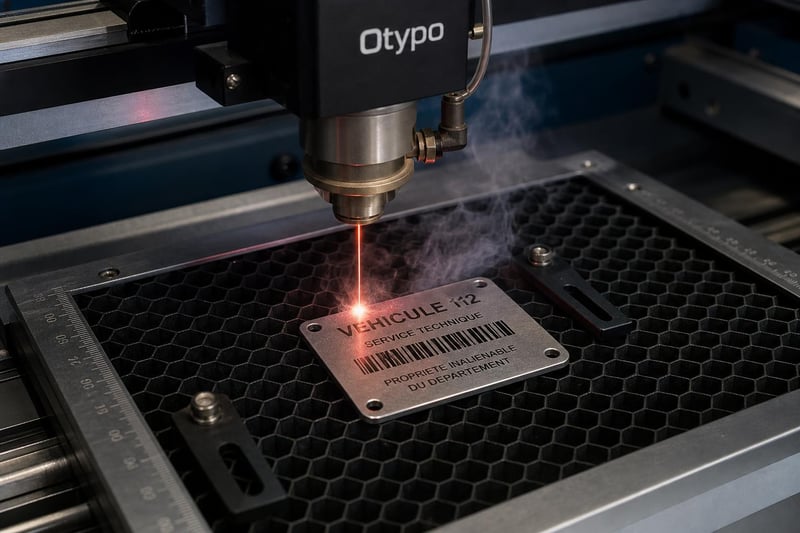
Text and graphics cut directly into the substrate (precision to 0.08 mm), producing a permanent, tamper-proof mark.
Full-colour CMYK printing with UV-cured inks, delivering photographic-quality output and vibrant, long-lasting colours.
Matt or textured finish providing robust protection against impact, abrasion, and everyday wear in industrial settings.
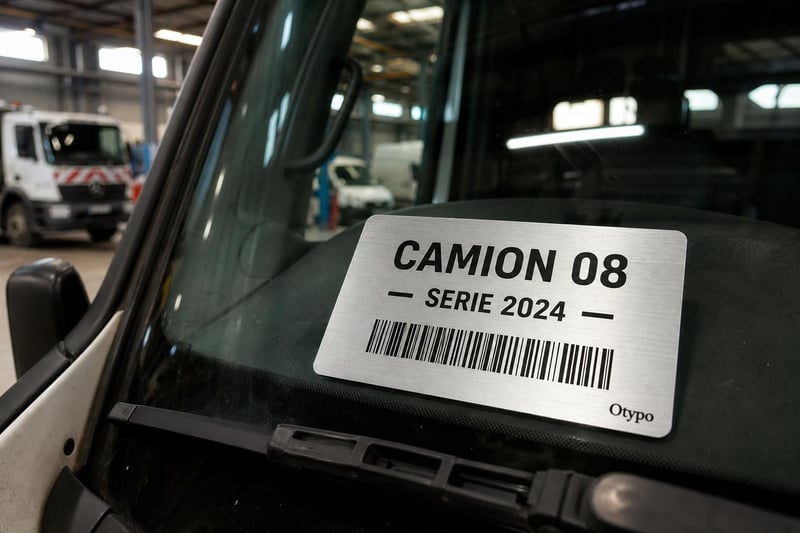
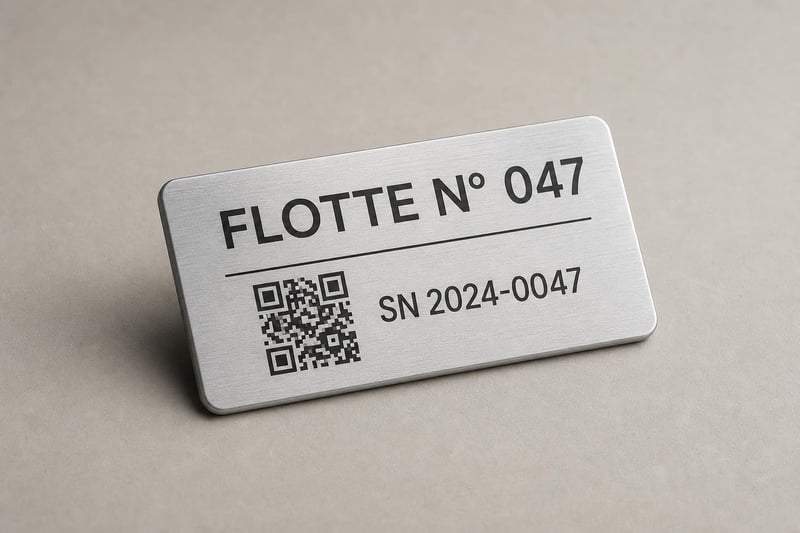
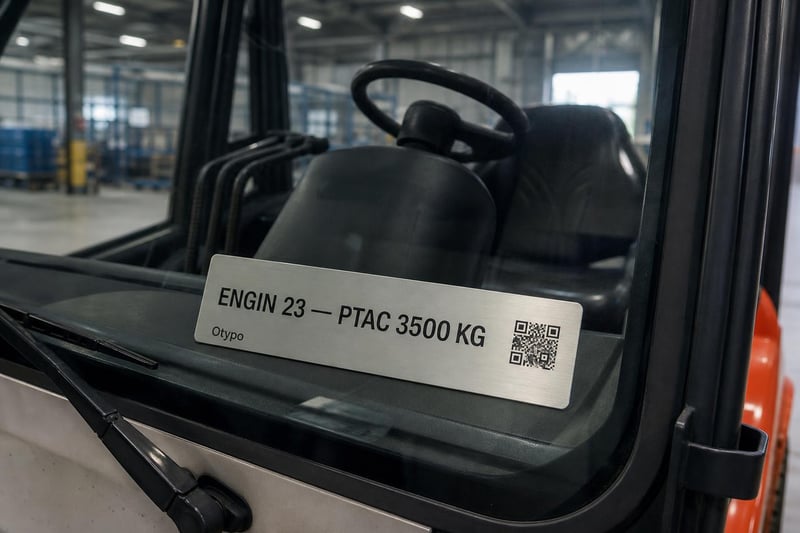
From industrial fleet marking to the identification of local authority vehicles, vehicle badges address permanent identification needs across very different contexts: numbered warehouse trucks, tracked plant machinery, service vans on regulated sites.
Shuttle vehicles with aesthetic requirements, municipal service vehicles or materials handling equipment: each application imposes its own legibility and durability constraints, which the badge must meet throughout the vehicle's operational life.
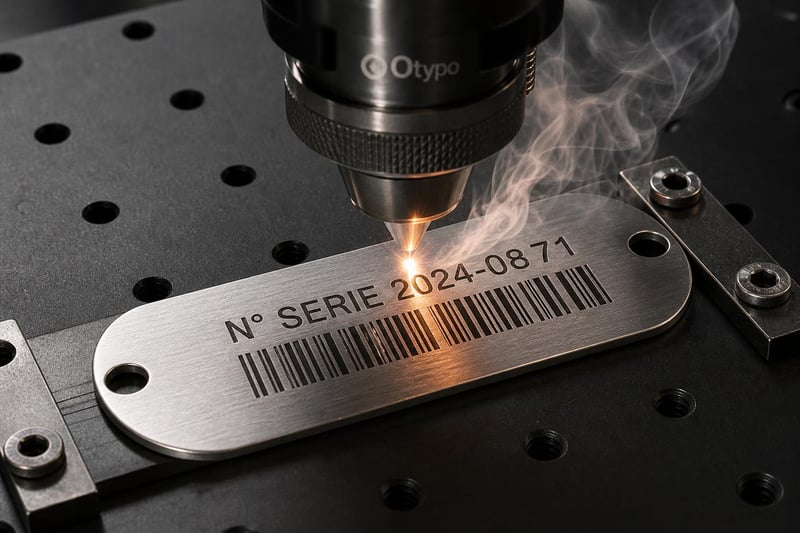
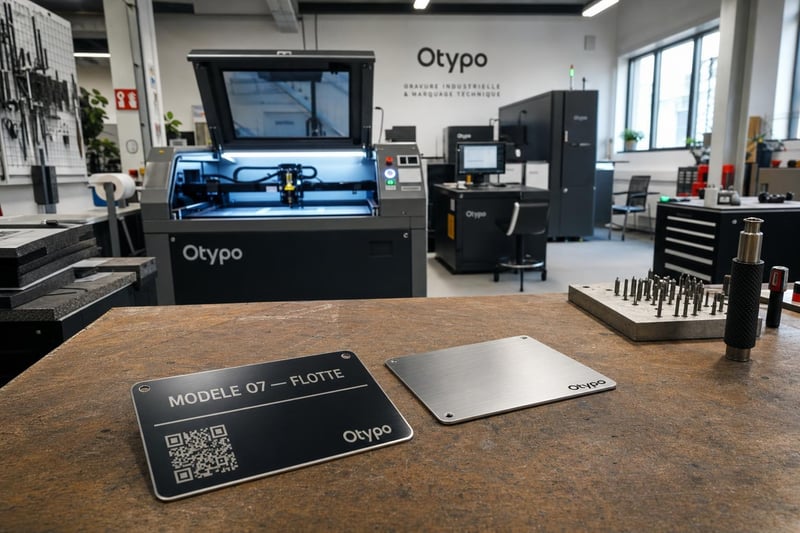
The longevity of a vehicle badge depends as much on the marking process as on the material. Laser engraving, UV printing and resin doming do not address the same constraints — the choice directly determines legibility over several years.
Send us your plans or your specifications. Our design office analyses your requirements and sends you a bespoke commercial proposal within 4 to 8 working hours.
The choice of material for a vehicle identification badge is not made on appearance alone. In permanently outdoor environments, anodised aluminium is the benchmark: lightweight and corrosion-resistant, it retains its integrity against UV exposure, temperature variation and repeated washing. Stainless steel is preferred where chemical constraints are high — food production sites, de-icing zones, petrochemical environments. Rigid engineering plastic is suited to semi-outdoor or interior applications with lower mechanical demands. This material is less appropriate for environments exposed to solvent-based products or fuel splashing.
Industrial vehicles and construction plant expose badges to stresses that passenger cars do not generate: continuous vibration, repeated impacts and significant temperature differentials between day and night. A badge designed for these conditions incorporates appropriate fixings and a material whose mechanical performance has been verified over time. We regularly observe that badges under-specified for their environment lead to premature replacements and identification discrepancies during internal audits.
Laser engraving inscribes text or graphics directly into the material by ablation. The resulting mark is permanent: no chemical, abrasion or high-pressure wash can remove it. It is the reference process for serial numbers, fleet identifiers and any data where permanent legibility is a requirement. On anodised aluminium, engraving reveals the bare metal beneath the anodised layer, creating a lasting contrast without ink or paint.
UV digital printing allows full-colour logos, barcodes and QR codes to be applied to metal or plastic with high precision. The inks are cured by ultraviolet radiation at the point of deposition, giving them resistance to outdoor UV exposure and common chemical attack. Resin doming adds a layer of transparent polyurethane that protects the print from impact and moisture, whilst providing the three-dimensional visual effect valued on prestige and corporate fleet badges.
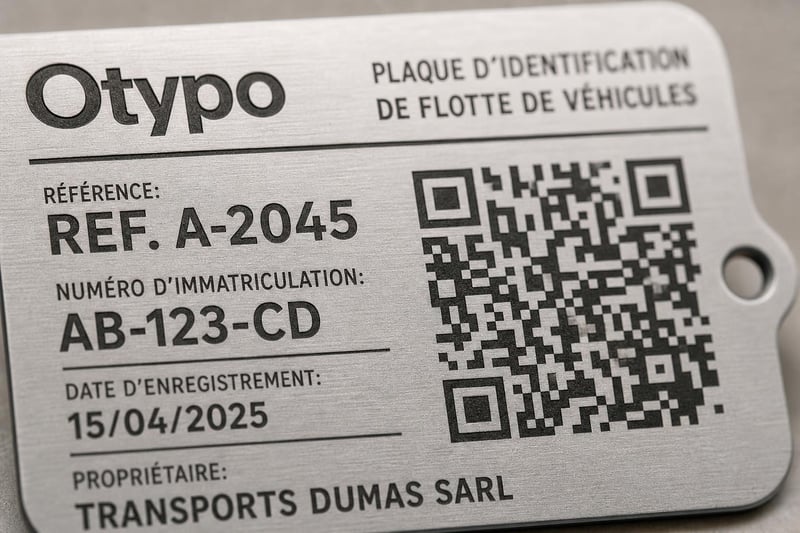
Effective vehicle fleet marking rests on two simultaneous requirements: each badge must be unique in its content — fleet number, registration mark, assignment code — whilst belonging to a visually consistent series. Digital processes allow series with variable data to be produced without breaking brand guidelines. The integration of barcodes or QR codes readable by industrial scanners facilitates document management and fleet audits, particularly in logistics and industrial sectors where traceability is an operational requirement.
Industrial vehicles, mobile machinery and construction plant are subject to permanent identification obligations. The badge must remain legible throughout the vehicle's operational life, without detachment or visible deterioration. Industry best practice recommends selecting a marking process whose resistance is matched to the vehicle's actual environment, and planning for fleet renewal by choosing badges that can be replaced cleanly without leaving marks on the bodywork.
The fixing method for an aluminium vehicle badge determines its long-term retention as much as the material itself. High-performance double-sided adhesive is suitable for lightweight badges on smooth, clean surfaces. Riveting or screwing is necessary whenever the badge is subject to continuous vibration or repeated impacts — a common situation on materials handling equipment and construction vehicles. Having worked with hundreds of fleet managers, we find that the question of removal at fleet renewal is frequently underestimated: a reversible fixing method simplifies replacement without damaging the bodywork.
In industry and logistics, the fleet vehicle identification badge primarily carries an identification number and barcode for fleet management. In construction, plant must display identification information legible at a distance, resistant to mud and splashing. Local authorities and municipal technical services prioritise visual consistency across the entire fleet, with badges that can be replaced on a like-for-like basis at renewal. In the energy sector and on regulated sites, contractor vehicle badges play a role in access control and the documented traceability of personnel on site. In each of these contexts, the industrial vehicle identification plate is not a secondary accessory: it is a standardised identification tool whose reliability underpins rigorous long-term fleet management.