Get a quote
express 4h


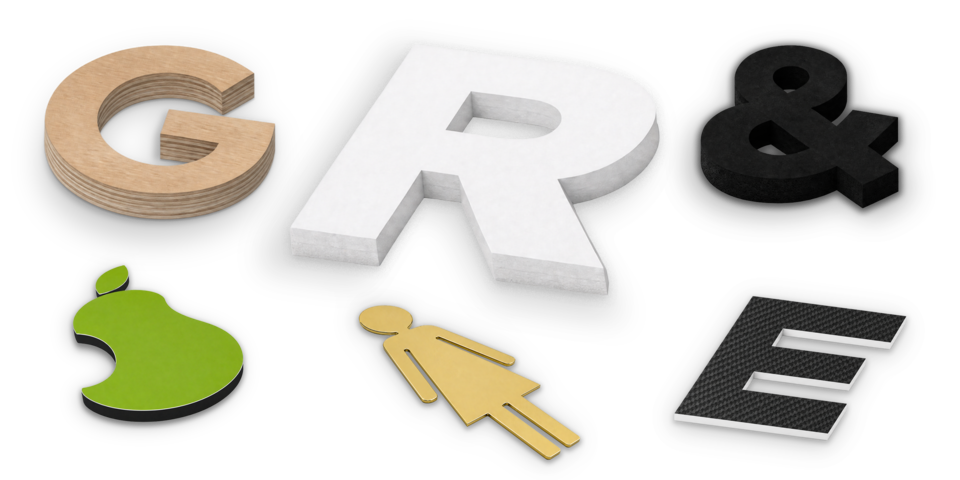
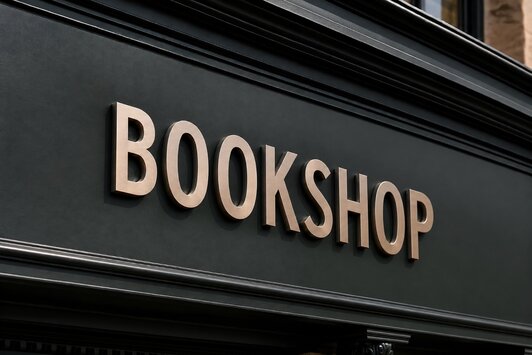
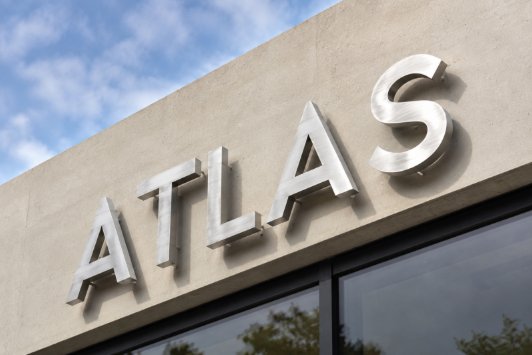
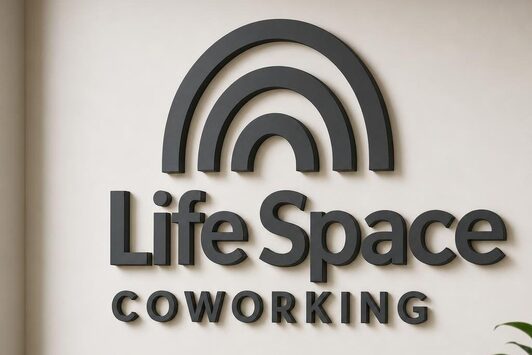
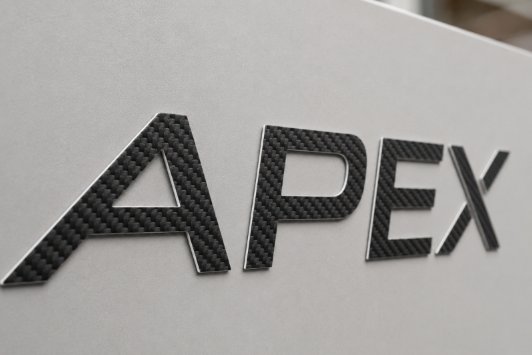
Shop window, reception desk or meeting room: show off your identity with letters and logos cut to measure.
Many businesses already trust us to fit out their premises.
A shop sign, a first name, a wine cellar logo… everything is cut to measure.
Choose your format — letters only, a shape or logo only, or both combined — and give your home some character.


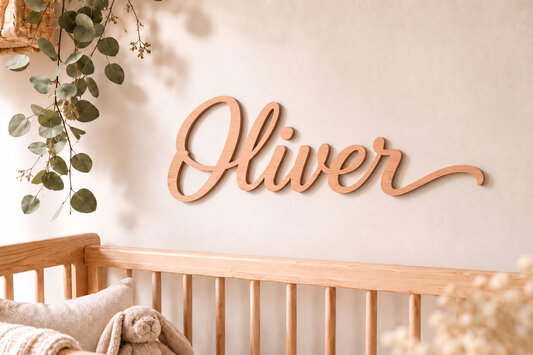
Wooden names, door lettering or decorative words: add a personal, warm touch to your interior.
Many families already trust us to personalise their homes.
Otypo is a family business with over 60 years of experience, specialising in high-quality stamps and personalised signs.
Since 1990, we have been combining traditional craftsmanship with the latest technologies.
Our highly motivated team of 20 offers bespoke solutions at the best value for money:
Whether personalised signs for special occasions or professional Trodat stamps - we deliver precisely and quickly.
Our core values are customer satisfaction, innovation and sustainability.
We focus on environmentally friendly practices and local products to offer high-quality printing and signage solutions.
Our ultimate goal is to turn new customers into long-term loyal customers.
That's why consistently high quality and your satisfaction are our absolute priority.
Trust Otypo - your reliable partner for creative and responsible communication tools.


Otypo's cut out letters are individual letters, words, numbers and logos cut to your design from solid sheet material: wood, acrylic (plexiglass), expanded PVC (Foamex), aluminium, Dibond and brass. Choose a thickness from 1.3 mm to 19 mm and any size from 7 cm to 4 m. Fix them with Ultra Adhesive, with magnets on a steel surface, or on snap-on spacers about 1.5 cm off the wall for a 3D shadow effect, using a paper mounting template. Design online and see the price instantly, with no quote: tiered pricing by size. Made and dispatched within one working day.
Every piece of cut out lettering we make is a separate part, cut flat from a sheet of solid material to match your own text, logo or file. These are not off-the-shelf A–Z letters, cardboard shapes or printable templates. They are custom made letters, produced order by order for shop fronts, reception walls, nurseries and wedding venues.
Ordering cut out letters online takes a few minutes. Type your words in the editor and pick a font from the editor, including script and handwritten styles such as Pacifico, Great Vibes and Dancing Script. You can also import your own file. Font files cannot be uploaded, but text vectorised inside an SVG works perfectly. Then choose the material, thickness, size and fixing. The price updates live, so custom cut out letters are as easy to buy as any stock product.
Size is where custom letter cutouts really pay off. Small letters start at 7 cm high for a door, a counter or a shelf. Large cut out letters go up to 4,000 × 2,400 mm for façades, entrance halls and function rooms. For extra large letters or large custom letters, we recommend sending an SVG so that every curve stays sharp at full scale.
The shape is cut through the material rather than printed on top. As a result, the relief stays readable from a distance, and there is no surface ink to flake off the edges. All our custom cut letters and 3D cut out letters are flat cut. Built-up letters with side returns and adhesive vinyl lettering are different products that we don't make.
Search for "3D letters" and you will find drawings, 3D fonts and 3D-printed figurines. Ours are none of those. An Otypo 3D letter is a flat letter cut from a thick sheet. Its depth comes from two things: the thickness of the material and the way the letter is fixed.
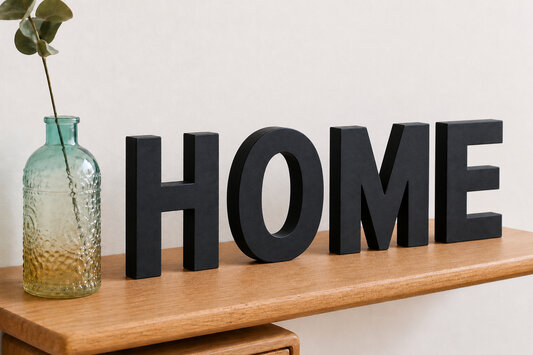
First, thickness. Thin PVC starts at 1.3 mm, while Dibond and plexiglass start at 3 mm. Printed plexiglass and expanded PVC also come in 5 and 8 mm, and wood and expanded PVC reach 18 to 19 mm. That thickest group gives you true block letters in 3D: chunky capitals in 19 mm Premium Douglas fir or Black expanded PVC that stand on a shelf with no fixing at all.
Second, fixing. On snap-on spacers, each letter floats about 1.5 cm off the wall and casts a soft shadow. This is the effect people call 3D shadow letters or floating letters. Big 3D letters and large 3D letters scale up to 4 m for a façade, while small 3D letters start at 7 cm for a desk or a door.
Dimensional lettering, three dimensional letters and 3D lettering are simply the sign trade's terms for the same product. You might want custom 3D letters for a brand wall, or 3D letters for sale for a home project. Either way, you order 3D letters online with the same editor and the same live price.
Built-up letters are hollow, box-shaped letters with side returns, and they are often illuminated. They use a different manufacturing process that we don't offer. Our 3D letters are solid flat cut pieces, with no lighting and no assembly.
Cut out numbers are made exactly like our letters, in the same materials, thicknesses and fixings, from 7 cm to 4 m. They are solid pieces, not printable templates or card numbers to fill in. Large cut out numbers suit a unit number on a façade, a floor number in a stairwell or the year a business opened. In wood, large number cutouts make a striking birthday age or wedding date. Many customers combine cut out letters and numbers, such as a first name with a date of birth. For a house number on a plate, see our house number signs.
Every order is cut in-house, using CNC routing or laser cutting depending on the material. Edges come out clean, a chamfer is possible for a bevelled finish, and every letter is delivered as a separate piece. You don't need to choose the process: we use the right one for the sheet you select.
Ordering laser cut lettering or CNC cut letters from us is simpler than preparing files for a workshop. We accept jpg, png, pdf, ppt, eps, svg and doc files, so you don't need a vector file. Once your order is confirmed, you receive a proof by email within 24 business hours. This applies equally to custom laser cut letters, laser cut 3D letters in thick acrylic and laser cut out letters for a logo.
Looking for laser cut letters near me or laser cut letters UK? At Otypo, laser letter cutting is ordered entirely online, and your letters are made and shipped within 24 working hours. Delivery options and costs are shown at checkout.
Our range covers 25 materials in five families. The table below compares them all, so you can match the look, thickness and indoor or outdoor use before you open the editor.
| Material | Thickness | Finishes / colours | Indoor / outdoor | Max. size |
|---|---|---|---|---|
| Wood | ||||
| Premium Douglas fir | 19 mm | Natural Douglas fir | Indoor + sheltered outdoor only | 4,000 × 2,400 mm |
| Okoumé wood | 18 mm | Warm pinkish tone | Indoor + outdoor (the wood for exposed use) | 4,000 × 2,400 mm |
| Hevea wood | 18 mm | Assembled slats | Indoor only | 4,000 × 2,400 mm |
| Plywood (veneer) | 3 mm | Maple, oak, bamboo, walnut | Indoor only | 2,000 × 1,200 mm |
| Acrylic (plexiglass) | ||||
| Printed plexiglass | 3 mm | Colour of your choice (print) | Indoor + outdoor | 4,000 × 2,400 mm |
| Printed plexiglass 5 mm | 5 mm | Colour of your choice (print) | Indoor + outdoor | 4,000 × 2,400 mm |
| Printed plexiglass 8 mm | 8 mm | Colour of your choice (print) | Indoor + outdoor | 4,000 × 2,400 mm |
| Transparent plexiglass | 3 mm | Clear, green, blue | Indoor + outdoor | 4,000 × 2,400 mm (green / blue 600 × 600 mm) |
| Transparent plexiglass 5 mm | 5 mm | Clear | Indoor + outdoor | 4,000 × 2,400 mm |
| Transparent plexiglass 8 mm | 8 mm | Clear | Indoor + outdoor | 4,000 × 2,400 mm |
| Mirror plexiglass | 3 mm | Silver, gold, rose gold mirror | Indoor only | 4,000 × 2,400 mm |
| PVC | ||||
| Standard expanded PVC (Foamex / Forex) | 3 mm | Colour of your choice | Indoor + outdoor | 4,000 × 2,400 mm |
| Standard expanded PVC 5 mm | 5 mm | Colour of your choice | Indoor + outdoor | 4,000 × 2,400 mm |
| Standard expanded PVC 8 mm | 8 mm | Colour of your choice | Indoor + outdoor | 4,000 × 2,400 mm |
| Standard expanded PVC 19 mm | 19 mm | Colour of your choice | Indoor + outdoor | 4,000 × 2,400 mm |
| Black expanded PVC | 19 mm | Black | Indoor + outdoor | 4,000 × 2,400 mm |
| Thin PVC | 1.3 mm | Around 38 colours (metal, standard, wood look) | Indoor + outdoor | 4,000 × 2,400 mm |
| Aluminium and Dibond | ||||
| Natural aluminium | 1.5 mm | Anodised, Brushed, Gold, Black, Bronze, Blue, Red, Green | Indoor + outdoor | 4,000 × 2,400 mm |
| Aluminium Dibond | 3 mm | Colour of your choice (print) | Indoor + outdoor | 4,000 × 2,400 mm |
| Brushed Aluminium Dibond | 3 mm | Brushed silver or gold | Indoor + outdoor | 4,000 × 2,400 mm |
| Mirror Aluminium Dibond | 3 mm | Mirror | Indoor only | 4,000 × 2,400 mm |
| Brass | ||||
| Polished glossy brass | 1.5 mm | Premium mirror look | Indoor + outdoor (natural patina possible) | 4,000 × 2,400 mm |
| Polished glossy brass 3 mm | 3 mm | Premium mirror look | Indoor + outdoor (natural patina possible) | 4,000 × 2,400 mm |
| Raw matt brass | 1.5 mm | Vintage look | Indoor + outdoor (natural patina possible) | 4,000 × 2,400 mm |
| Raw matt brass 3 mm | 3 mm | Vintage look | Indoor + outdoor (natural patina possible) | 4,000 × 2,400 mm |
The minimum letter height is 7 cm. Up to four fixings are available, depending on the material, although magnetic and spacer fixings need letters of at least 20 × 20 mm. Our cut-out letters don't come in stainless steel. For the same brushed-metal look, choose Brushed Aluminium Dibond. For a mirror shine, choose Mirror Aluminium Dibond or Polished glossy brass.
Premium Douglas fir (19 mm) suits indoor and sheltered outdoor spots only. Okoumé wood (18 mm) is the one wood we recommend for exposed outdoor use. Hevea wood (18 mm) and 3 mm Plywood in maple, oak, bamboo or walnut are for indoor use only. Each wood keeps the natural colour of its species. This warmth makes our wooden letters for walls a favourite for first names and cosy interiors.
Printed plexiglass comes in 3, 5 or 8 mm in the colour of your choice. Transparent plexiglass comes in clear, green or blue, and Mirror plexiglass in 3 mm silver, gold or rose gold. Printed and transparent sheets work indoors and outdoors, although aluminium is often the better choice for a very exposed façade. The mirror finish is indoor only. Explore our acrylic letters for glossy, contemporary lettering.
Standard expanded PVC comes in 3, 5, 8 and 19 mm with any printed colour, and Black expanded PVC in 19 mm. Thin PVC is 1.3 mm thick and comes in around 38 colours, from metal effects to wood looks. All three are light, affordable and suitable for indoor and outdoor use. Our PVC letters are the go-to option for thick, budget-friendly lettering up to 19 mm.
Natural aluminium (1.5 mm) comes in eight colours: Anodised, Brushed, Gold, Black, Bronze, Blue, Red and Green. Aluminium Dibond (3 mm) takes any printed colour, and Brushed Aluminium Dibond comes in silver or gold. Mirror Aluminium Dibond is indoor only. Looking for stainless steel lettering? Our brushed finish gives the same look. For a plate in real stainless steel, see our stainless steel signs. You can compare every finish on our aluminium letters page.
Polished glossy brass gives a premium mirror look, while Raw matt brass has a vintage feel. Both come in 1.5 or 3 mm and both suit indoor and outdoor use. This is genuine golden metal, a copper-zinc alloy. Brass can develop a natural patina; a clear lacquer applied after fitting keeps its original colour. Discover our brass letters for elegant hotel, restaurant or boutique lettering.
For a business name above a counter or on a meeting-room wall, our signage letters give a crisp, professional finish. For façades, pick a material marked indoor + outdoor in the table and browse our letters for outside signs. Check with your local planning authority whether consent is needed.
We cut the outline of your logo itself, so it sits directly on the wall with no background panel. Printed acrylic, PVC or Dibond reproduce a multicolour logo in a single piece. Start with a 3D wall logo.
A first name in Okoumé or Hevea, perhaps paired with a date of birth in cut out numbers, makes a lasting keepsake. Our wooden name signs bring together font choices and ideas for children's rooms and family spaces.
Single words, quotes or initials in gold mirror, brushed metal or natural wood can turn a plain wall into a feature. See our 3D letters for walls for décor ideas.
Sign makers and fitters order our flat cut letters as loose components for their own installations, with live pricing and a 24-working-hour production time.
Do you need a panel with printed or engraved text rather than loose letters? See our custom signs, or compare board options in signs by material.
Every material offers the same four fixing options:
The paper mounting template is a 1:1 kraft guide. It is included with spacers and optional with the other fixings. Letters are always delivered separately, never mounted on a backing board, so you can place each one exactly where the template shows. We don't supply rails or direct screw fixings, and we don't offer on-site installation.
Pricing is tiered by size. The total depends on surface area, material, thickness and fixing, and it appears live in the editor, with no quote to request. Send your design as a jpg, png, pdf, ppt, eps, svg or doc file. A proof arrives by email within 24 business hours of your confirmed order. Letters are made and shipped within 24 working hours, and delivery options and costs are displayed at checkout. For inspiration, browse our work.