Get a quote
express 4h


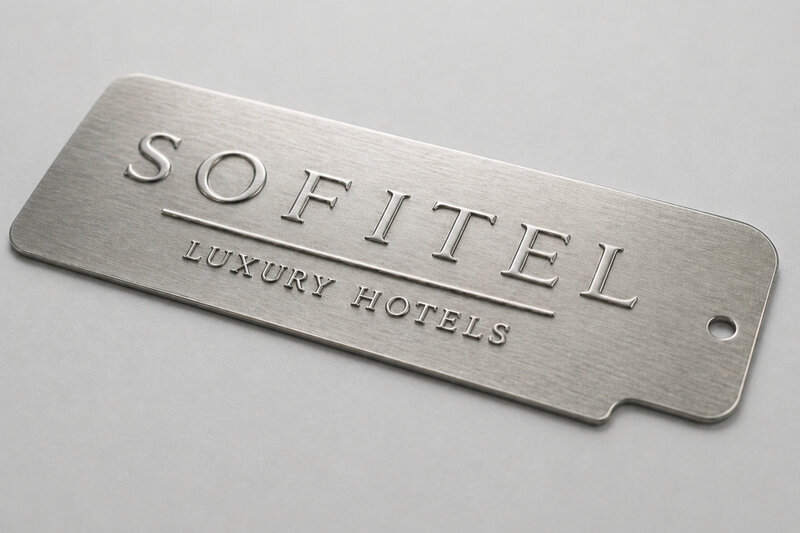
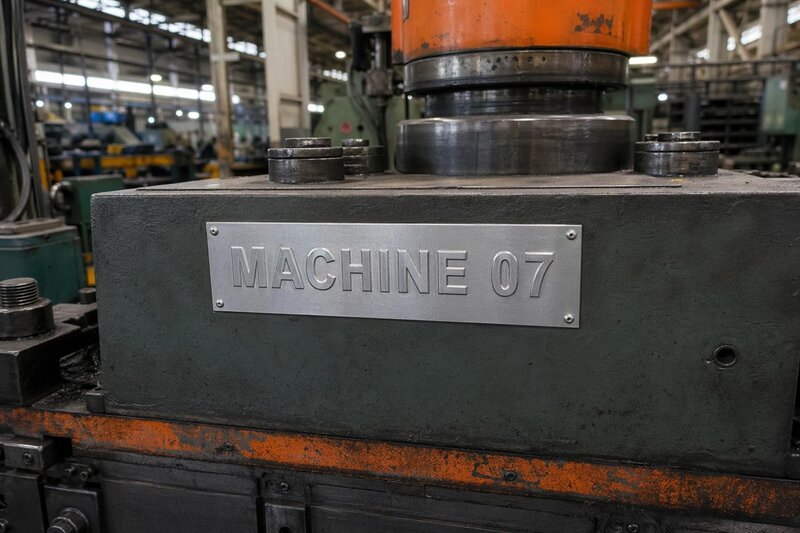
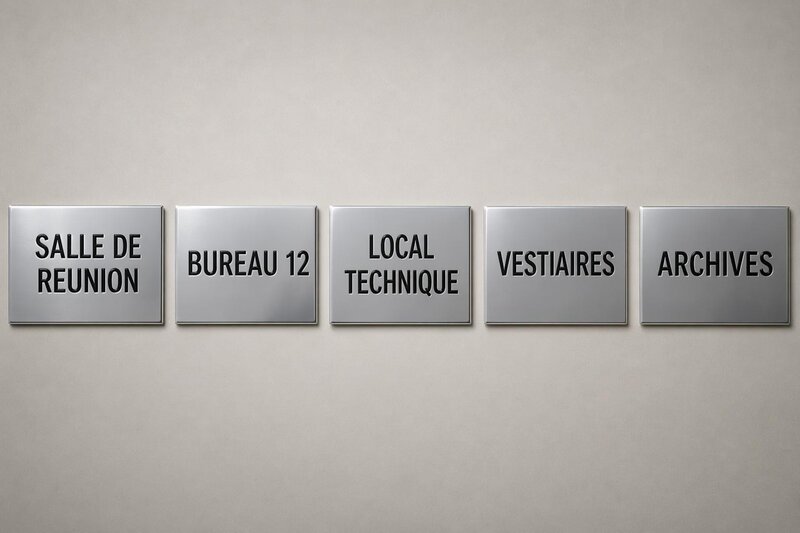

Premium industrial aesthetic. Anodised surface treatment ensures lasting corrosion resistance in demanding conditions.
Surface withstands harsh industrial contact including solvents, mild acids, oils, greases, and heavy-duty cleaning agents.
Matt or textured finish providing robust protection against impact, abrasion, and everyday wear in industrial settings.
Deep mechanical engraving by rotary cutting. Ideal for solid brass and aluminium where infilled painted lettering is required.
Text and graphics cut directly into the substrate (precision to 0.08 mm), producing a permanent, tamper-proof mark.
Suitable for prolonged outdoor exposure. Material and colours resist fading and degradation under direct sunlight.
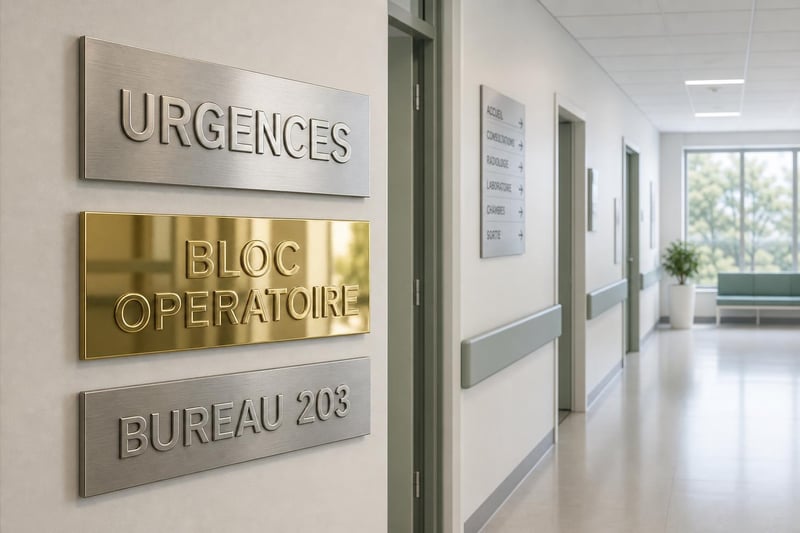
From industrial machinery identification to Braille plates in public access buildings, raised marking covers a wide range of uses with a single requirement: permanent legibility, without maintenance, in often demanding environments.
Manufacturer plates, hotel signage, accessible pictograms or safety marking: each application imposes its own constraints on substrate and relief depth, defined from the outset of the project design phase.
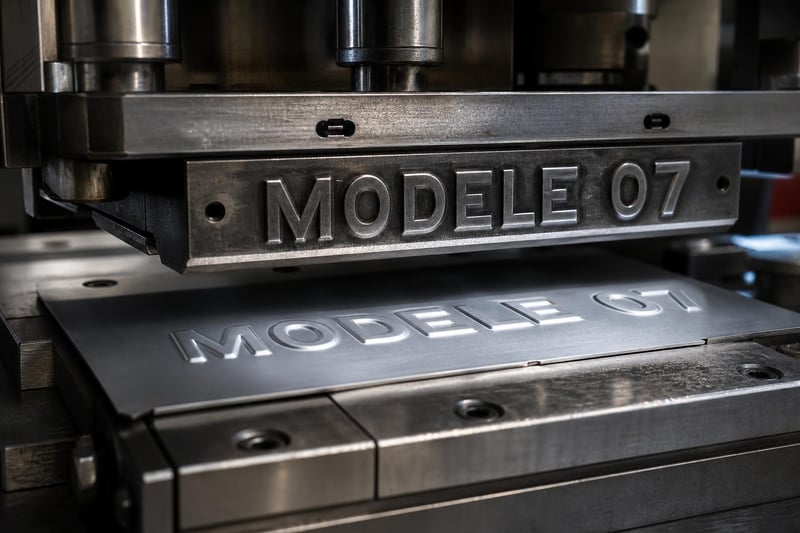
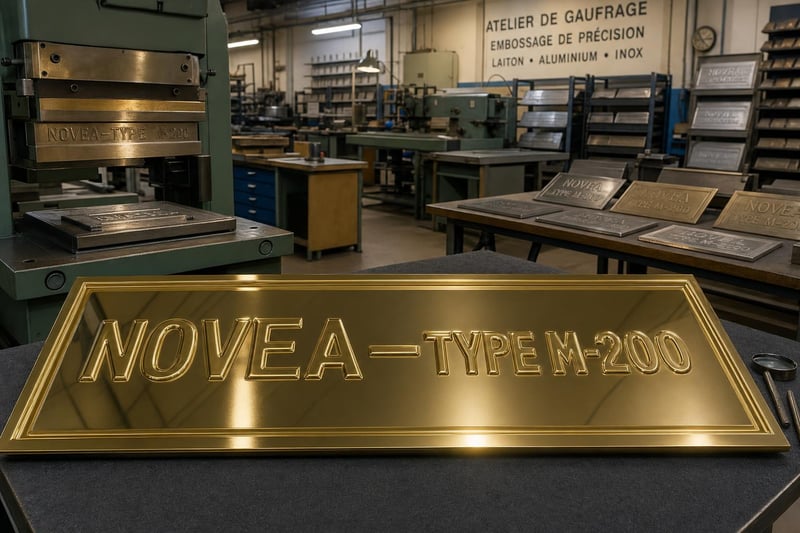
The plastic deformation of the substrate produces a relief that is inseparable from the material: it cannot peel away, cannot be erased by UV exposure or chemical products, and remains legible after years of intensive use.
Send us your plans or your specifications. Our design office analyses your requirements and sends you a bespoke commercial proposal within 4 to 8 working hours.
Embossing refers to the creation of a raised relief through mechanical deformation of the material, whilst debossing produces a recessed impression. The term raised marking encompasses both techniques depending on the sector. In every case, the principle is the same: a male die and a female counter-form compress the substrate to deform its structure without removing any material. The resulting marking is permanent by nature — it relies on no ink deposit or film that could degrade over time.
Aluminium, brass, stainless steel and engineering plastics are the most commonly used substrates. Each offers a different balance between mechanical resistance, chemical durability and aesthetic finish. The choice of substrate directly determines the achievable relief depth and the longevity of the marking in the intended installation environment.
Anodised aluminium combines low weight with UV resistance, making it the reference substrate for manufacturer plates and exterior signage. Brass offers a premium, naturally corrosion-resistant finish, favoured for door plates and hotel signage. Stainless steel is the material of choice in wet, chemical or high-temperature cleaning environments. Engineering plastics are suited to interior applications where weight and colour take precedence over mechanical resistance.
Industrial equipment must carry permanent, legible identification throughout its entire service life. Raised marking meets this requirement without maintenance: serial numbers, manufacturer references, safety warnings — the relief withstands vibration, impact and repeated chemical cleaning where printed marking would progressively fade.
Buildings open to the public are subject to requirements for tactile and universally legible signage under the Equality Act 2010. Embossing is the reference technique for Braille characters and raised pictograms: the relief is perceptible by touch and visible under raking light, without requiring colour contrast. This dual legibility is particularly valuable in dark or soiled environments.
Laser engraving is preferable for small one-off runs, very fine geometric designs or thin substrates that are difficult to deform without risk of tearing. Embossing is the right choice whenever tactile output is a functional requirement — Braille, accessible pictograms — or when the run size justifies investment in a reusable die. Both processes can be combined on a single plate to unite fine precision with a three-dimensional effect. In abrasive or chemical environments, embossing on metal offers a structural advantage: no recesses accumulate cleaning residues.
A precise vector file is the primary condition for a sharp relief that faithfully reproduces the original design. The substrate must be confirmed before the die is engraved, as each material requires specific deformation parameters. Once produced, the die is retained to allow identical repeat orders — an essential advantage for standardised equipment fleets where series reproducibility determines the consistency of marking across the entire installation. In sectors subject to audit, this documentary traceability is a requirement in its own right.
We consistently find that the most successful projects are those in which the choice of process and substrate is integrated from the design phase — before environmental constraints or permanent marking obligations narrow the available options. Anticipating these parameters from the outset is the surest way to guarantee legible, compliant marking throughout the service life of the equipment.