Get a quote
express 4h


Your sign in just 2 minutes.
Full editor: 27 materials, 219 colors, 12 mounting options
Marking: laser engraving, mechanical or printed
Get a mockup within 24 h
'%3e%3cg%20id='Vector'%20opacity='0.2'%20filter='url(%23filter0_f_0_480)'%3e%3cpath%20d='M4.97964%2012.6185L5.18373%2012.7392C6.04091%2013.2469%207.02374%2013.5155%208.02602%2013.5159H8.02812C11.1061%2013.5159%2013.6111%2011.0163%2013.6124%207.94404C13.6129%206.45525%2013.0326%205.05523%2011.9783%204.0021C11.4611%203.48272%2010.8459%203.07087%2010.1683%202.7904C9.49061%202.50993%208.76394%202.3664%208.03032%202.36812C4.94996%202.36812%202.44489%204.86748%202.44379%207.93957C2.44228%208.98861%202.73825%2010.0166%203.29751%2010.9048L3.43037%2011.1156L2.86613%2013.1715L4.97964%2012.6185ZM1.25294%2014.7643L2.20619%2011.2906C1.6183%2010.274%201.30901%209.12067%201.30938%207.93912C1.31093%204.2428%204.32472%201.23569%208.02822%201.23569C9.8254%201.2366%2011.5123%201.93465%2012.7809%203.20179C14.0496%204.46892%2014.7476%206.15321%2014.747%207.9445C14.7453%2011.6405%2011.7311%2014.6482%208.02812%2014.6482H8.0252C6.90083%2014.6477%205.796%2014.3662%204.81463%2013.8321L1.25294%2014.7643Z'%20fill='black'/%3e%3c/g%3e%3cpath%20id='Vector_2'%20d='M1.184%2014.6954L2.13725%2011.2217C1.54834%2010.2026%201.23901%209.04662%201.24043%207.87021C1.24199%204.1739%204.25578%201.16679%207.95927%201.16679C9.75646%201.1677%2011.4433%201.86575%2012.712%203.13288C13.9806%204.40002%2014.6787%206.08431%2014.678%207.87559C14.6764%2011.5716%2011.6621%2014.5793%207.95918%2014.5793H7.95626C6.83189%2014.5788%205.72706%2014.2973%204.74569%2013.7632L1.184%2014.6954Z'%20fill='white'/%3e%3cg%20id='Vector_3'%3e%3c/g%3e%3cpath%20id='Vector_4'%20d='M7.96128%202.29922C4.88092%202.29922%202.37586%204.79858%202.37476%207.87067C2.37324%208.9197%202.66922%209.94774%203.22847%2010.8359L3.36134%2011.0468L2.7971%2013.1027L4.91069%2012.5496L5.11478%2012.6703C5.97197%2013.178%206.9548%2013.4465%207.95708%2013.447H7.95918C11.0372%2013.447%2013.5422%2010.9474%2013.5434%207.87514C13.5457%207.14287%2013.4025%206.41742%2013.122%205.74078C12.8415%205.06414%2012.4293%204.44976%2011.9093%203.93319C11.3922%203.41381%2010.777%203.00195%2010.0993%202.72148C9.42161%202.44101%208.69492%202.29748%207.96128%202.29922Z'%20fill='url(%23paint0_linear_0_480)'/%3e%3cpath%20id='Vector_5'%20fill-rule='evenodd'%20clip-rule='evenodd'%20d='M6.27997%205.06772C6.15414%204.78873%206.02173%204.78308%205.9022%204.77825L5.5804%204.77433C5.46845%204.77433%205.28655%204.81626%205.13277%204.98396C4.979%205.15166%204.54516%205.55696%204.54516%206.38133C4.54516%207.20571%205.14674%208.00228%205.23057%208.1142C5.3144%208.22612%206.39193%209.97175%208.09835%2010.6434C9.51639%2011.2015%209.80495%2011.0905%2010.1129%2011.0626C10.4208%2011.0347%2011.1061%2010.6573%2011.2459%2010.266C11.3857%209.87477%2011.3858%209.53956%2011.3439%209.46947C11.302%209.39938%2011.19%209.35773%2011.022%209.27388C10.854%209.19003%2010.0288%208.78472%209.8749%208.72876C9.72103%208.6728%209.60917%208.64501%209.49712%208.8127C9.38508%208.9804%209.06374%209.35764%208.96576%209.46947C8.86777%209.5813%208.76997%209.59533%208.60195%209.51157C8.43393%209.42782%207.89334%209.25082%207.25194%208.68C6.7529%208.23587%206.41604%207.68739%206.31796%207.51978C6.21989%207.35217%206.30755%207.26139%206.39175%207.17791C6.46708%207.10281%206.55958%206.98223%206.64369%206.88443C6.72779%206.78664%206.75546%206.71673%206.81134%206.60509C6.86723%206.49344%206.83938%206.39537%206.79737%206.31161C6.75537%206.22785%206.42918%205.39911%206.27997%205.06772Z'%20fill='white'/%3e%3c/g%3e%3cdefs%3e%3cfilter%20id='filter0_f_0_480'%20x='-1.74706'%20y='-1.76431'%20width='19.494'%20height='19.5286'%20filterUnits='userSpaceOnUse'%20color-interpolation-filters='sRGB'%3e%3cfeFlood%20flood-opacity='0'%20result='BackgroundImageFix'/%3e%3cfeBlend%20mode='normal'%20in='SourceGraphic'%20in2='BackgroundImageFix'%20result='shape'/%3e%3cfeGaussianBlur%20stdDeviation='1.5'%20result='effect1_foregroundBlur_0_480'/%3e%3c/filter%3e%3clinearGradient%20id='paint0_linear_0_480'%20x1='7.8454'%20y1='2.96819'%20x2='7.9018'%20y2='12.4947'%20gradientUnits='userSpaceOnUse'%3e%3cstop%20stop-color='%2357D163'/%3e%3cstop%20offset='1'%20stop-color='%2323B33A'/%3e%3c/linearGradient%3e%3cclipPath%20id='clip0_0_480'%3e%3crect%20width='16'%20height='16'%20fill='white'/%3e%3c/clipPath%3e%3c/defs%3e%3c/svg%3e) On WhatsApp
On WhatsApp'%3e%3cg%20id='group'%3e%3cpath%20id='Vector'%20d='M1.36364%2015.0039H4.54546V7.2766L1.90735e-06%203.86751V13.6402C1.90735e-06%2014.3948%200.611365%2015.0039%201.36364%2015.0039Z'%20fill='%234285F4'/%3e%3cpath%20id='Vector_2'%20d='M15.4545%2015.0039H18.6364C19.3909%2015.0039%2020%2014.3925%2020%2013.6402V3.86751L15.4545%207.2766'%20fill='%2334A853'/%3e%3cpath%20id='Vector_3'%20d='M15.4545%201.36753V7.27661L20%203.86752V2.04934C20%200.36298%2018.075%20-0.598384%2016.7273%200.41298'%20fill='%23FBBC04'/%3e%3cpath%20id='Vector_4'%20d='M4.54545%207.2766V1.36751L10%205.45842L15.4545%201.36751V7.2766L10%2011.3675'%20fill='%23EA4335'/%3e%3cpath%20id='Vector_5'%20d='M1.90735e-06%202.04934V3.86752L4.54546%207.27661V1.36753L3.27273%200.41298C1.92273%20-0.598384%201.90735e-06%200.36298%201.90735e-06%202.04934Z'%20fill='%23C5221F'/%3e%3c/g%3e%3c/g%3e%3c/svg%3e) By Email
By Email

Dibond® is today one of the leading materials for bespoke professional signage. An aluminium composite panel (ACP) combining rigidity, lightweight construction and outstanding weather resistance, it is equally suited to durable external signage and premium office nameplates. At Otypo, we supply custom-cut Dibond panels, engraved and personalised to your requirements, delivering professional signage that truly reflects your brand.
Dibond® is an aluminium composite panel (ACP) manufactured by 3A Composites. Its structure consists of three distinct layers: two thin aluminium face sheets bonded to a solid polyethylene (PE) core. It is precisely this sandwich construction that gives Dibond its remarkable mechanical properties — high rigidity combined with a weight significantly lower than that of a solid aluminium sheet of equivalent thickness.
In professional signage, Dibond is commonly available in thicknesses of 2 mm, 3 mm and 4 mm. Otypo works primarily with 3 mm, a thickness that offers the best balance between rigidity, machinability and visual finish after engraving. As a guide, a 3 mm Dibond panel weighs approximately 3.8 kg/m², making it highly manageable during installation, even in larger formats.
The panel is perfectly flat and does not bow or warp, even at large dimensions. This impeccable flatness is a major advantage for large-format signage, fascia signs and information panels, where any distortion would immediately undermine a professional appearance.
One of Dibond®'s greatest strengths is its exceptional resistance to the elements. The material does not rust, withstands impact, temperature fluctuations and ultraviolet radiation. A Dibond panel installed on a building façade retains its flatness, colour and overall appearance for many years with no special maintenance required. This is why it is so widely used for corporate signage, professional practice nameplates and directional signs installed permanently outdoors.
For projects subject to fire regulations — public buildings, commercial premises — it is important to verify the fire classification of the Dibond® range being used. Certain specialist ranges, such as Dibond® FR (Fire Retardant), incorporate a fire-retardant core and can achieve a B-s1,d0 classification in accordance with EN 13501-1. Standard Dibond®, with its polyethylene core, does not meet these requirements and should be reserved for general applications where fire regulatory compliance is not required. Otypo can assist you with these checks during the design stage of your project.
At Otypo, Dibond panels are offered in two principal finishes, suited to different applications and visual identities.
The white finish is the most versatile option. Its lacquered surface provides a clean, bright background that allows engravings, text and pictograms to stand out clearly. White is particularly popular for interior signage (room identification, office nameplates, instruction panels) as well as for clean, professional external signs. The smooth surface of white Dibond allows for sharp, precise engraving with strong visual contrast between the background and the marking.
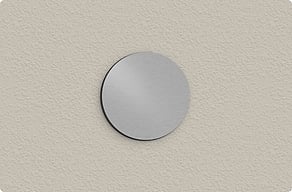
The brushed finish delivers an elegant metallic appearance, similar to brushed aluminium or stainless steel. It is ideally suited to environments seeking a premium, industrial or contemporary aesthetic: medical practices, professional offices, corporate headquarters, hotels and showrooms. Brushed Dibond is characterised by its distinctive directional sheen, which adds depth and texture to the panel even without deep engraving.
Engraving is the preferred personalisation technique for Dibond panels at Otypo. It involves mechanically machining the upper aluminium layer of the panel to inscribe text, logos, pictograms or numbering. The result is a recessed marking that is permanent and highly resistant to abrasion, scratching and weathering.
Unlike printed or self-adhesive marking, engraving will not peel, fade or deteriorate under the effects of UV exposure or moisture. It is an ideal solution for professional nameplates intended to remain in place for several years, particularly outdoors. Engraving on 3 mm Dibond produces clean, consistent line depth for a refined finish and excellent legibility at a distance.
Mechanical engraving on Dibond can reproduce a wide range of typefaces, vectorised logos, standard pictograms (accessibility, safety, evacuation) and sequential numbering for matching series of panels. Otypo produces each panel from your artwork file or brief, with rigorous quality control carried out before despatch.
Dibond can be cut and machined with precision, whether by saw, router or CNC. Otypo offers panels cut to your exact dimensions, with the option of rounded corners, custom shapes or integrated cut-outs (raised logos, pierced pictograms). This flexibility is a genuine advantage for bespoke signage projects that require a strong visual identity or careful architectural integration.
Drilling is also straightforward: Dibond accepts holes for screws, bolts or decorative standoffs without any risk of rust or edge weakening. This is an important consideration for panels installed outdoors, where the durability of fixing points is essential.
The lightweight nature of Dibond makes installation considerably easier, even for larger formats. Several fixing methods are compatible with this material, depending on the substrate, the architectural context and the desired finish.
Fixing with decorative standoffs is the most widely used method for professional Dibond panels. The standoffs — typically cylindrical, in aluminium or stainless steel — create a slight gap between the panel and the wall, producing a raised effect that is highly popular for entrance signs, practice nameplates and office signage. This system is straightforward to install and delivers a neat, polished result.
For an even cleaner finish, Dibond can be bonded directly to its substrate using high-performance double-sided tape or structural adhesives such as MS polymer or polyurethane, following thorough degreasing of both surfaces. This technique is particularly suited to interior panels mounted on smooth partitions, glazing or wall cladding. Rail or profile systems fixed to the back of the panel also allow for a concealed, removable installation.
Dibond® stands apart from other materials commonly used in signage through a combination of qualities rarely found in a single panel. Compared to solid aluminium sheet, it is significantly lighter for equivalent rigidity, simplifying logistics and installation. Compared to expanded PVC (Forex®), it offers far superior outdoor performance, greater rigidity and a considerably more premium appearance. Compared to acrylic or plastic materials, it is more resistant to impact and to significant thermal variation.
For businesses, associations, professional practices, public sector organisations and site managers seeking durable, attractive and maintenance-free external signage, Dibond is a particularly sound choice. At Otypo, every panel is made to measure, based on your dimensions and content, for signage perfectly tailored to your brand and your environment.