Get a quote
express 4h


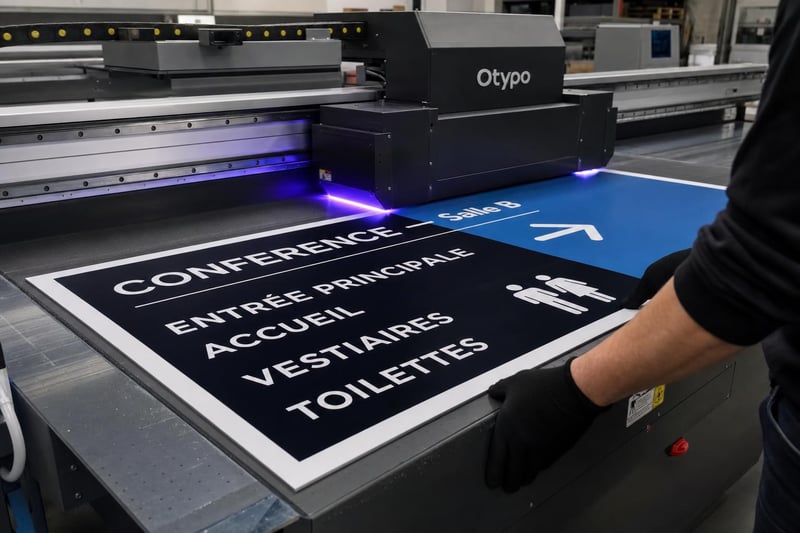
Full-colour CMYK printing with UV-cured inks, delivering photographic-quality output and vibrant, long-lasting colours.
Suitable for prolonged outdoor exposure. Material and colours resist fading and degradation under direct sunlight.
All-purpose material equally suited to smart interior signage and durable long-term outdoor display.
Precision cutting to the millimetre. Easily processed by laser, saw, or guillotine shear to suit your production requirements.
Matt or textured finish providing robust protection against impact, abrasion, and everyday wear in industrial settings.
Through-body pigmentation blocks light completely, ensuring maximum legibility with no translucency or bleed-through.
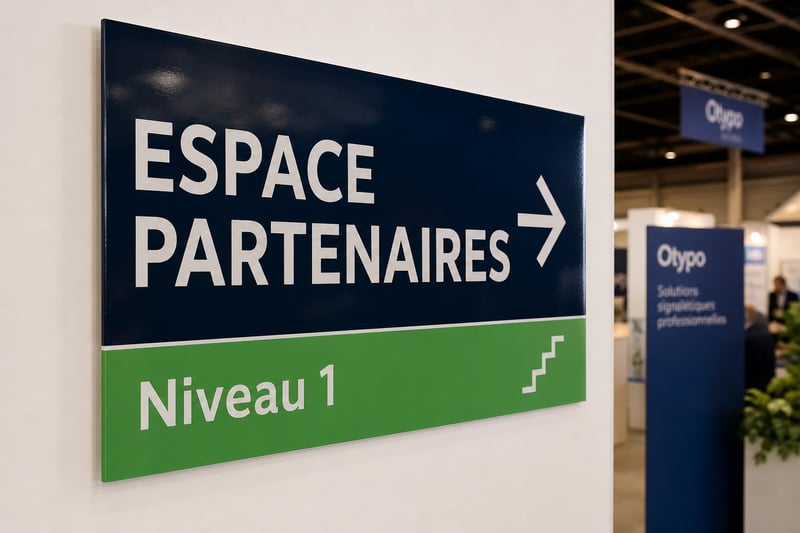
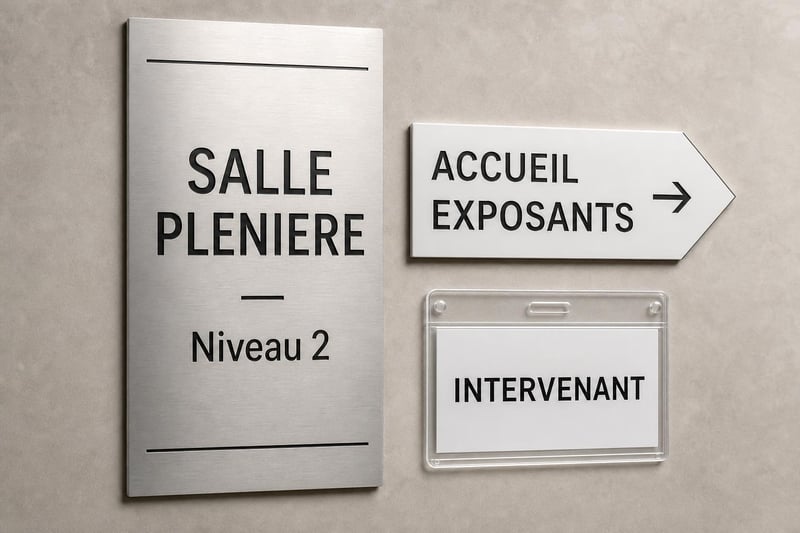
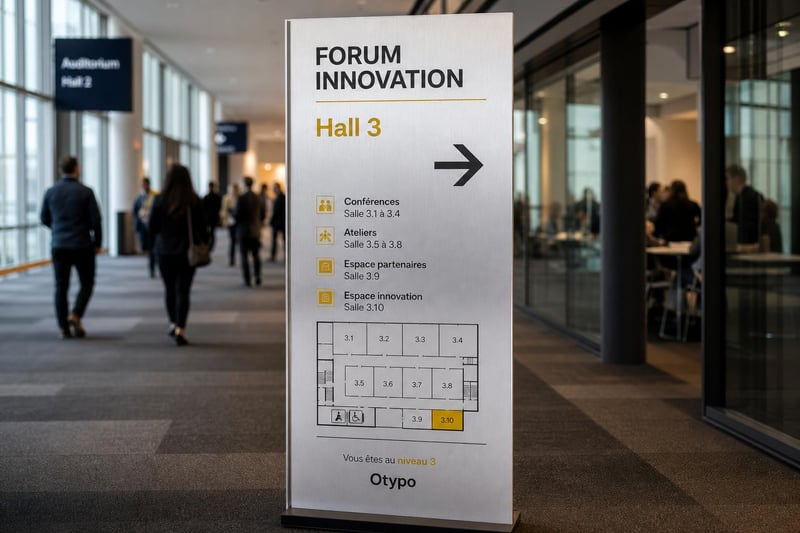
From car park wayfinding to stand displays, event signage structures the visitor experience at every stage. Trade shows, conferences, student forums, institutional ceremonies: each context calls for specific items — directional panels, welcome totems, speaker badges, room plates and programme displays.
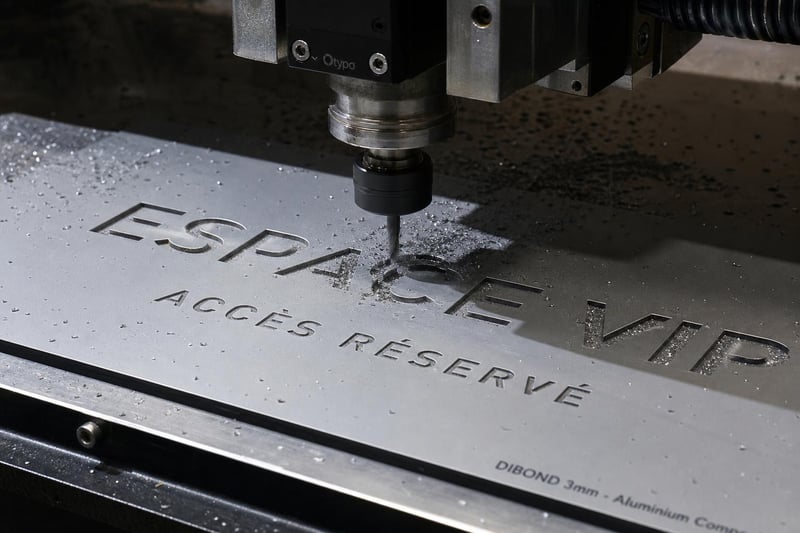
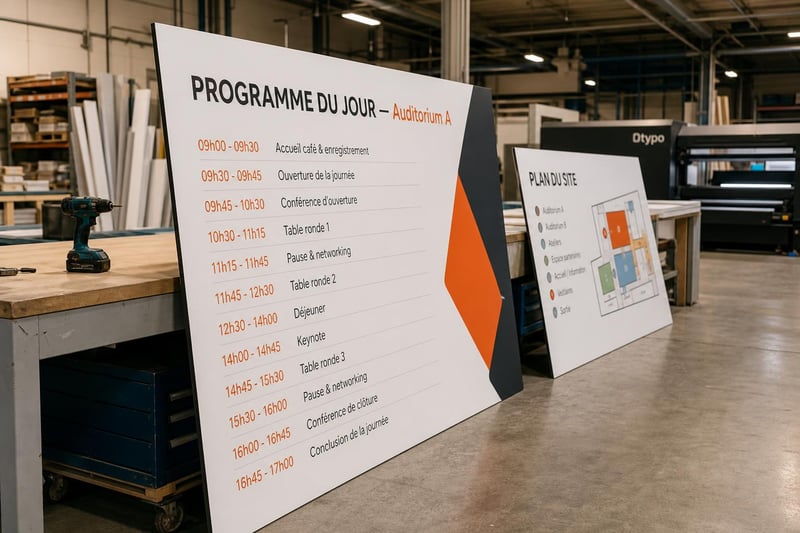
The choice of substrate and process directly determines on-site performance. UV printing, CNC routing and doming allow the finish to be tailored to the duration of use and exposure conditions, without compromising print quality.
Send us your plans or your specifications. Our design office analyses your requirements and sends you a bespoke commercial proposal within 4 to 8 working hours.
Effective event signage relies on a systems approach: each item fulfils a precise function within the visitor journey. Directional panels orient visitors from the moment they arrive on site, welcome totems identify key zones, room plates structure internal navigation, and badges distinguish speakers from general attendees. Designing these items in isolation generates visual inconsistencies and gaps in wayfinding — two pitfalls we regularly observe at events where signage has been split across multiple suppliers.
Achieving visual consistency between an event totem and a speaker badge is not straightforward. It requires the same colours, typefaces and visuals to be reproduced faithfully across very different substrates — rigid, flexible, matt, gloss. Direct UV printing on rigid materials and doming make it possible to reach this level of consistency on short runs, without resorting to offset printing processes that are costly and ill-suited to event volumes.
For temporary event wayfinding lasting a day or a weekend, corrugated PP meets the brief: lightweight, moisture-resistant, easy to fix to temporary structures and economically suited to single use. For items intended to travel across multiple events — totems, large-format directional panels, stand displays — aluminium composite is the natural choice, owing to its resistance to transport impacts, UV exposure and repeated assembly cycles. Expanded PVC occupies an intermediate position, appropriate for events lasting a few days to a few months where a high standard of print finish is required.
Open-air trade shows, industrial open days and marquee events impose constraints that indoor items never face: direct sunlight, humidity fluctuations, wind. UV-cured inks used in high-definition digital printing offer the colour stability required for these conditions, provided the substrate itself has been selected for outdoor use. A material without UV stabilisation can yellow or warp within a few weeks of exposure — a particularly significant risk for items reused across multiple seasons.
On a bespoke exhibition stand, every element contributes to the impression the visitor forms. PVC banner backdrops or aluminium composite panels, roller banners, floor graphics and CNC-routed totems form a visual ensemble that the exhibitor must control end to end. Custom-cut shapes — silhouettes, raised lettering, arches — allow a stand to stand out visually without relying on standardised modular systems that make exhibition spaces look uniform.
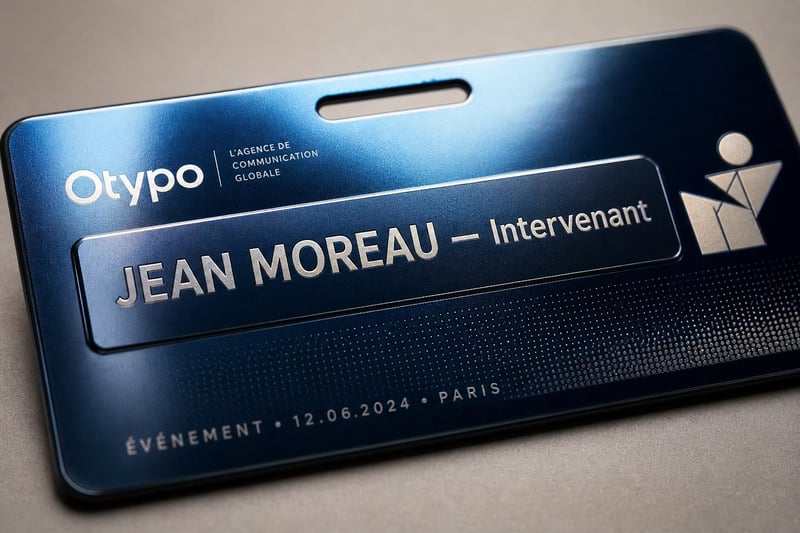
Doming applied to badges, stand logos and identification labels adds a raised relief and a level of protection that immediately distinguishes a well-crafted event item from a simple laminated print. This technique is particularly well suited to personalised short runs — named badges, exhibitor plates — where a premium finish must be reproducible per unit without additional set-up costs.
An effective event directional panel rests on three principles: a clear hierarchy of information, sufficient contrast for reading at distance, and rapid fixing to temporary structures. Best practice in the sector recommends limiting each panel to a maximum of three destinations to avoid cognitive overload. Full substrate opacity is critical in brightly lit environments — glazed exhibition halls, marquee spaces — where a translucent panel loses legibility against natural light.
Any space admitting members of the public, even temporarily, is subject to mandatory safety signage requirements under current UK regulations. Emergency exit markings, evacuation signs and restricted-area notices must comply with requirements regarding pictograms, standardised colours and legibility at distance — irrespective of the duration of the event. Incorporating these items from the outset of the signage plan avoids last-minute additions that undermine the overall visual coherence.
For recurring organisers — trade associations, federations, companies on roadshow tours — investing in durable items is an economically sound decision. The criteria to verify at the point of order are: resistance to transport impacts (aluminium composite or dense expanded PVC), compatibility of fixings with multiple structure types, and ease of flat storage. Having supported numerous organisers across multiple event cycles, we consistently find that the initial choice of substrate determines the actual service life of an item far more than its stated intended use.
Screwed fixings, reinforced eyelets and adjustable suspension systems facilitate reuse across different structures from one event to the next. An event totem designed with a removable ballast base and an aluminium composite upright can be reused across ten events without visible deterioration, provided the surface finish resists the abrasion of transport — which a scratch-resistant coating on exposed faces ensures.