Get a quote
express 4h


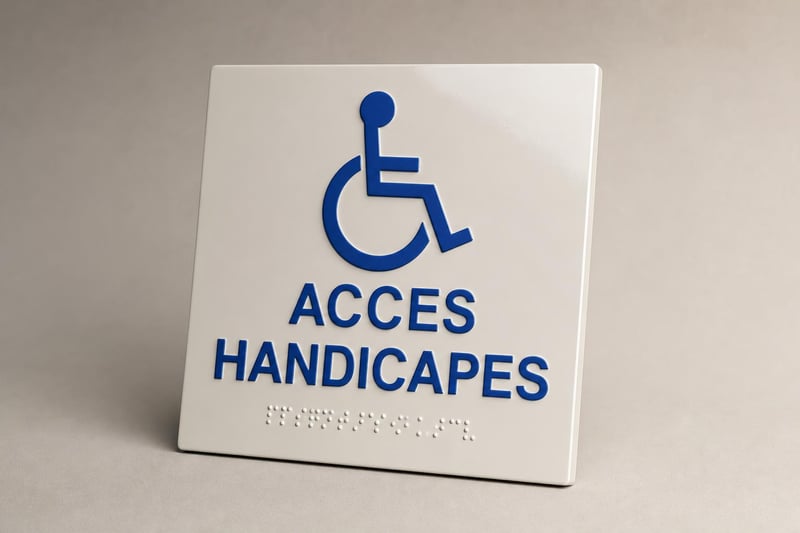
Premium acrylic engineered with a thin cap layer (0.05 mm) over a contrasting core, delivering sharp legibility and crisp engraved detail.
Suitable for prolonged outdoor exposure. Material and colours resist fading and degradation under direct sunlight.
Matt or textured finish providing robust protection against impact, abrasion, and everyday wear in industrial settings.
All-purpose material equally suited to smart interior signage and durable long-term outdoor display.
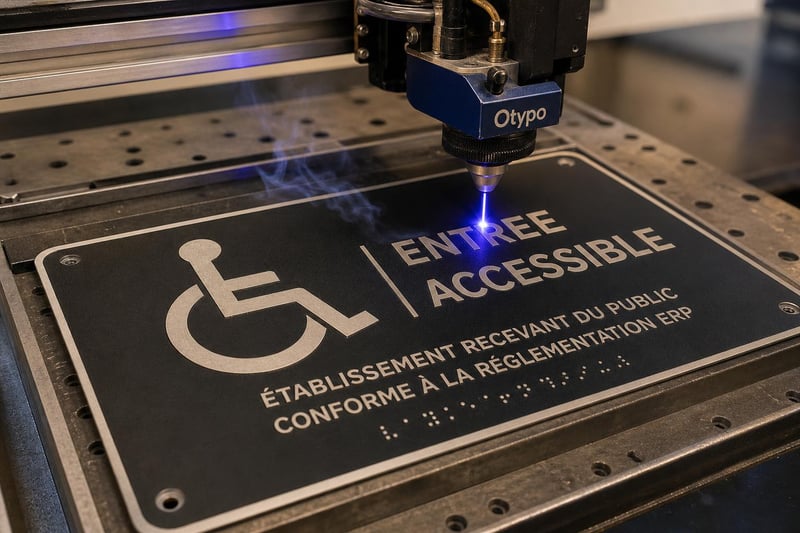
Text and graphics cut directly into the substrate (precision to 0.08 mm), producing a permanent, tamper-proof mark.
Full-colour CMYK printing with UV-cured inks, delivering photographic-quality output and vibrant, long-lasting colours.
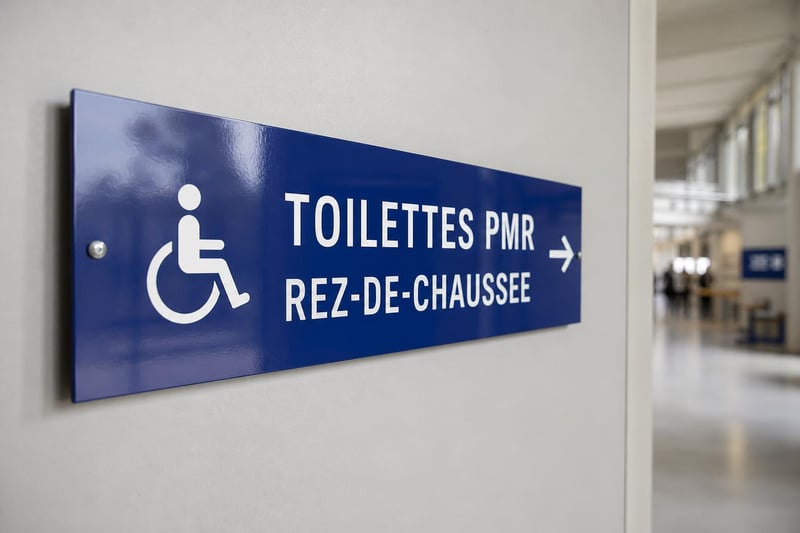
From accessible parking signage at the building entrance to interior door plates with pictograms, every zone of a public building requires an appropriate support. Local authorities, hospitality, healthcare, industry and transport: accessible marking obligations cover all spaces open to the public.
The durability of an accessibility sign depends directly on matching the chosen material to the constraints of the zone: UV exposure, moisture, cleaning frequency and the presence of raised Braille.
Send us your plans or your specifications. Our design office analyses your requirements and sends you a bespoke commercial proposal within 4 to 8 working hours.
An exterior accessibility sign is subject to conditions that interior environments do not encounter: ultraviolet radiation, freeze-thaw cycles, water run-off and significant temperature variation. Powder-coated or anodised aluminium meets these demands through its resistance to atmospheric corrosion and the long-term stability of its finishes. Indoors, expanded PVC offers a lightweight, easy-to-install option, while acrylic enables aesthetically refined door plates with an anti-glare finish that is particularly well suited to visually impaired users.
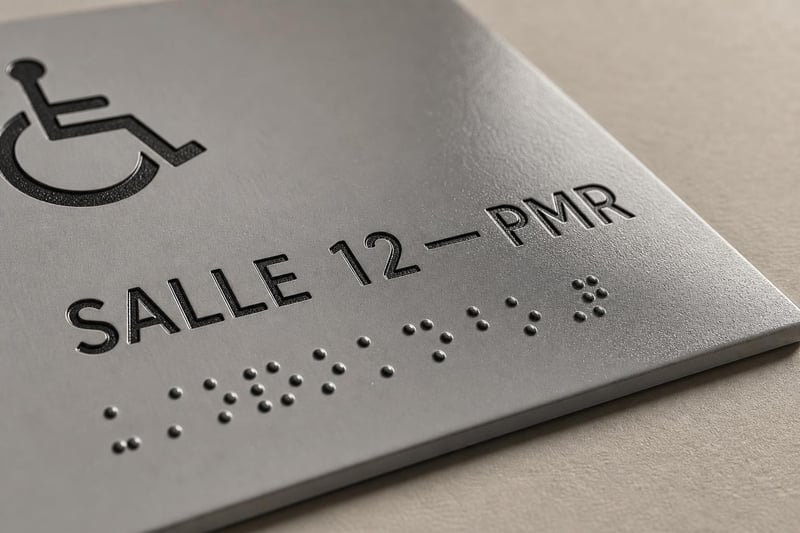
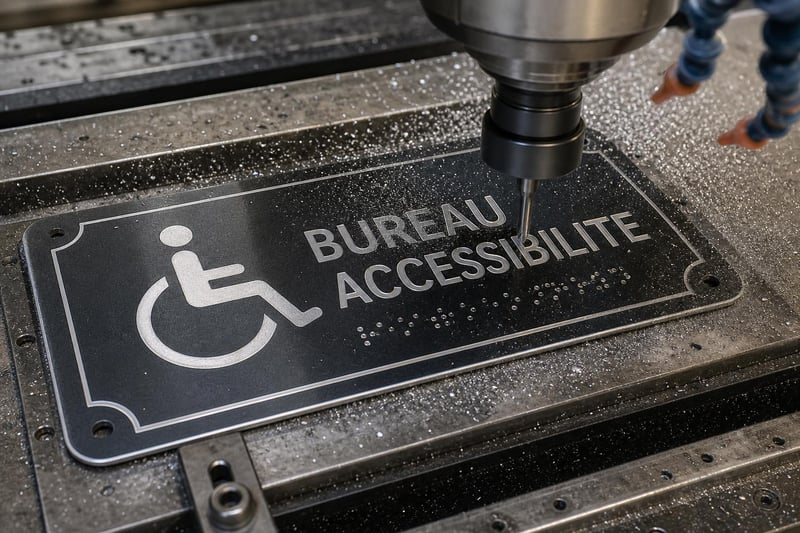
Engravable two-layer plastic is the benchmark material for any signage requiring tactile marking. Laser engraving cuts through the upper layer to reveal a contrasting base, producing pictograms and Braille in relief that remain clearly legible even without direct lighting. This marking is permanent: neither repeated cleaning nor mechanical wear affects the legibility of the support.
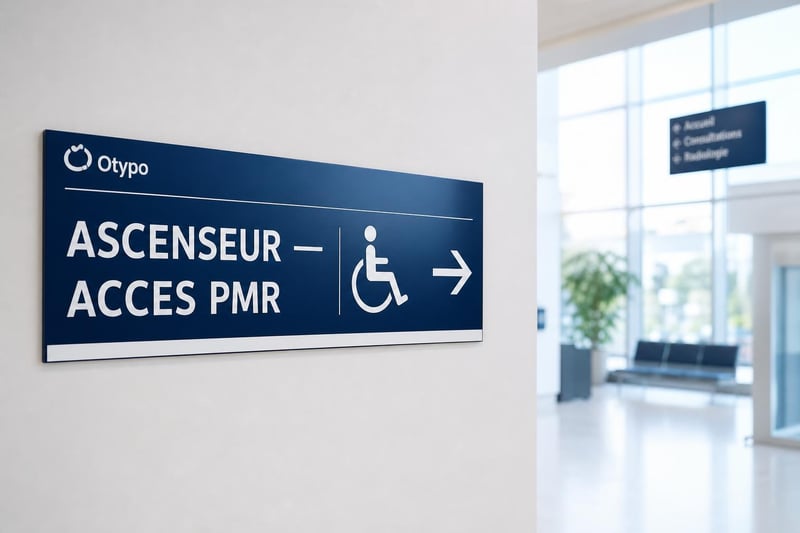
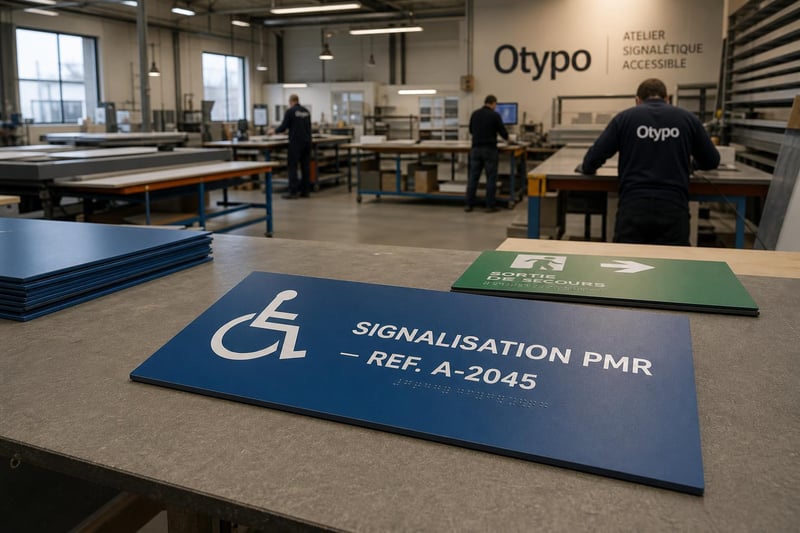
A structured accessible signage programme covers several categories of support. Entrance and parking signs direct visitors from the public realm; directional wayfinding guides users to adapted access points, ramps and service counters; door plates identify accessible toilets, lifts and meeting rooms; manifestation bands secure glazed partitions in circulation zones. Each type of support calls for a specific material and production process.
Programme consistency depends on uniformity of pictograms, colours and finishes between the exterior and interior series. Producing the entire programme with a single manufacturer ensures that colour references and graphic templates remain identical from one support to the next, even when materials vary according to the installation zone.
Laser engraving is the preferred process for Braille and raised pictograms on two-layer material: precision to a tenth of a millimetre, permanent marking and no risk of fading. UV-cured digital printing ensures colour accuracy for standardised pictograms on aluminium, acrylic or PVC, with high resistance to UV exposure and cleaning. CNC routing is used on thicker substrates requiring deep machining, in particular for solid aluminium sign plates intended for demanding environments.
The fixing of accessibility signs must be suited to the wall substrate: screw fixing with rawl plugs for concrete or masonry facades, high-strength double-sided adhesive for lightweight partitions, and retaining profiles for glazed surfaces. Custom manufacture to the exact format simplifies individual replacement without removing the surrounding signage. For maintenance, powder-coated aluminium and engravable two-layer materials tolerate standard cleaning agents; acrylic and PVC require solvent-free products to preserve surface integrity.
In local authorities and commercial buildings, programmes often involve large volumes with consistency requirements across multiple buildings. In industrial settings, chemical resistance and tolerance of aggressive cleaning regimes take precedence over aesthetics. The hospitality sector favours acrylic door plates for the refined appearance they bring to public areas. In healthcare, material compatibility with disinfection protocols is a non-negotiable selection criterion. The most successful programmes are those where material choices are confirmed at the outset, taking into account all usage constraints specific to each zone and in compliance with the Equality Act 2010.
Entrusting a complete accessibility signage programme to a single manufacturer simplifies project management, reduces the risk of visual inconsistency and facilitates repeat orders during phased compliance upgrades. Industry best practice recommends defining a signage specification before placing any order, so that every support produced integrates naturally into the overall scheme, regardless of the zone in question.