Get a quote
express 4h


Suitable for prolonged outdoor exposure. Material and colours resist fading and degradation under direct sunlight.
Surface withstands harsh industrial contact including solvents, mild acids, oils, greases, and heavy-duty cleaning agents.
Designed for demanding environments. Thermal integrity guaranteed from -40°C to +80°C with no warping or distortion.
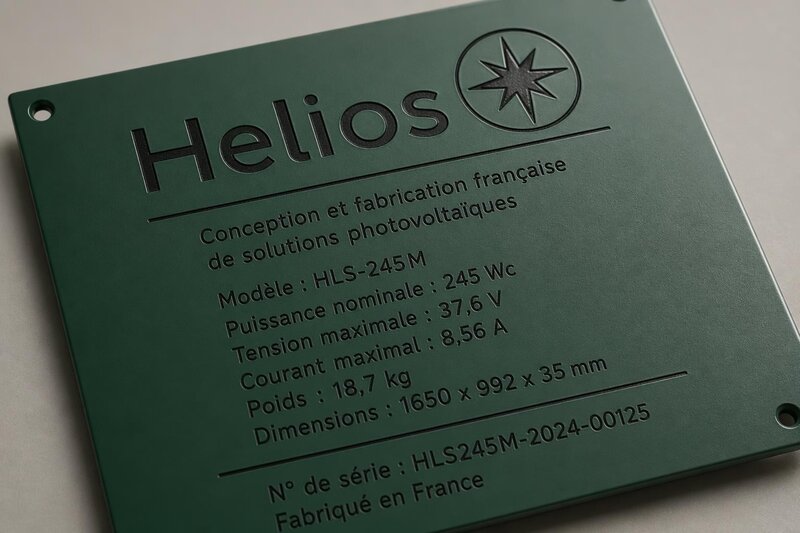
Deep mechanical engraving by rotary cutting. Ideal for solid brass and aluminium where infilled painted lettering is required.
Text and graphics cut directly into the substrate (precision to 0.08 mm), producing a permanent, tamper-proof mark.
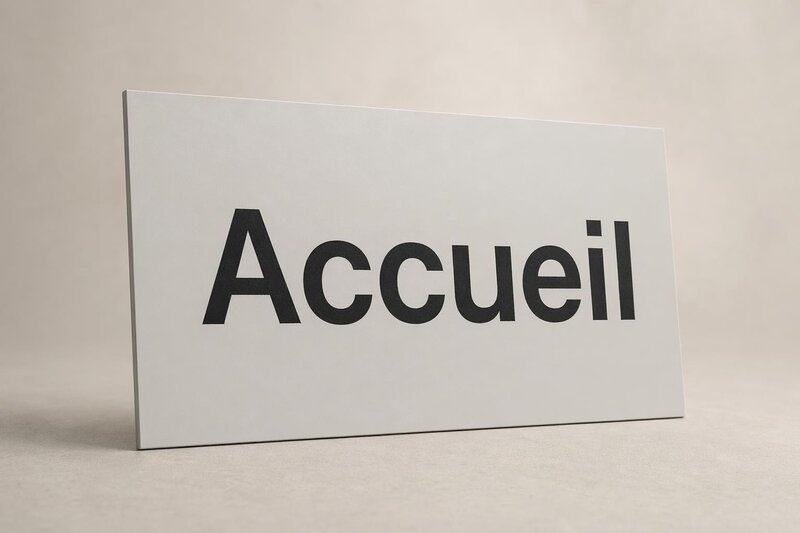
All-purpose material equally suited to smart interior signage and durable long-term outdoor display.
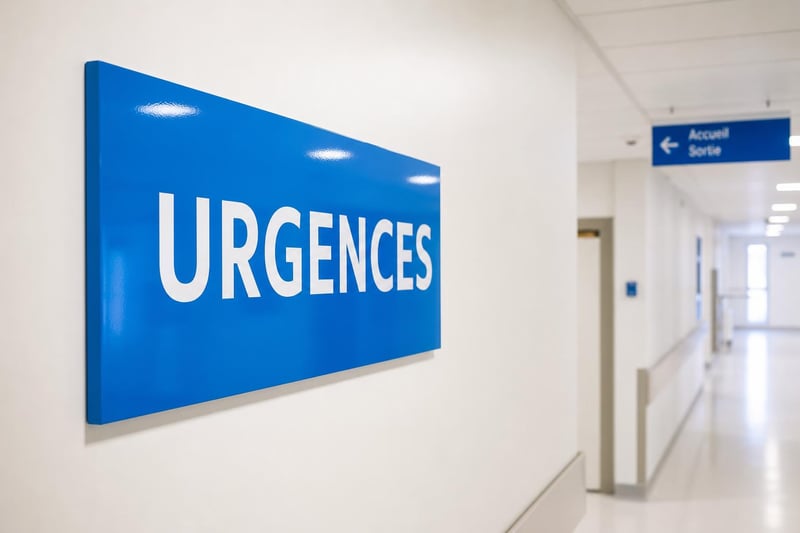
From machine and electrical enclosure marking in industrial environments to façade signage for public bodies, powder coating is the preferred choice wherever surface durability is a selection criterion.
Petrochemical, food production, hospitality and retail: every sector finds a solution suited to its exposure, maintenance and identification requirements.
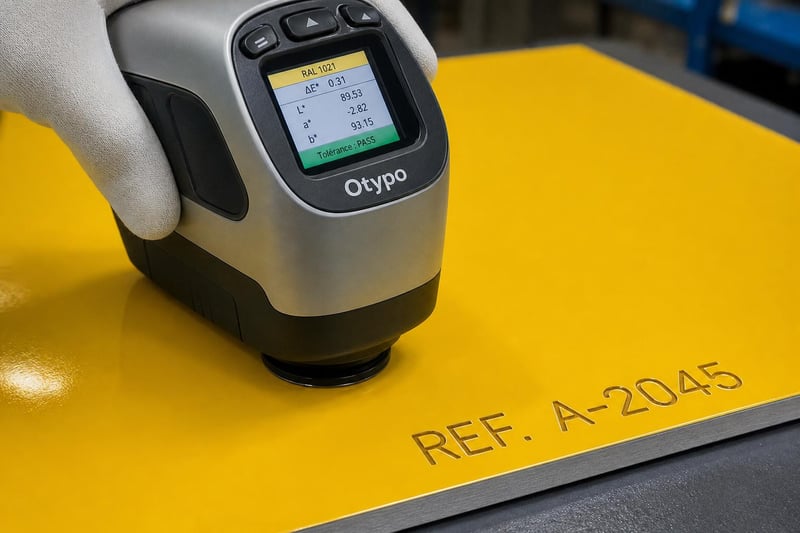
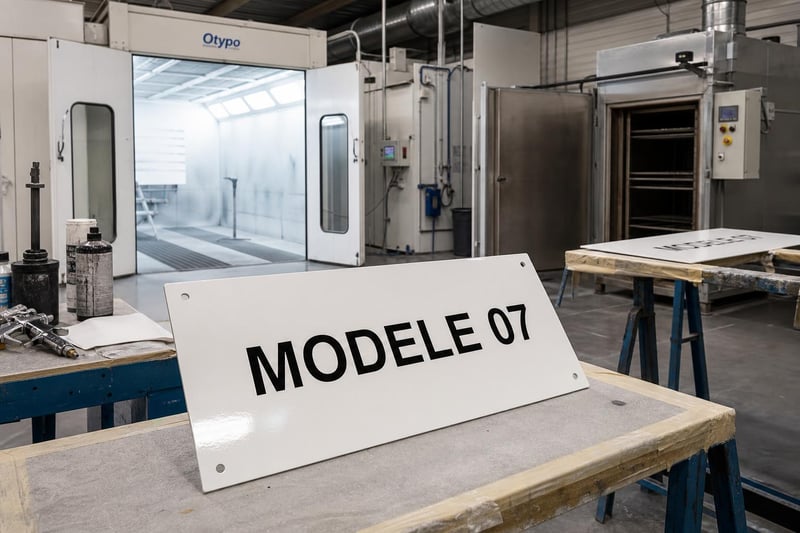
A continuous, pore-free coating film protects the metal substrate from moisture, common solvents and thermal cycling. The chosen finish directly affects marking legibility depending on lighting conditions and viewing angle.
Send us your plans or your specifications. Our design office analyses your requirements and sends you a bespoke commercial proposal within 4 to 8 working hours.
Liquid polyurethane or acrylic coating is applied in a spray booth to parts of varied shapes, including complex geometries. It is particularly suited to small and medium production runs, assembled components and composite substrates. Polyester powder coating, applied electrostatically and then cured in an oven, delivers a highly uniform film on aluminium and steel. It is preferred for larger volumes and demanding outdoor performance requirements.
For decorative or hospitality interiors, a matt or satin acrylic coating is sufficient. Outdoors or in industrial environments, a two-component system with an epoxy primer and polyurethane topcoat meets the anti-corrosion protection best practices recognised in sector specifications. The choice of system directly determines maintenance frequency and the duration of marking compliance.
The quality of an industrial coating depends as much on preparation as on the product applied. Thorough degreasing followed by a chemical treatment suited to the substrate — chromate conversion or anodising for aluminium, phosphating for steel — creates the conditions for lasting adhesion. Without this step, the film may delaminate prematurely under the effect of thermal cycling or moisture.
Dry film thickness measurement, carried out by electromagnetic gauge, is a documented step that allows marking compliance to be demonstrated during audits. Quality and HSE managers validating sector specifications find in this traceability a concrete selection argument. We regularly observe that it is precisely this rigour in preparation that distinguishes a durable coating from one that deteriorates within the first year of service.
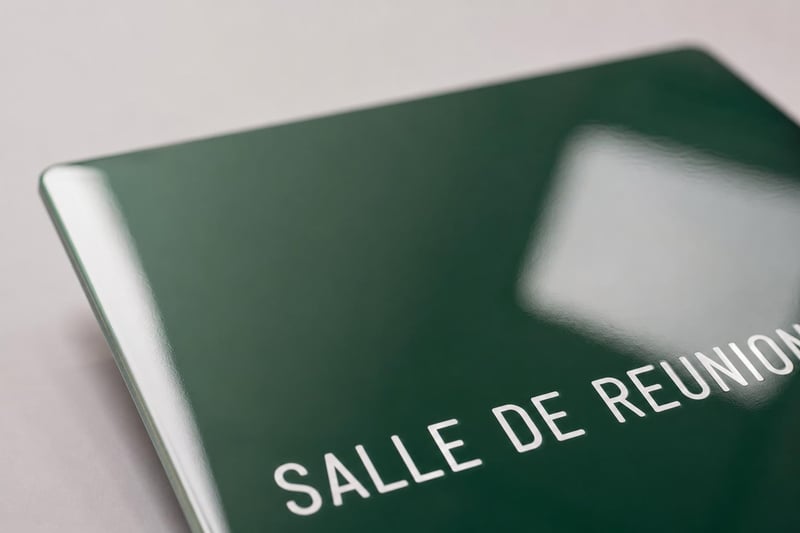
A matt finish absorbs light and eliminates unwanted reflections — it is preferred in safety, medical or high-intensity raking light environments. A satin finish offers a balance between legibility and UV resistance, making it the reference for outdoor and industrial signage. A gloss finish maximises visual impact but generates reflections that can impair legibility under variable lighting conditions.
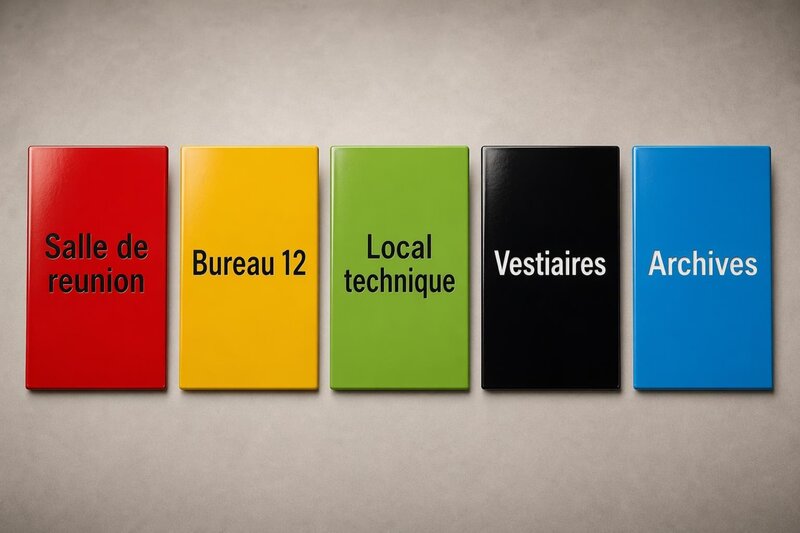
Beyond standard gloss levels, metallic, textured or custom RAL-tinted finishes allow signage to be aligned with a corporate identity or the visual codes of an architectural environment. These options are particularly sought after in high-end hospitality, retail and public spaces where surface quality is a selection criterion in its own right.
A coated surface is a first-rate marking substrate. Laser engraving on a coated base reveals the substrate or a contrasting layer beneath, producing a permanent, high-contrast marking that is resistant to abrasion and industrial cleaning agents. UV printing adheres to a prepared coated surface without altering the base, enabling full-colour reproduction on equipment identification plates. Screen printing on powder coated panels is a proven combination for large runs of directional signage.
Having supported hundreds of industrial signage projects, we observe that the consistency between the coated base and the applied marking is directly linked to control of the entire production cycle in one location. Cutting, coating, engraving and assembly carried out without transferring parts between suppliers guarantees uniformity of finish and complete traceability of the manufacturing record.
Coated surfaces should be cleaned with neutral or mildly alkaline cleaners applied with a non-abrasive cloth. Strong solvents, concentrated acids and abrasive pads must be avoided — they attack the film and expose the substrate to corrosion. In food production environments, chlorinated disinfectants should be rinsed off promptly to preserve the long-term integrity of the coating.
An ageing coating first shows a loss of gloss, followed by a whitish haze or surface chalking — signs of progressive UV degradation. A finish protected from direct UV exposure, installed away from repeated condensation and regularly maintained, retains its properties well beyond its expected service life. Assessing total cost of ownership consistently leads to specifying a quality coating system, which reduces the frequency of signage element replacement and simplifies on-site document management.