Get a quote
express 4h


Suitable for prolonged outdoor exposure. Material and colours resist fading and degradation under direct sunlight.
Designed for demanding environments. Thermal integrity guaranteed from -40°C to +80°C with no warping or distortion.
Matt or textured finish providing robust protection against impact, abrasion, and everyday wear in industrial settings.
Surface withstands harsh industrial contact including solvents, mild acids, oils, greases, and heavy-duty cleaning agents.
Full-colour CMYK printing with UV-cured inks, delivering photographic-quality output and vibrant, long-lasting colours.
All-purpose material equally suited to smart interior signage and durable long-term outdoor display.
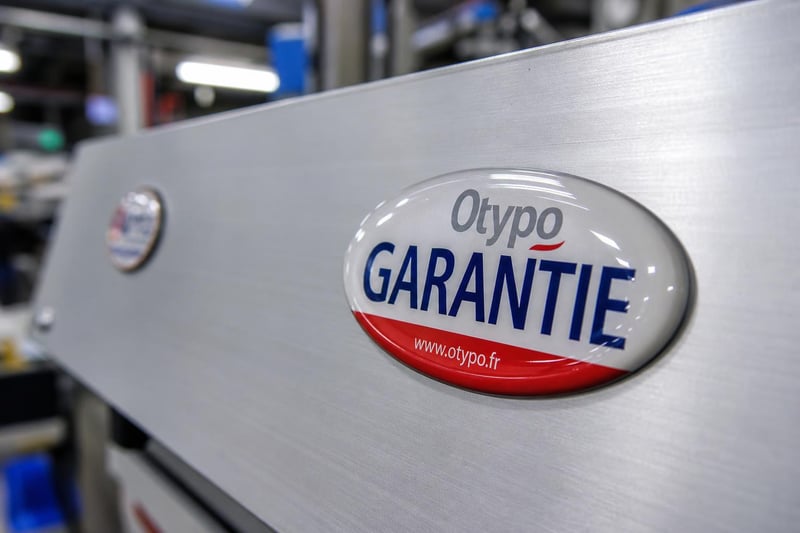
From hotel staff badges to industrial machine identification plates, the resin dome finish integrates wherever marking must remain legible, protected and visually refined. Construction, transport, food manufacturing, events: every sector finds a practical answer to its on-site constraints.
In industry, the resin protects traceability labels subject to repeated handling. In office and retail environments, it enhances badges and point-of-sale displays with an immediately premium finish.
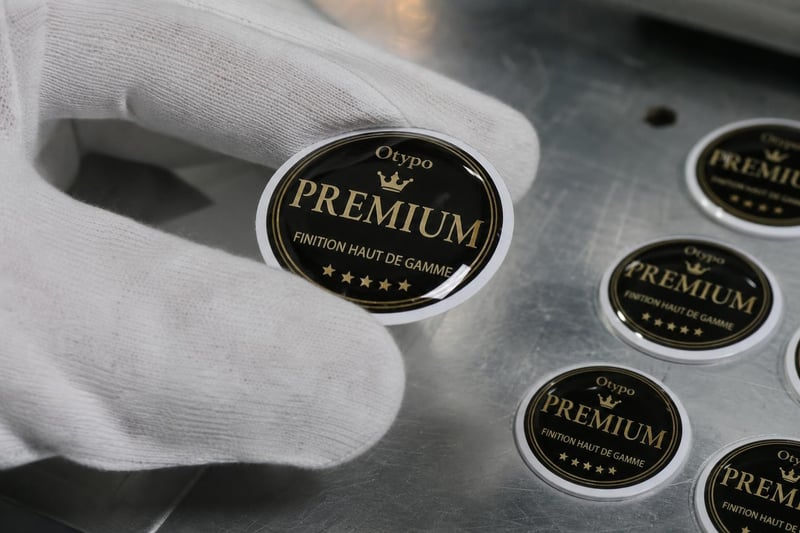
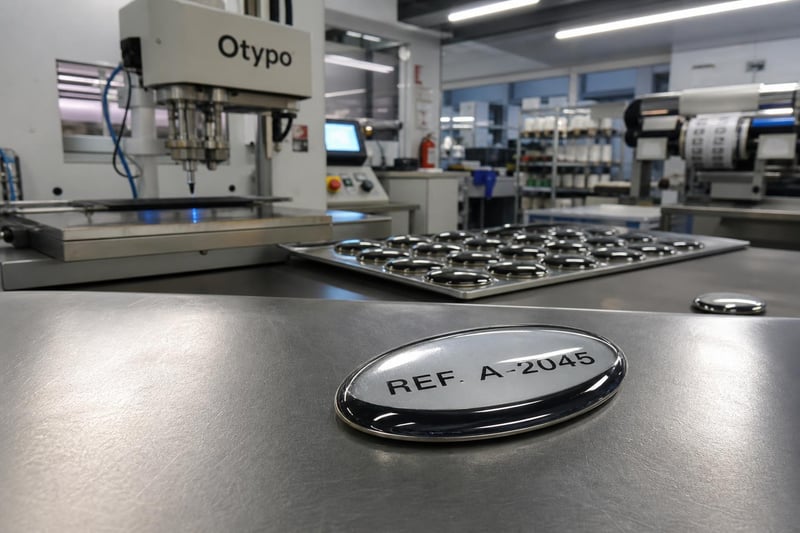
The two-component polyurethane resin forms a continuous physical barrier over the print. It absorbs friction, blocks moisture and filters UV without altering the original artwork.
Send us your plans or your specifications. Our design office analyses your requirements and sends you a bespoke commercial proposal within 4 to 8 working hours.
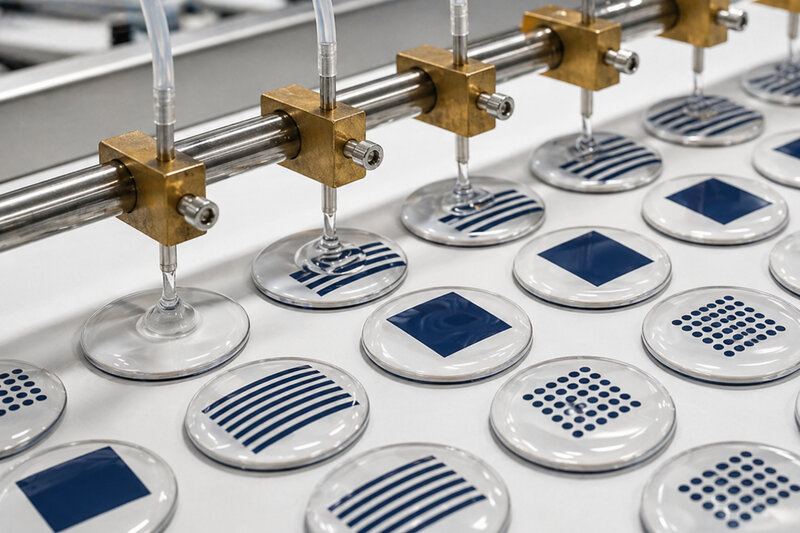
The resin dome finish is based on depositing a clear polyurethane resin in liquid form onto a four-colour printed self-adhesive substrate. Through surface tension, the resin stabilises to form a convex, glossy dome without requiring a mould. Two variants exist: the two-component resin with controlled curing, the most widely used in industrial signage, and UV-cured resin, used for higher production throughput. In both cases, the dome finish does not replace the print — it protects and enhances it by adding a functional layer over the existing artwork.
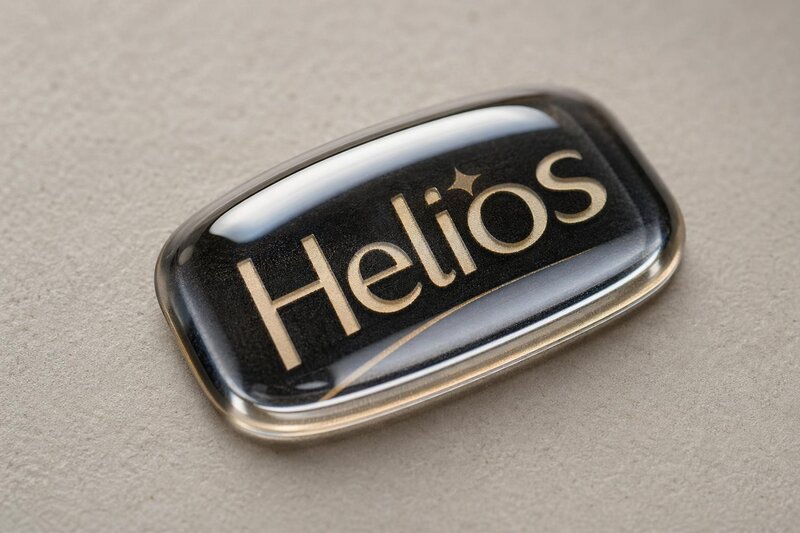
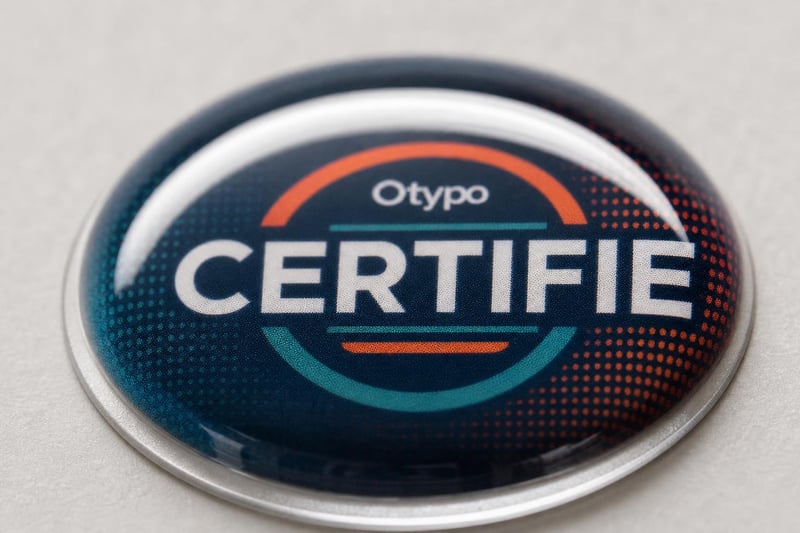
The transparency and curvature of the resin create a magnifying lens effect that accentuates the saturation of printed colours and improves marking legibility. This effect is not a graphic artifice: it results directly from the refractive index of the polyurethane resin. The original artwork is not retouched — the resin amplifies what is already printed.
Polyurethane resin forms a continuous elastomeric surface that absorbs minor impacts, resists friction and blocks moisture from penetrating to the underlying print. This layer protects pigments from UV-induced fading, which significantly extends the legibility of outdoor dome marking. The thermal operating range covers the most demanding environments, from refrigerated workshops to surfaces exposed to direct sunlight.
The resin withstands light oils, greases, standard detergents and repeated water-based cleaning. We consistently find that this chemical resistance is sufficient for the vast majority of industrial and commercial environments. For highly aggressive agents — concentrated solvents, strong acids, high-frequency disinfection protocols — sample validation remains best practice before any production run.
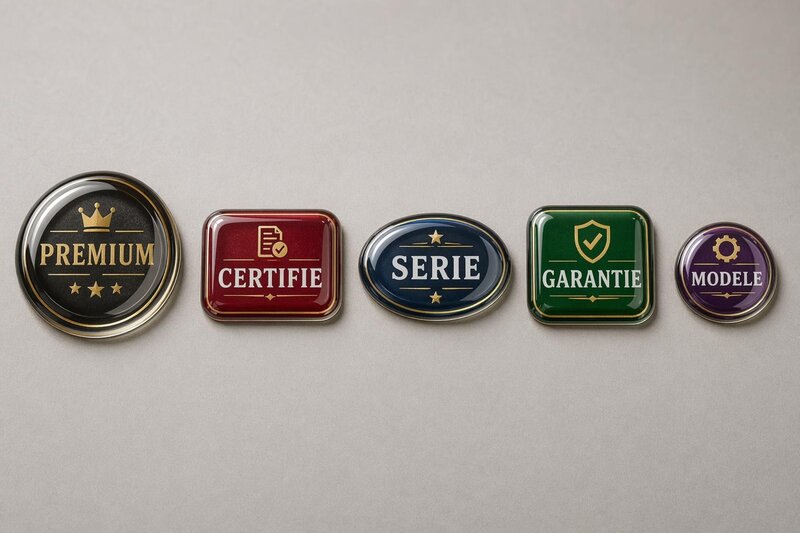
In manufacturing and automotive industries, industrial signage dome labels are used on machine logos, manufacturer plates and identification labels subject to repeated handling. In hospitality and the luxury sector, the raised, glossy effect delivers an immediately high-end finish on reception badges and point-of-sale displays. In construction and transport, fleet logos and equipment plates benefit from the resin's weather resistance to remain legible in real outdoor conditions.
The smooth, continuous surface of the resin does not trap dirt and facilitates periodic visual inspections. These properties meet the requirements of environments subject to frequent cleaning and regular audits, where permanent marking legibility is an operational obligation rather than an option.
Regulatory requirements in many professional environments — including those governed by the Health and Safety at Work etc. Act 1974 and sector-specific BS EN standards — stipulate that safety markings, equipment identification plates and traceability labels must remain legible and compliant over time. Degraded marking — faded, detached or illegible — constitutes a documented non-conformance during a quality audit or risk assessment. Polyurethane resin reduces this risk by protecting the artwork from the mechanical, chemical and environmental degradation that would compromise the compliance of the substrate.
The polyurethane resin dome is the natural choice when the specification combines visual enhancement of the logo, outdoor or wet-environment use, and a need for reinforced mechanical protection. Laser engraving remains preferable for permanent marking on solid metal without a self-adhesive substrate. Direct UV printing is better suited to large rigid surfaces where raised relief is not required. Screen printing is the right option for very high volumes with opaque colours and full coverage. These processes are complementary: having supported hundreds of professional marking projects, we find that resin doming occupies a distinct position whenever durability and visual identity are simultaneous requirements.