Get a quote
express 4h


Suitable for prolonged outdoor exposure. Material and colours resist fading and degradation under direct sunlight.
Surface withstands harsh industrial contact including solvents, mild acids, oils, greases, and heavy-duty cleaning agents.
Through-body pigmentation blocks light completely, ensuring maximum legibility with no translucency or bleed-through.
Matt or textured finish providing robust protection against impact, abrasion, and everyday wear in industrial settings.
All-purpose material equally suited to smart interior signage and durable long-term outdoor display.
Precision cutting to the millimetre. Easily processed by laser, saw, or guillotine shear to suit your production requirements.
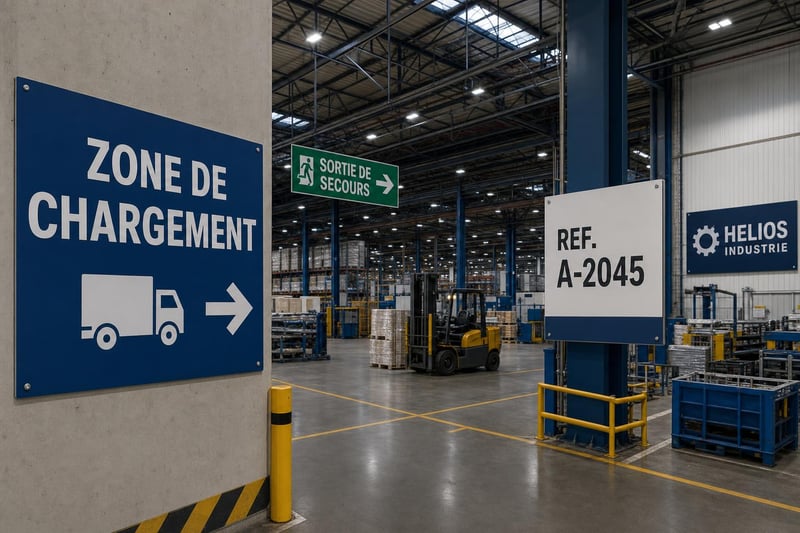
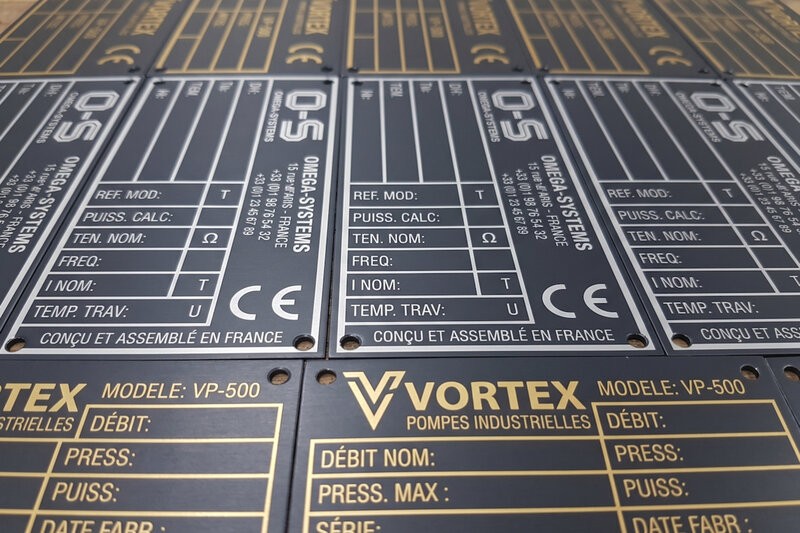
From electrical enclosure fascias to manufacturer's plates on industrial machinery, screen printing meets the requirements for permanent marking in energy, food processing, transport, and public buildings. A process suited to recurring production runs where visual consistency between batches is a firm requirement.
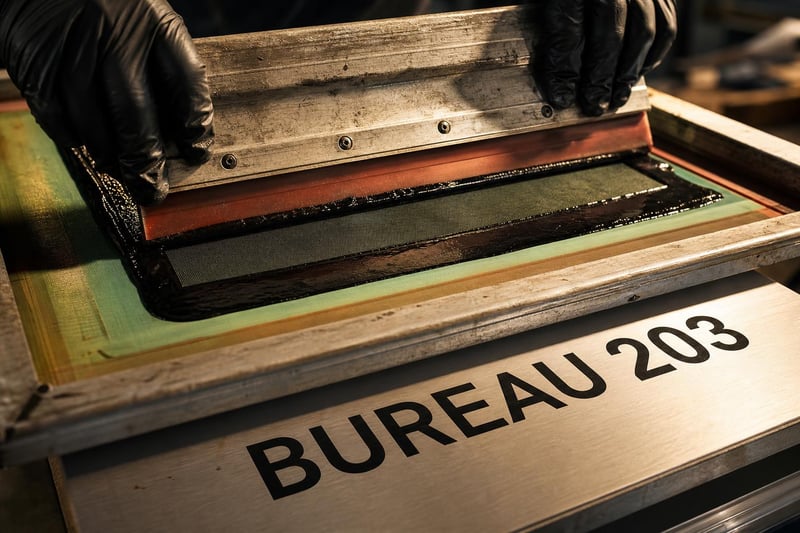
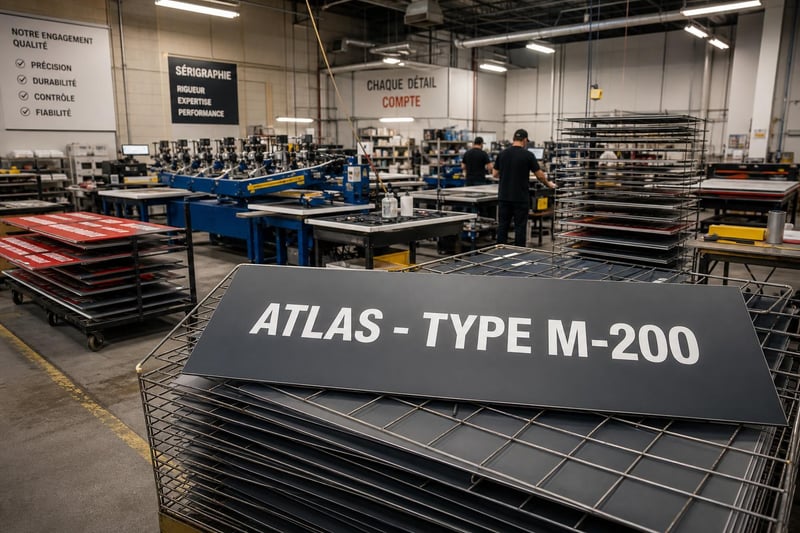
Industrial screen printing deposits a dense ink film that covers dark or metallic substrates uniformly, withstands repeated contact, and retains its colours without drift over time. A decisive advantage in environments where permanent legibility is a requirement.
Send us your plans or your specifications. Our design office analyses your requirements and sends you a bespoke commercial proposal within 4 to 8 working hours.
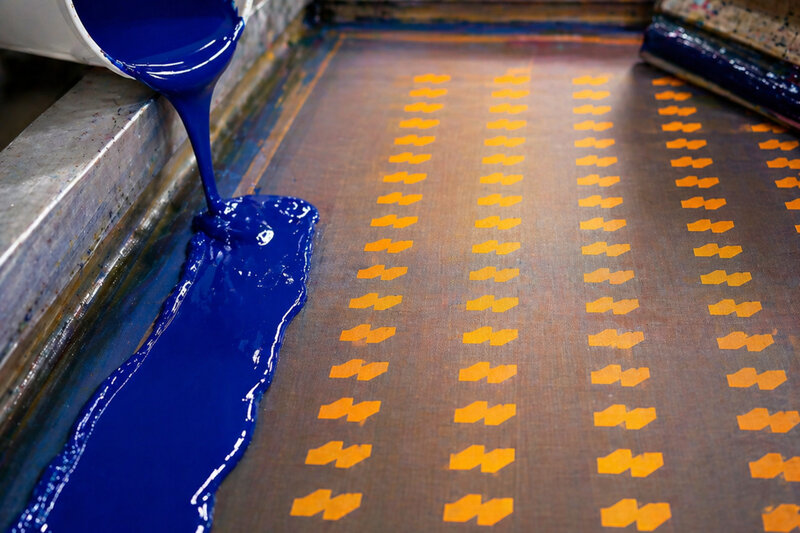
Industrial screen printing is not simply one printing technique among many. It involves forcing a viscous ink through a tensioned mesh screen, depositing onto the substrate an ink film whose thickness has no equivalent in digital printing or thermal transfer. This dense deposit gives the marking full opacity, perfectly uniform solid areas, and increased mechanical resistance to abrasion, repeated contact, and the harsh conditions of industrial environments. We consistently find that it is precisely this ink film thickness that makes the difference on equipment subjected to daily cleaning or continuous vibration.
The choice of ink directly determines how well the marking holds up over time. Solvent-based inks offer high adhesion on plastic substrates and chemical resistance suited to petrochemical and heavy maintenance environments. UV-cured inks, hardened by exposure to ultraviolet light, provide increased resistance to solar UV and alkaline cleaning agents, making them particularly well suited to outdoor signage and food processing and pharmaceutical sectors. In both cases, the formulation is selected according to the substrate and actual conditions of use, not from a generic catalogue.
Screen printing on industrial panels becomes relevant as soon as the same artwork must be reproduced identically across a medium to large run. The screen is a physical production tool: once prepared, it guarantees absolute reproducibility without digital recalibration between prints. This is a decisive advantage for maintenance managers overseeing equipment fleets renewed in phases, who cannot afford colour drift between orders placed several months apart. Digital printing remains the appropriate solution for one-off pieces, very short runs, or artwork with significant photographic content.
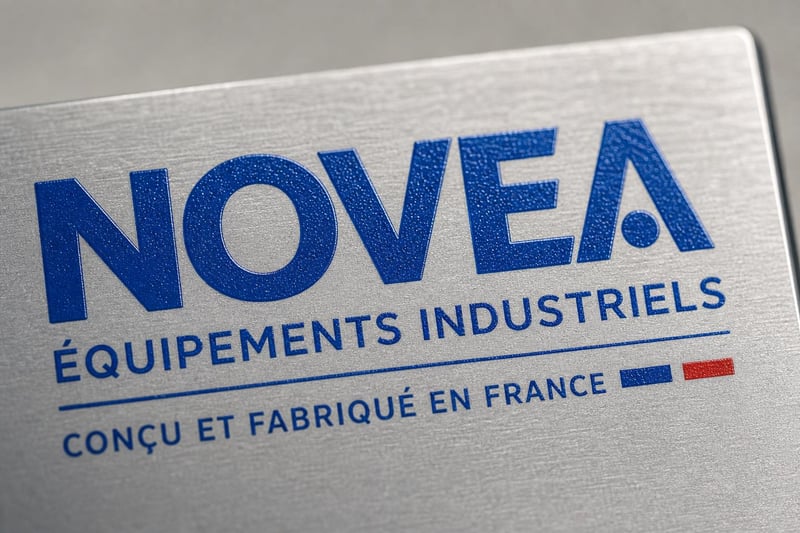
Screen printing excels on artwork with a limited number of solid colours: safety pictograms, logos, regulatory text, and standardised colour codes. Each colour corresponds to an ink formulated to the exact shade — Pantone, RAL, or a proprietary house colour — mixed before printing, not reconstructed by halftone. This approach guarantees a level of colour accuracy that digital four-colour process printing cannot always achieve on metallic or dark substrates.
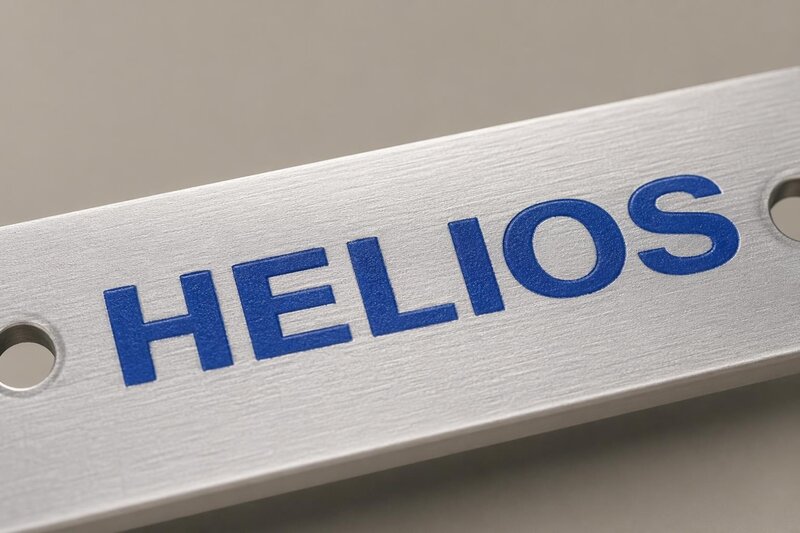
B2B screen printing is applied to a wide range of substrates: anodised or mill-finish aluminium, brushed or polished stainless steel, polycarbonate, polyester, rigid PVC, and glass. On anodised aluminium, the ink adheres to the porous oxide layer for a particularly stable long-term result. On polycarbonate and polyester, second-surface screen printing — reversed artwork visible through the material — is a common technique for machine front panels and control displays, protecting the marking from any direct abrasion. Having supported hundreds of industrial projects, we find that the combination of anodised aluminium and UV ink is the benchmark for equipment identification plates exposed outdoors.
The requirements for permanent marking in the machinery, electrical equipment, pressure equipment, and potentially explosive atmospheres sectors demand indelible, legible, and durable markings throughout the service life of the installation. Industrial screen printing meets these criteria by design: the ink film is bonded to the substrate, not applied to the surface. The regulatory requirements applicable to workplace safety signage under BS EN ISO 7010 and the Health and Safety (Safety Signs and Signals) Regulations 1996 impose pictograms with precise contrast ratios and long-term durability — conditions that the screen printing process satisfies provided inks and substrates are correctly selected.
The repeatability of the process facilitates the documentary traceability required by clients subject to audit: each run is produced using the same parameters, with the same validated inks, on the same referenced substrates. This consistency makes it straightforward to include screen printing within a technical file or declaration of conformity without having to revalidate the process with each new order. It is recommended to retain the technical data sheets for the inks used and the print parameters for each product reference — a practice that the very nature of the screen printing process makes entirely natural.
A screen-printed marking can be completed with a protective varnish as a final layer — matt, gloss, or satin — applied by the same process to protect the entire marking from abrasion and UV exposure. Metallic inks (silver, gold, bronze) and fluorescent inks are available for applications requiring enhanced visibility or a premium finish. A raised effect, achieved by successive deposits of thick ink, adds a tactile dimension appreciated on control interfaces and high-end hospitality signage.
Screen printing integrates naturally into a multi-process production workflow. A plate can be laser cut to the exact required shape, mechanically engraved for permanent identification zones that must withstand any conditions, then screen printed for colour fills, pictograms, and regulatory text. This combination is common on machine front panels and complex manufacturer's plates, where engraving guarantees the indelibility of critical information whilst screen printing delivers the visual finish and compliance with standardised colour codes.